

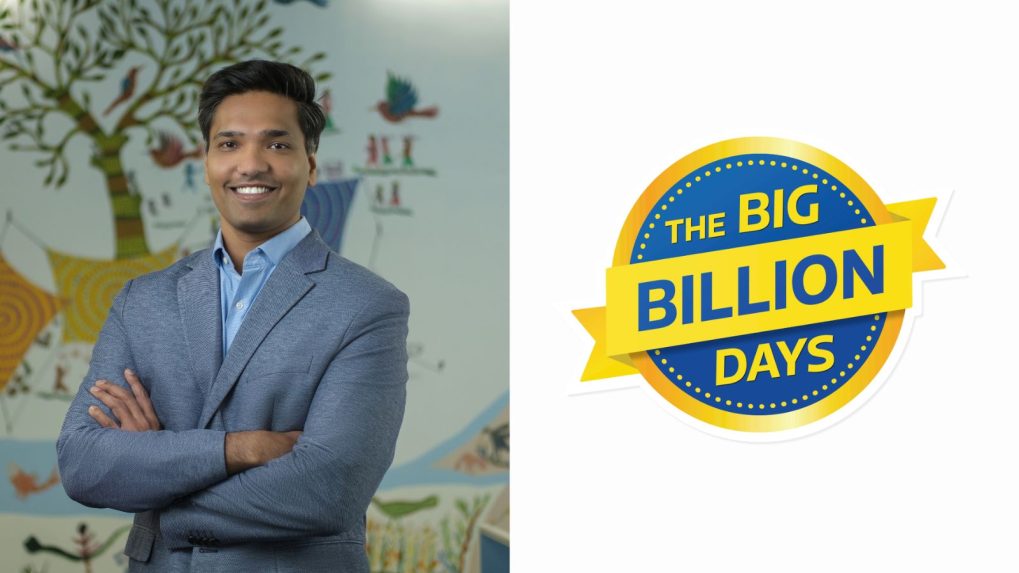
Pratik Shetty, Vice President and Head of Growth & Marketing at Flipkart, believes the evolution of e-commerce has brought an old consumer behaviour back in a new form. Flipkart is responding by attempting to make the platform itself more discovery-led. Shetty says the company has been increasing the role of video within its app and scaling live commerce, with the broader objective of making the shopping environment more inspirational rather than purely transactional.
For years, festive e-commerce marketing was built around a familiar equation. Create awareness, drive traffic, push offers and convert intent into transactions. But as consumer behaviour becomes increasingly discovery-led, that funnel is beginning to look less linear. For Flipkart, the shift is becoming particularly visible during Big Billion Days, where creators, video and digitally enabled discovery are increasingly becoming as important to the marketing engine as conventional advertising.
The change is also geographical. While India’s metros continue to remain important markets, Flipkart says around 50% to 60% of its customers now come from Tier 2 and Tier 3 cities. More importantly, the company is not seeing a fundamental difference in aspiration between consumers in smaller cities and their counterparts in metros. What differs, according to the company, is access. Social media has narrowed that gap by giving consumers across geographies exposure to the same products, trends, celebrities and creators.
That democratisation of exposure is altering how consumers discover products and, consequently, how brands need to market to them. For Flipkart, the implication is that Big Billion Days is no longer simply about communicating discounts at scale. It is increasingly about being present wherever consumers are discovering, evaluating and imagining their next purchase, whether that is a television screen, a social feed, a metro station or a creator’s content.
From shopping with intent to shopping through discovery
Trending Topics
Yogesh MulgaonkarYoutube Shorts UpdateJLR Wholesale SalesGen Z Festive SpendingAmazon Expands in India
Pratik Shetty, Vice President and Head of Growth & Marketing at Flipkart, believes the evolution of e-commerce has brought an old consumer behaviour back in a new form.
Before e-commerce, consumers routinely walked into malls and stores without a fixed purchase intention. They browsed, discovered products and sometimes returned later to buy them. Digital commerce initially appeared to reverse that behaviour, with consumers actively searching for a specific product. But the rise of social platforms, short-form video and creator content is bringing discovery back into the shopping journey.
“The way they shop is very similar to how window shopping used to happen in the past, but the way technology is evolving, that window shopping is also now happening digitally,” Shetty says.
For marketers, this has significant implications. The consumer does not necessarily begin with a product requirement. A piece of content can create the requirement itself. A creator can introduce a product, a video can demonstrate it and an e-commerce platform can eventually complete the transaction.
Flipkart is responding by attempting to make the platform itself more discovery-led. Shetty says the company has been increasing the role of video within its app and scaling live commerce, with the broader objective of making the shopping environment more inspirational rather than purely transactional.
That shift is closely tied to the company’s creator strategy. Flipkart says it works with more than 500,000 creators across social media, while around 450,000 creators are expected to create content for the platform during the festive period.
The scale matters because it signals a movement away from influencer marketing being treated primarily as an awareness channel. Creators are increasingly becoming part of the commerce infrastructure itself, helping brands reach consumers at the point where product discovery is taking place.
Why smaller creators are becoming more valuable
The creator economy is also changing internally. While celebrity and macro-influencers continue to command attention, Flipkart is seeing increasing value in smaller creators, particularly when the objective is shopping.
Shetty says micro creators often produce content that feels more natural and relatable, whether in the environment in which the product is shown or in the manner in which it is demonstrated. That relatability, he argues, can translate into greater credibility for the product being showcased.
“Small content creators have actually become more and more important, more than macro influencers for shopping,” he says.
The distinction is important for marketers. Reach and credibility are not necessarily the same metric. A celebrity can generate visibility for a campaign, but a smaller creator may be better positioned to demonstrate how a product fits into everyday life.
This is particularly relevant as Gen Z becomes a larger force in e-commerce. Shetty says around 45% of Flipkart’s consumer base falls within this age bracket, making the cohort important not only for current business but also for the company’s future growth. Yet Shetty pushes back on one of the most persistent assumptions about the demographic, the idea that Gen Z has an inherently short attention span.
The company’s experience with a four-minute Big Billion Days campaign challenges that perception. Rather than viewing the format simply as a long advertisement, Flipkart built the campaign around storytelling and monitored view-through and completion rates. According to Shetty, the campaign recorded some of the highest completion rates the company has seen on YouTube. “As long as you have a compelling story, people will watch your content,” he says.
The takeaway for marketers is less about the length of an advertisement and more about the quality of the proposition. Short-form video may dominate consumption, but short attention does not necessarily mean low attention. If the content creates enough curiosity or emotional relevance, consumers can stay with it for considerably longer.
Rohit Sharma, Sreeleela, Samay Raina, Jackie Shroff feature in Flipkart Big Billion Days 2026 campaign
The television plan is becoming a large-screen plan
The changing media landscape is also forcing brands to reconsider how they define television.
For Big Billion Days, Flipkart no longer looks at television purely through the lens of linear broadcasting. Instead, Shetty describes the approach as a “large screen plan”, combining linear television with connected television, YouTube and OTT platforms consumed on television screens.
The logic is straightforward. Rather than separating television and digital television into different media buckets, the objective is to maximise reach across the largest screens available to consumers.
This approach is complemented by digital media and physical activations in consumer hotspots such as bus stations, metro stations and cinema halls. The company also invests in ideas designed to encourage consumers to share campaigns within their own networks, creating an additional layer of earned attention around the event.
The strategy reflects a broader change in advertising. Media planning is increasingly being organised around consumer behaviour rather than legacy media definitions. The question is no longer simply where consumers watch television, but where they consume large-screen content and how different formats can work together to build reach.
Personalisation moves beyond the message
The same principle is visible in Flipkart’s approach to regional marketing. The company is using data to understand what consumers are searching for and what products are trending across different parts of the country, while forecasting models help determine the assortment required in individual markets.
But personalisation is not limited to inventory.
Shetty describes a second layer in which Flipkart uses its understanding of consumer segments to determine what content should be shown to individual users. Alongside this data-led personalisation, the company is experimenting with culturally specific storytelling.
Its BBD Bagh campaign in Kolkata, for instance, used the cultural familiarity associated with the city’s BBD Bagh and incorporated local nuances into the storytelling. The objective was not simply to translate a national campaign into another language, but to create a narrative that felt native to the market.
The company is also experimenting with physical media innovation. In Bengaluru’s Majestic metro station, Flipkart deployed a laser-based installation designed to resemble a train arriving with Big Billion Days products. Such activations are intended to create a deeper connection with consumers while also generating social sharing.
The creator economy may be the bigger story
For all the attention around AI, quick commerce and new advertising formats, Shetty believes one of the most underappreciated shifts in marketing is the creator economy.
“It really is,” he says, referring to the importance of the creator economy. “Even when people talk a lot about it, I don’t think people understand how to get inroads into that.”
That observation points to a larger structural change. Building a creator ecosystem at scale is not simply a matter of signing influencers for campaigns. It requires relationships, content systems, affiliate mechanisms and the ability to connect creator-led discovery with commerce.
At the same time, Shetty believes another widely discussed trend is being overestimated. Despite the rapid adoption of generative AI, he does not see a future in which brands simply replace human-led storytelling with AI-generated content. “Genuine human connection is something which we still feel is happening through real people,” he says.
For Flipkart, therefore, the next phase of festive marketing appears less about choosing between old and new media than about connecting multiple forms of consumer attention. Television can build scale. Digital can extend reach. Physical experiences can create memorability. Video can drive discovery. And creators can make products feel credible and culturally relevant.
The underlying business shift is more consequential. Big Billion Days is becoming less about persuading a consumer who has already decided what to buy and more about influencing what that consumer decides to want in the first place. In that environment, the creator is no longer simply an advertising channel. Increasingly, the creator is part of the discovery layer of commerce itself.
Amazon cuts referral fees, Flipkart tightens seller discipline as e-commerce platforms gear up for Festive 2026
Follow Storyboard18 on Google for the latest and breaking brand makers and industry updates, along with in-depth coverage of digital media and brand marketing. Stay informed with the latest perspectives only on Storyboard18.
Tags
First Published onOctober 5, 2026, 17:03:13 IST
SPOTLIGHT

Special CoverageGen Z is rewriting the media-to-commerce funnel, forcing brands beyond traditional cohorts
The conversation highlighted a fundamental shift underway in the relationship between audiences, platforms and brands. Rather than treating Gen Z as a uniform consumer segment, marketers are increasingly having to account for individual behaviours, fragmented content consumption and a stronger expectation
SAC 2026: Swiggy, Nestlé, HDFC, Flipkart, Puma, Lahori Zeera shine | Why Piyush Pandey remains India’s creative North Star
Storyboard18 brings you top five news updates from the world of advertising, marketing, and business of brands.
