

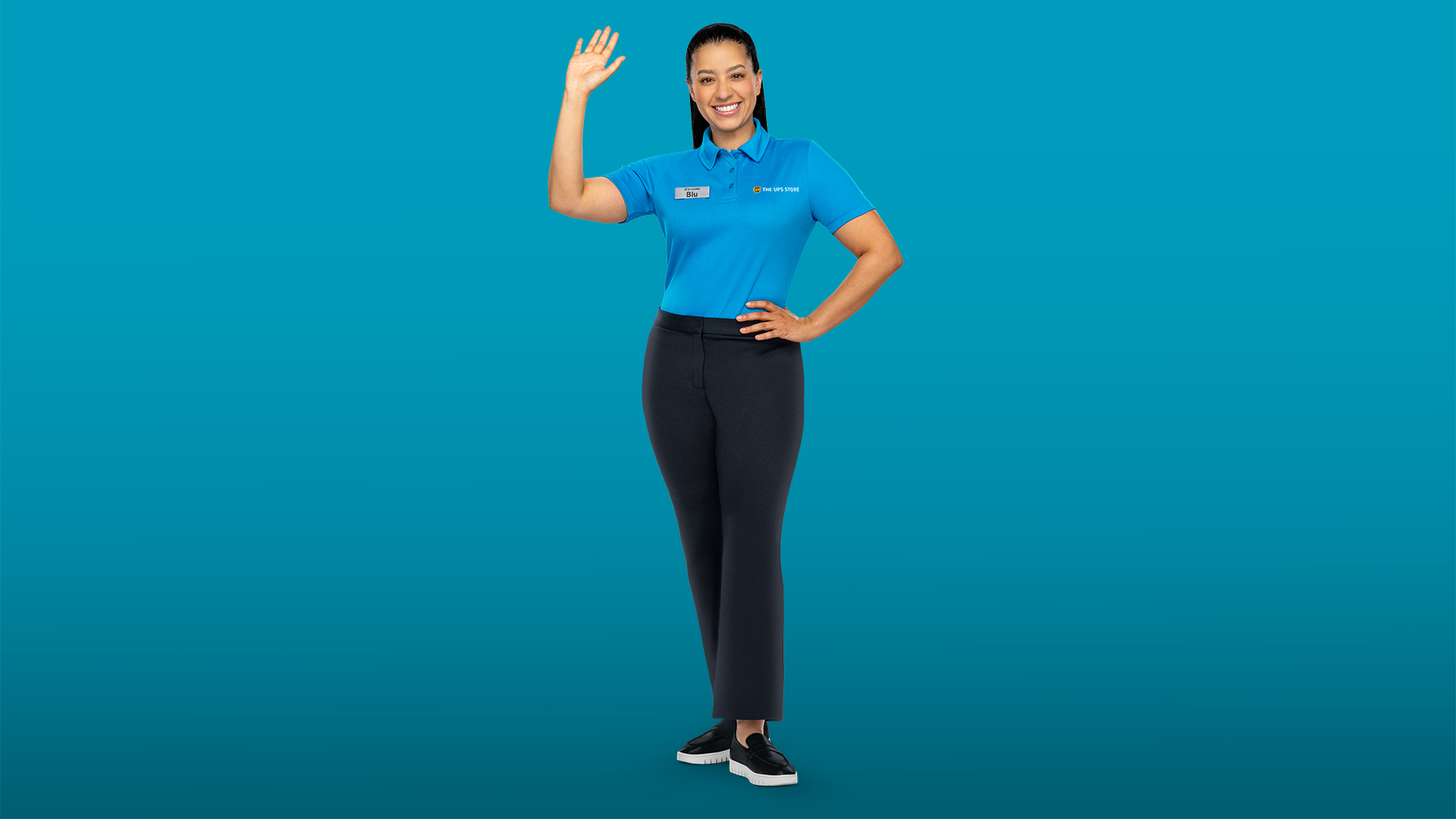
The UPS Store Inc. wants small-business owners to remember that the brand is there for them during their challenges. The franchiser of 5,600 retail locations recently launched a campaign featuring its first-ever brand character, Blu, who aims to embody a UPS Store employee committed to helping small-business owners.
Agency Doner Advertising pitched the idea three years ago to The UPS Store, and it immediately resonated with the corporate team, said Michelle Van Slyke, The UPS Store Senior Vice President of Marketing and Sales. The UPS Store researched and tested the idea for two years before unveiling the concept in July to its franchise owners at its biennial conference.
The campaign launched Aug. 31 and also included a spot with National Football League player Aidan Hutchinson, who also operates a small business.
Van Slyke shares more about business-to-business marketing, why her background as a traditional marketer is an advantage and why characters resonate with its target demographic in the below Q&A.
Chief Marketer: Tell me more about the rigorous testing you did pre-launch.
Van Slyke:I’m a marketer by training. I’ve got actually degrees in marketing, which seems like it’s a novelty in today’s environment. We follow a classic marketing path when it came to research. We did seven pieces of what I call hardcore research.
The first piece that we did was, we held a focus group with our franchise owners. We have a marketing advisory council that I meet with on a monthly basis and in person every quarter. And I thought I need to start with, is this going to be authentic across the counter and in our store environment and does it resonate with our owners? And the overwhelming feedback from our store owners was positive. In fact, it went so far as to make them feel proud of this Blu character and what it represents and how it supports small-business owners.
Then we researched conquest customers, or those who don’t prefer The UPS Store, as well as those who do prefer The UPS Store. And then, of course, we talked to our loyal customers as well to see how it resonated with them. So we did all that. Then, as we had creative to react to, we also put that into testing as well.
Chief Marketer: What are the main KPIs for the campaign?
Van Slyke: Certainly, transactions are at the top of our list in terms of what we do every day in terms of the throughput of the store environment itself. We’re like any other retailer, and we track same-store sales, and then after that we track our sales by product categories. And in addition to that, when we do our annual study, we look at awareness levels to see how those change over time. We look at usage levels to see how those change over time.
Chief Marketer: A character seems like a business-to-consumer marketing tactic rather than a business-to-business one. Would you agree with that?
Van Slyke:That’s generally how marketers use something like this. However, when we, again, researched it and tested, it’s interesting that other small-business owners felt like a character like Blu had a better understanding about them or some type of connection with them in terms of what they go through. There is nothing easy about being a small-business owner. It is hard and you need help and you need support. There was this immediate reaction to Blu as a character of somebody who understands what I’m going through who could help me.
That’s one of the best parts about the creative in that Blu is in your environment and she shows up at the minute that you’re struggling and you’re having challenges. That resonated to have that connection with small-business owners, that there was that almost empathy and understanding, yet she has energy, she’s cool, she’s calm, she’s can-do.
Chief Marketer: Do you think that having a character is becoming more of a trend for businesses?
Van Slyke:Well, it’s interesting because we found that Blu works in different media quite nicely. These different media, like social media, and how they’re used today work better with a character because that’s generally how those media work. It makes it a way that’s more authentic for those media, and we can still talk about our products and services.
Chief Marketer: Can you talk about the goals for the longevity of a character like this?
Van Slyke:We did talk openly about whether we were going to have one Blu character to start or whether we were going to frankly have multiple Blu characters to start. And so we chose to go with one, but it’s not to say in the future we might add another character, have the characters work with each other, have a different character. We’re wanting to see how the launch went, how it’s resonating, what’s happening before we make any future decisions about where we take this.
Chief Marketer: How many people are engaging with Blu so far? Is it what you were expecting?
Van Slyke:We’re only a couple of weeks in, so we don’t have that kind of data, but we will be measuring it. We have it in all different channels, so we’ll be looking at how it resonates on social. We have some PR activity coming, and that has done exceedingly well in terms of it just resonating in general from a PR perspective.
Chief Marketer: Have you done anything similar to this?
Van Slyke:Not exactly like this. Our advertising has been focused on small-business owners as our core target, but nothing quite like this. Generally speaking, we have focused more on our products and services than necessarily having a character that somebody could relate to.
As we’ve transitioned from talking just about packing and shipping and mailboxes and ensuring that everyone knows everything we have to offer, we’ve added this character that sort of brings all of those products and services to you in a way that’s meaningful and one where you could have an emotional connection as well.
We’re in a needs-based business. We need to be top of mind when individuals need these products and services so that they think about The UPS Store and remember The UPS Store. The goal also with Blu as a character is that she will be more sticky and memorable and when someone needs printing or notary or faxing or whatever it is, that they will remember Blu as an individual at The UPS Store that can assist you and provide that support.
Chief Marketer: What would you say the overall ROI of the campaign will be?
Van Slyke:We always look at our top-line revenue. At the end of the day, we’re retail locations, and that’s critically important for us.
Chief Marketer: Did you use AI at all to create the campaign?
Van Slyke:Not for the campaign that’s running. Certainly to start, we used computer-generated material to begin our initial research, but then after that, we shot live. Everything’s live.
Chief Marketer: Is there a reason for that?
Van Slyke:We wanted it to be authentic and thought that individuals could resonate and communicate more effectively in the marketplace than using anything that was computer generated. We thought it was important to have that personality and that character.
Chief Marketer: Have you guys done any coordinating with the NFL before for your marketing?
Van Slyke:We have not, no. We put out an RFP (request for proposals) to see what would resonate from different media firms, and Paramount came back with the strongest proposal. We were super excited. They brought to us Aidan Hutchinson and they shot that piece themselves, and their offering across their platforms was very attractive. I had never done something like this. We have never done something like that before.
Chief Marketer: Going back to a comment you made at the start, you said you have a degree in marketing, which seems uncommon these days. I’m curious as to why you would say that?
Van Slyke:It’s interesting that I find a lot of individuals who are either marketers or engaged in marketing in some fashion who don’t necessarily have a marketing degree. They have not taken a Marketing 101 class.
I’m more of a classic marketer in terms of having creative briefs, having a marketing plan, having the core targets, looking at it from a comprehensive perspective, being fact-based and the like. In today’s environment, it’s turned into something else. It’s turned into creative engagement and how quick that is or whatever it is and not necessarily focused on what you’re trying to accomplish in your business.
When I say I’m a classically trained marketer, I still follow the same marketing insight and practices that I learned in my Marketing 101 class.
Chief Marketer: Do you think that gives someone with a marketing degree an advantage?
Van Slyke:It improves or enhances your probability of success is what I would say. You definitely increase your ability to be effective is what I would say. And again, as I mentioned, we’re a franchise system, so we collect the marketing funds from our franchisees. It’s our job to effectively get a return on that investment. I believe following some core marketing practices increases your chances, probability of getting a stronger return.
Chief Marketer: How do you think that changes the industry with more marketers not having the classic training?
Van Slyke:Well, it’s interesting. It’s using all the resources that you have available to you, the expertise that I get from Doner, the expertise I get from Erwin Penland. I use all of those combined. I joke with the team that it does take a village. It takes us as being good clients, being fact-based, thorough, good direction. It provides the opportunity for the agencies to thrive, be creative, bring their expertise as well, depending on what the medium is and what we’re trying to accomplish for our business.
This interview has been edited for length and clarity.
