

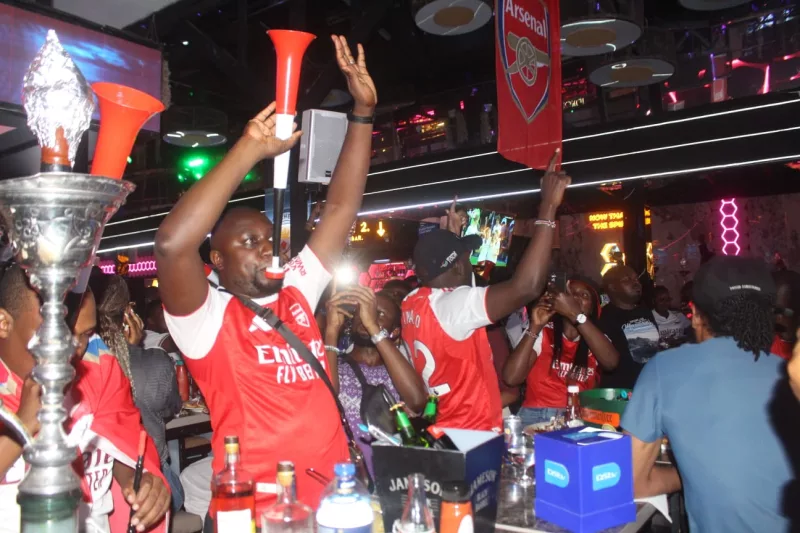

Arsenal fans celebrate at a club in Nairobi after their team lifted the EPL cup on Sunday, May 24 /MOSES MWANGI
There was a time when a business could win a customer with a
good product and a fair price. That equation still matters, but it no longer
decides the contest on its own.
Across Kenya and the wider region, the
businesses pulling ahead are the ones that have understood a quieter shift in
what people actually want: not just to buy something, but to feel something
while they buy it.
This is the logic of the experience economy, a term that has
moved from marketing textbooks into boardroom strategy. The idea is simple
enough. Consumers increasingly place a premium on experiences over
transactions. A meal is no longer just a meal if the restaurant has turned
dinner into a live jazz evening.
A gym membership is no longer just access to
equipment if it comes with a community of people who show up for each other.
And increasingly, entertainment itself has stopped being a nice-to-have bolted
onto a business and become a core part of how that business builds
relationships with the people it serves.
Nowhere is this clearer than in the way people watch sport.
Football, in particular, has become one of the great unifying experiences of
modern life, and the venues that understand this are thriving.
Think of a Nairobi sports bar on a Saturday afternoon when
the Premier League kicks off, or a neighbourhood joint packed shoulder to
shoulder for a Champions League final. The product on offer is technically the
same thing you could watch alone at home: a football match.
What people are
actually paying for is something else entirely. It is the shared gasp when a
last-minute goal goes in, the friendly needling between rival fans, the sense
of belonging to something bigger than an individual transaction. That is an
experience and it is not easily replicated or replaced.
Businesses that have leaned into this understanding are
seeing the payoff in ways that go well beyond a single evening’s till receipts.
Emotional connection, it turns out, is a far more durable foundation for
loyalty than price competitiveness ever was.
A customer who associates your
establishment with the thrill of watching their team win a derby is a customer
who comes back without needing to be persuaded. They also do something even
more valuable: they talk about it. Word-of-mouth marketing, still the most
trusted form of advertising there is, flows naturally out of genuinely
memorable experiences in a way it never flows out of a discount code.
This has real implications for how local businesses think
about their offering. A bar or restaurant that treats live sport as background
noise on a muted television is missing the point entirely. One that treats it
as a centrepiece, complete with reliable big-screen access to the matches people
actually care about, comfortable seating built for groups and an atmosphere
that rewards showing up, is building something closer to a destination than a
venue. The margin between the two, in terms of footfall and repeat business,
tends to be significant.
Reliable access to that content, of course, is the quiet
infrastructure behind all of it. None of the communal energy of a Champions
League night matters if the screen goes dark at kick-off. This is part of why
partnerships between hospitality venues and established content providers have
become such a fixture of how Kenyan businesses plan their calendars around the
football season.
Getting that infrastructure right, consistently and without
fuss, is what allows a bar owner to focus on the experience itself rather than
worrying about whether the signal will hold. It is a reminder that behind every
good customer experience sits a less visible chain of decisions about content
rights, distribution and technical reliability, decisions that most customers
never think about precisely because they were made well.
The broader lesson for businesses outside hospitality is
worth sitting with too. Entertainment does not have to be your core product to
be part of your customer experience strategy. A bank that sponsors community
football viewing, a mall that sets up a fan zone during a major tournament, and a
telco that bundles content into its offering, are all making the same bet: that
shared moments of genuine enjoyment build brand affinity in a way that advertising
spend alone cannot buy.
The businesses that will keep winning in this environment
are the ones paying attention to what their customers actually value in the
moment and building around that with intention. In an economy increasingly
defined by experience rather than transaction, that attentiveness may be the
most important competitive advantage a business can have.
The writer is the Head of
Customer Experience & Care at MultiChoice Kenya
