

Front page
InterviewProductivity AI19m · 09:01 BST · 4 min read
Slack Is Now Salesforce’s Front Door for AI and Productivity
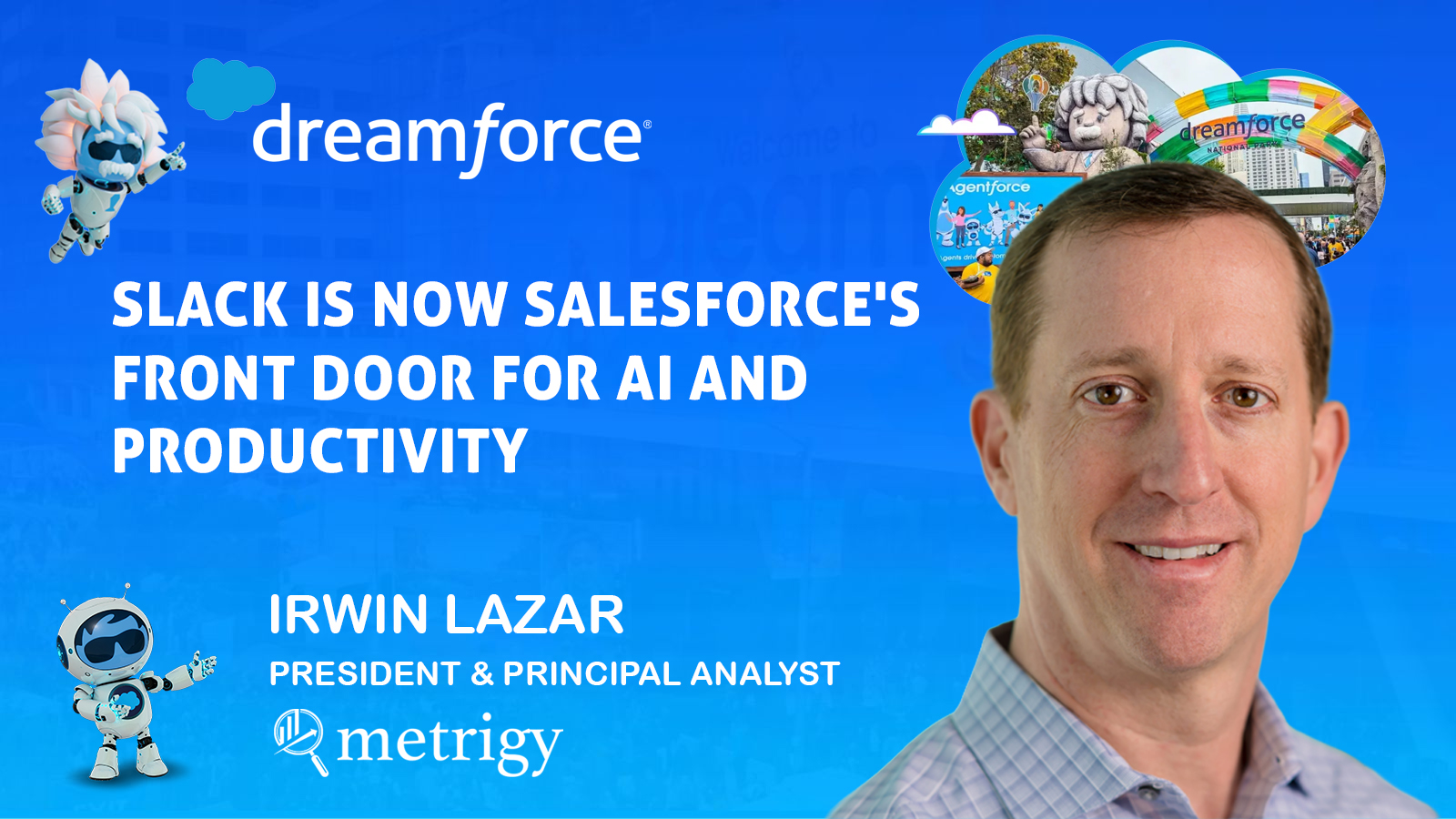
Irwin Lazar, President and Principal Analyst at Metrigy, tells UC Today that Salesforce has finally given Slack a clear job inside its AI strategy. He explains why Slackforce, AIforce, and the shift toward a headless CRM represent a renewed direction for the collaboration platform.
Every Dreamforce produces a headline announcement. But President and Principal Analyst at Metrigy, this year’s real story for workplace leaders wasn’t a single product. It was Salesforce finally answering a question that’s lingered since it bought Slack five years ago
“I think AIforce, specifically Slackforce, was really, for me, the key takeaway,” Lazar told UC Today at the event.
“It’s been a few years now since Salesforce bought Slack, and I think Slack was almost wandering a little bit in the darkness trying to figure out what it turns into under the Salesforce umbrella. I think that’s really clear now.”
That clarity, Lazar argues, comes from Salesforce positioning Slack not just as a messaging tool but as a shared environment where employees and AI agents work side by side.
“Salesforce views Slack as this place where people can not only just work together, but they can work with AI agents. They can bring their AI agents into it. The agents can communicate within channels, people can communicate with agents in channels.”
That strategy was made concrete through Slackforce: Slack CRM for prompt-led record updates, Slackbot’s deeper access to Salesforce context and actions, and Slackforce Surfaces, which can turn a channel prompt into a live, shared dashboard, report, or presentation.
For Lazar, that shift connects directly to a strategy Salesforce has been building for over a year: making its underlying data and business logic accessible from wherever people actually work, rather than requiring them to open Salesforce itself, a theme that ran through much of this year’s keynote coverage.
“It ties nicely into the headless strategy that Salesforce unveiled about a year ago now, where they want to make all of the data from Salesforce accessible by a variety of different user interfaces. Slack is really ideal as a primary user interface for that.”
AIforce is Salesforce’s new umbrella for that model, extending the same underlying CRM data, workflows, permissions, and business logic into interfaces including Slack, Claude, Amazon Quick, Gemini Enterprise, and Agentforce Coworker.
The End of “Log In to Get Work Done”
One of the most prominent themes at this year’s event was the idea that employees no longer need to open Salesforce to use it. Whether someone is working in Slack or Claude, the plan is for Salesforce’s capabilities to follow them there.
Lazar sees this as a meaningful departure from how SaaS platforms have historically competed.
“The goal has always been to get people to work within my application versus their application, my competitors, as an example. And that’s not the way people work. People work across different applications depending on what it is they’re working on.”
He’s careful to note the significance isn’t confined to Salesforce, a point that echoed across several of the week’s other announcements.
“Obviously here it’s mostly focused around Salesforce, but it could potentially be around other agents. In the broader story, you’re seeing platforms like Claude and Workday, as an example, where a coworker has that same kind of capability. I can build a dashboard, I can build interfaces into the applications I use. But at the end of the day, if I need to chat with somebody or ask a question or share, I’m going back to a messaging platform.”
The Real Work Starts After the Keynote
Asked what he expects for the rest of the year, Lazar was direct: the technology announcements are the easy part.
“I think the biggest issue in the rest of the year is overcoming challenges that people have to adopting and using AI.”
But Lazar’s bigger concern is more operational than regulatory:
“Companies really struggle with getting their data right, getting their governance and security strategies in place, training people, sharing best practices, working with the right partners to take from planning to execution.”
Reflecting on the event as a whole, Lazar highlighted the optimism and opportunity for innovation that spread across attendees. However, he was quick to note the next steps for enterprise leaders.
“You come out of an event like this with all of the ideas of what’s possible and then turning what’s possible into realism is always the challenge. I think that’s where we’ll be focusing in the next few months.”
rate this storyhelps rank stories across uc today
Read nextordered by techtelligence · every pick explained
picked for this story
Dreamforce Roundup: 5 Takeaways on AIforce, Slack, and Agent Trust
17 Sept 2026picked for this storyDreamforce 2026 Keynote: AIforce & The End of the Interface?16 Sept 2026picked for this storySalesforce Deepens Slackbot Integration to Position Slack as the Enterprise AI Orchestration Layer9 Jul 2026
More from the Productivity AI desk

Oracle Turns AI Agents Loose on Talent Management Tasks
Oracle has launched new AI agents for talent management, aiming to automate skills tracking and workforce planning tasks.
Christopher Carey · 13 Aug 2026Case Study
KPMG’s AI Productivity System Goes Global
KPMG expands Microsoft 365 Copilot to 276,000 staff, pairing Microsoft Agent 365, Fabric and Workbench for governed AI productivity.
Alex Cole · 12 Aug 2026News
Google Gemini Reaches One Billion Monthly Users as AI Assistant Race Accelerates
Google Gemini has surpassed one billion monthly users as Google expands voice, visual AI and task automation features.
Christopher Carey · 12 Aug 2026
