

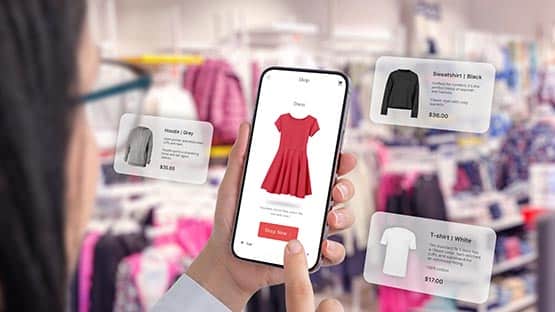
A shopper asks an AI assistant to find a waterproof jacket under $200, checks whether the right size is available nearby, and expects a pickup option within hours. Another customer walks into a store, scans a product, receives a personalized offer, and completes the purchase without a conventional checkout queue. At the same time, store teams expect inventory alerts before shelves are empty, and merchandising teams want demand signals early enough to adjust pricing and replenishment.
That is what retail digital transformation looks like in 2026 and beyond. The discussion has moved well beyond launching e-commerce, moving applications to the cloud, or connecting a POS system with inventory software. Those capabilities remain the operating foundation. The newer layer combines real-time data with AI agents, machine learning, voice interfaces, IoT, computer vision, and automation.
Deloitte’s 2026 retail outlook shows how quickly that shift is happening. 68% of surveyed retail executives expect to deploy agentic AI for operational and enterprise activities within 12 to 24 months, and 67% expect AI-driven personalization capabilities within the next year. Salesforce reports a similar direction, with 75% of retailers saying AI agents will be essential by 2026.
For CEOs and COOs, the question is where intelligent systems can change revenue, cost, inventory, and customer-service performance.
How retail businesses benefit from digital transformation solutions
Modern retail transformation creates value by improving how retailers manage products, customers, employees, and daily decisions.
1. Inventory visibility becomes predictive inventory control
Inventory is expensive, and keeping it optimized is one of retail’s hardest problems to solve. When stock data doesn’t sync perfectly across POS, ecommerce, ERP, warehouse, and marketplace systems, this misalignment manifests as over- or underselling online, missed sales in the store, excess or rushed transfers of stock, or lost profit due to excessive discounts.
In the fast world of retail, a single, accurate view of stock is the starting point for logical next-step decisions powered by AI.
Machine learning models can help predict demand for SKUs or specific locations. The algorithms use historical data for sales, promotions, and seasonal data, combined with local demand, weather, lead time, and stock on hand to generate stock recommendations for transfer, replenishment, allocation, and markdowns.
For a fashion chain, this may mean detecting that one style is selling faster in Warsaw than in Kraków and recommending an inter-store transfer before the first location runs out. For grocery, demand models can help purchasing teams adjust orders for highly perishable products and reduce waste.
AI is already moving deeper into supply chain operations. Deloitte reports that 30% of surveyed retailers currently use AI for supply chain visibility and expects that figure to reach 41% within a year; 59% anticipate positive ROI from AI-led supply chain initiatives within 12 months.
2. Operations move from workflow automation to AI-assisted execution
Retail operations contain thousands of small decisions, such as where to route an order, when to replenish a shelf, whether a return needs manual review, which store should fulfill an online order, and which operational exception deserves attention first.
Traditional automation handles predictable steps. AI agents can interpret context, compare options, recommend an action, and, within approved controls, execute tasks across connected systems.
An operations agent could monitor inventory exceptions for hundreds of stores, identify products at risk of stockout, check inbound shipments, and create replenishment tasks. A regional manager could ask, “Why did sales fall across the northern stores this week?” and receive an analysis combining POS results, promotions, inventory availability, footfall, and customer feedback.
NVIDIA’s 2026 retail and CPG survey found that 47% of respondents were already using or assessing agentic AI. The leading goals included faster processes, stronger customer experience, and better decisions using real-time information.
This changes the productivity equation. Employees spend less time gathering data from multiple applications and more time handling exceptions that require commercial judgment.
3. Omnichannel becomes conversational and context-aware
In the past, omnichannel retail meant merging physical stores with online shopping. Currently, customers expect AI-assisted shopping as the next phase of omnichannel retail.
Customers rely much less often on online search to discover and buy goods. Generative AI, social shopping, retail shopping apps, voice command technology, and shopping through social media have replaced the use of search engines. Additionally, 71% of customers want integrated generative AI, and 58% prefer generative AI for product suggestions over search recommendations.
Conversational and voice AI can respond to the request “I need a carry-on suitcase for a 5-day trip for $250 or less” with desired product options based on consumer reviews, available inventory, and shipping times.
To do so, an AI assistant requires access to information about products along with pricing, promotions, customer profiles, order information, and fulfillment services. Permissions dictate which operations can be executed.
This architecture is essential because external shopping agents become another shopping channel. As chat-based tools currently account for approximately 15% to 20% of referrals for some retailers. The structure of the product catalog, prices, availability, delivery terms, and return policies must therefore be designed in a way that AI can understand
4. Personalization moves from segments to individual decisions
Although segmentation has been used in the industry for some time, AI technologies have revolutionized the personalization process, making it more real-time and granular.
An AI-based recommendation engine combines the buyer’s browsing history, purchase history, product affinity, and other factors to influence product ranking, offers, bundles, loyalty rewards and service notifications.
Consider a beauty retailer. A customer who previously purchased a foundation, viewed several skincare products, and has loyalty points available could receive a bundle assembled around her preferences and current store inventory. The commercial logic can also account for margin, stock position, and promotion rules.
The biggest constraint usually appears in the data layer. AI produces more reliable recommendations when customer identities, product attributes, consent records, inventory, and transaction histories can be resolved across systems.
5. IoT and computer vision turn stores into real-time data sources
Physical stores are becoming part of the retailer’s data infrastructure.
RFID readers can track merchandise movement. Smart shelves measure stock levels. IoT sensors monitor refrigeration, equipment, and environmental conditions. Computer vision technology has the ability to spot empty spaces in a shelf, long checkout lines, suspicious behavior, and even issues revolving around shelf merchandising.
AWS cites examples of smart stores integrating cameras, RFID, POS, mobile applications, IoT sensors, edge processing, stream compute, and AI models. The operational advantage is response speed. A shelf gap can generate a restocking task before an employee notices it manually. A queue-detection model can prompt a manager to open another checkout. Refrigeration sensors can flag abnormal conditions before merchandise is lost.
These technologies interlink events that happen in a store with overall business activities. One example is how RFID technology at American Eagle has shifted from tracking stocks to tracking activities that occur in fitting rooms, how customers engage with products, and the decisions made by the store surrounding the final placement of products.
How Computools helps retailers modernize for AI-driven operations
Retailers rarely start with a clean architecture. Years of expansion leave ecommerce platforms, custom POS applications, ERP systems, warehouse tools, loyalty platforms, data warehouses, and third-party services operating on different technology stacks.
Computools helps businesses connect these systems, develop new retail capabilities, and introduce AI-powered workflows through retail software development:
The company works with retailers on:
- custom retail applications that support ecommerce, customer engagement, loyalty programs, and internal operations;
- POS and inventory modernization to connect store systems with online channels, warehouses, and customer data;
- data integration and analytics solutions that create reliable information flows for reporting, forecasting, and AI adoption;
- AI-powered retail solutions including recommendation engines, predictive analytics, automation, and intelligent assistants;
- legacy system modernization through APIs, cloud migration, and modular architecture improvements.
A practical example is Stockentra B2B custom-built solution, where digitizing wholesale ordering and inventory workflows reduced manual order processing by up to 55%, improved order cycle speed by up to 40%, and increased transaction capacity by up to 3x. The case shows how retail digital transformation can turn fragmented, manual operations into faster order execution, better inventory visibility, and greater scalability.
Where retail digital transformation is moving next
The investment map now looks broader than a conventional POS–ERP–e-commerce modernization program.
| Area | Capabilities becoming relevant |
| Store technology | Mobile POS, computer vision, RFID, smart checkout, edge AI |
| Inventory and supply chain | Real-time inventory, AI forecasting, automated replenishment, robotics, supplier intelligence |
| Digital commerce | Conversational search, AI shopping assistants, voice AI, personalized discovery |
| CRM and loyalty | Unified customer profiles, next-best-action models, real-time offers |
| AI and analytics | Predictive models, generative AI, operational copilots, AI agents |
| Data architecture | Event streaming, governed APIs, master data, vector search, real-time pipelines |
| Legacy modernization | API layers, cloud migration, modular services, gradual application replacement |
The architecture behind these capabilities is becoming just as significant as the customer-facing technology. For engineering leaders, this makes integration and modernization part of the AI roadmap. An AI agent cannot reliably promise same-day pickup when inventory updates arrive hours late. A recommendation engine cannot personalize accurately when customer identities are duplicated across CRM, loyalty, and ecommerce systems.
Where digital transformation creates the most business impact
Digital transformation produces the strongest returns when technology is attached to a measurable operating problem.
1. Revenue
Better product discovery, higher availability, personalized offers, and AI-assisted shopping can increase conversion and basket size. During the 2025 holiday season, Salesforce reported that AI and agents influenced $262 billion in global online retail sales.
2. Operating cost
AI can reduce manual analysis, customer-service workload, reconciliation, inventory checks, and repetitive store tasks. NVIDIA’s 2026 survey found that 95% of respondents said AI had helped decrease annual costs, with 37% reporting reductions above 10%.
3. Inventory economics
Better forecasting and allocation can reduce stockouts, excess inventory, emergency transfers, and markdown exposure.
4. Customer retention
Having consistent information across stores, mobile applications, e-commerce, support, and AI interfaces lessens friction and allows loyalty interactions to be based on actual customer behavior.
5. Scalability
With event-driven integrations, APIs, cloud services, and modular platforms, adding stores, marketplaces, fulfillment channels, and AI capabilities is done with little to no impact on the rest of the retail infrastructure.
These outcomes also give transformation programs clearer performance targets. A retailer can set goals around stockouts, the accuracy of forecasts, fulfillment time, the cost of each interaction, conversions, the number of times inventory is sold, or the number of hours an employee’s work is automated, among other factors, depending on the new process.
How to choose the right retail digital transformation partner
A retail transformation partner should deeply understand the economics of a store and its adjacent service ecosystems within merchandising, fulfillment, customer care, and engineering.
Start with a partner’s capabilities to connect and integrate solutions and technologies with different POS, ecommerce, analytics, CRM, marketplace systems, WMS, and ERP. For AI, ask about the agents, the actions they can perform, how those actions are logged, data quality, and the context of the models.
Retail experience matters because operational edge cases are rarely obvious from a feature list. Returns, partial fulfillment, substitutions, store transfers, promotions, loyalty rules, and marketplace orders create dependencies across systems.
AI expertise should include more than model integration. Production deployments need data pipelines, retrieval architecture, evaluation, monitoring, access controls, human approval points, and fallback logic.
The modernization approach matters just as much. A retailer running hundreds of stores needs phased deployment, observability, rollback procedures, and compatibility with existing operations. The strongest roadmap usually improves one high-value workflow first and expands from proven infrastructure.
What usually slows retail transformation down
Many difficult programs start with an oversized scope. POS, e-commerce, data, inventory, CRM, and AI modernization quickly become one multi-year dependency chain. A more controllable sequence starts with one business constraint and maps every system and data dependency behind it.
Data quality often becomes the next bottleneck. Product hierarchies, inventory records, customer identities, prices, and promotion rules need clear ownership. AI exposes inconsistencies quickly because models and agents consume information at a scale that manual teams never could.
Legacy dependencies also deserve early attention. APIs, event layers, and modular services can create a controlled path between older systems and new capabilities, allowing modernization to progress with limited disruption to store operations.
AI governance now belongs in the same architecture discussion. NRF’s 2025 AI survey found that 86% of retailers already had AI governance policies and 93% planned to develop or continue developing them during the following year. Access permissions, customer consent, model evaluation, human oversight, audit trails, and security therefore need to be designed alongside the AI use case.
Employee adoption completes the picture. Store associates, merchandising teams, supply chain planners, and customer-service employees need tools that fit the decisions they already make. An AI assistant that adds another dashboard creates little operational value. One that identifies an exception, explains its reasoning, and opens the correct workflow has a much better chance of becoming part of daily work.
Retail transformation should start with the decision that needs to improve
A useful retail transformation roadmap starts with a specific question: Which decision costs the business the most when it is late, manual, or based on incomplete information?
For one retailer, that may be inventory allocation. For another, it may be product discovery, customer service, store labor, replenishment, or pricing.
Modern retail technology can connect decisions to real-time data and automate their execution through AI agents, machine learning, the IoT, computer vision, and voice interfaces. The underlying requirement remains disciplined architecture, including reliable data, governed integrations, and systems designed to support both people and intelligent software.
That is the point where digital transformation stops being a collection of technology projects and becomes part of how the retailer actually operates.
The best approach is to begin with the most important workflow that impacts either revenue or cost impact and develop the technology for that decision.
This content is provided for informational purposes only and is not a substitute for professional advice. AFP editorial staff were not involved in the creation of this content.
