

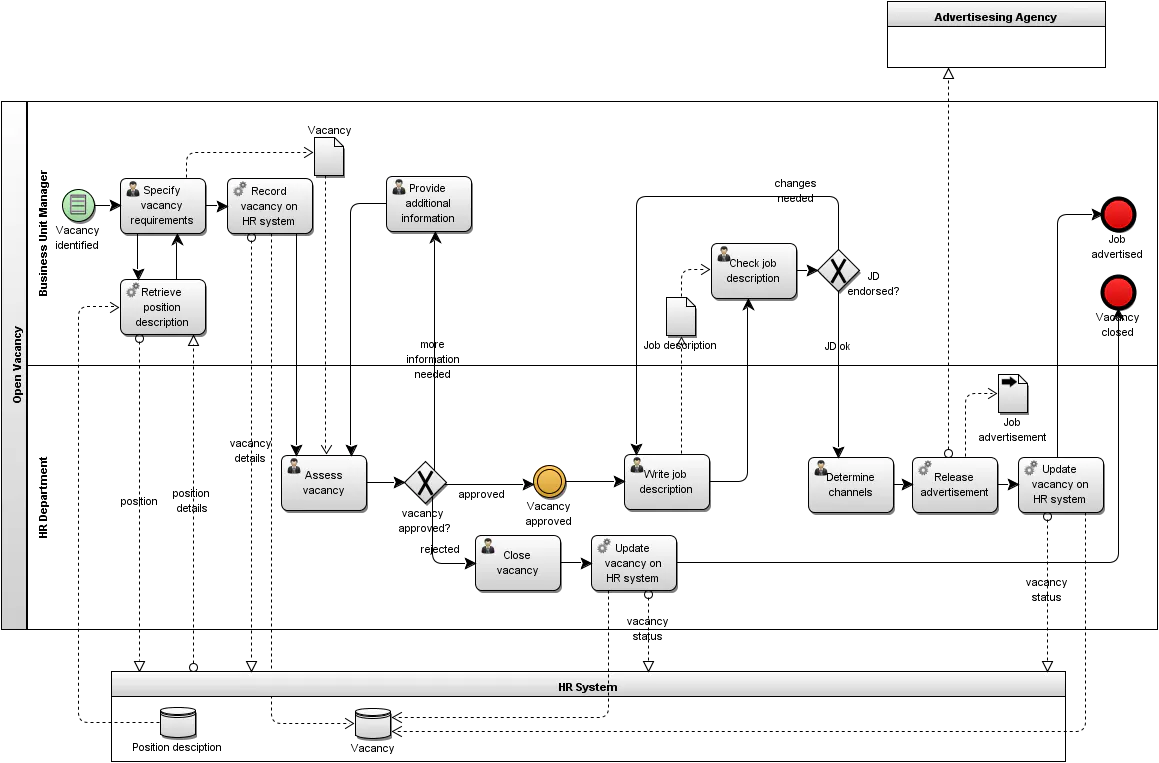
The height of digital transformation is Business Process Automation (BPA): Business Process Management (BPM) engines, expressed by the notation you see above. Tools that shepherded business processes from end to end, spanning multiple software systems, departments, divisions, and even organizations.
These systems were often massive in terms of effort and expense. Typically, only the wealthiest institutions could afford the commitment required to succeed.
They are used for things like employee onboarding, insurance claims processing, loan origination, and telecom provisioning. When well done, they achieved heights of adaptiveness and flexibility. When they failed… we all know what it can be like to deal with banks, phone, and insurance companies.
The rest of the world was stuck with a hodgepodge of systems (ERP, CRM, payroll, HR). People were the glue that connected the dots.
Today, each of those dots has been supercharged by bolting on an LLM. The ubiquitous chatbots that software vendors keep adding to their products.
“Little master, would you like me to design the perfect landing page for you? How about five variations? How about an outbound email sequence?”
Chatbots multiply the artifacts you can create within each isolated application. But people are still the primary glue that keeps it all connected. In my experience, that’s where the strain is showing in the world of work.
What if, instead of just providing the design and content for three variations of a landing page, your system designed and built the actual HTML pages, integrated them into your site architecture, ran the test suite, deployed them, and verified the deployment? Then it could add those pages to outbound sequences, monitor conversion performance, keep the winner, and retire the rest.
Truth be told, the biggest line item in those BPMN systems was often the automation connecting all those boxes.
You needed a software developer, sometimes a gang, to interpret the output of one system and map it to the input requirements of the next, while also keeping the overall business requirements in mind.
It was time and labor-intensive, even when each system had a robust API. Without an API, you had to use robotic automation (though nowadays it’s mainly browser automation), which was exponentially more work and brittle to boot; whenever an application’s UI changed, it would break the automation.
Coding agents like Claude Code, Codex, et al. were literally built to do this sort of work better than anything else. A mechanical integration can often be completed in minutes, even when you have to resort to browser automation!
But the mechanical integration is only the first step. Time and again, I’ve set out to use an LLM to automate something I’d been doing through an application UI, and the results have been qualitatively better than what I did by hand.
You and your team know your business better than anyone. Automating an end-to-end business process can be an opportunity to improve it. Think project initiation and termination, customer onboarding, and cold outreach as in the above example.
It might even be a chance to rethink some of your practices from the ground up. When I work with clients, it amazes me how often we discover that processes exist simply because things have always been done that way.
Collaborating with a talented developer will get you to an excellent result faster, and if you have any on tap, they should be working on automating end-to-end business processes throughout your organization.
One of the other things you paid for with those BPM systems was the tasklist or cockpit that allowed users to interact with the BPM engine. What we now call “human in the loop.” They made it easy for a developer to build forms, but the user ergonomics were rudimentary at best.
Today, agents can be wired directly into the work surface your team already uses, like MS Teams, Slack, Discord, and more. You can interact with them as you would with any collaborator. Current models are excellent at reading intent from an ambiguous conversation and converting it into function calls with the right arguments.
You have an unprecedented opportunity to reimagine and reengineer the way work gets done. Your organization will reap the rewards for years to come — even if the models never get one bit better.
