

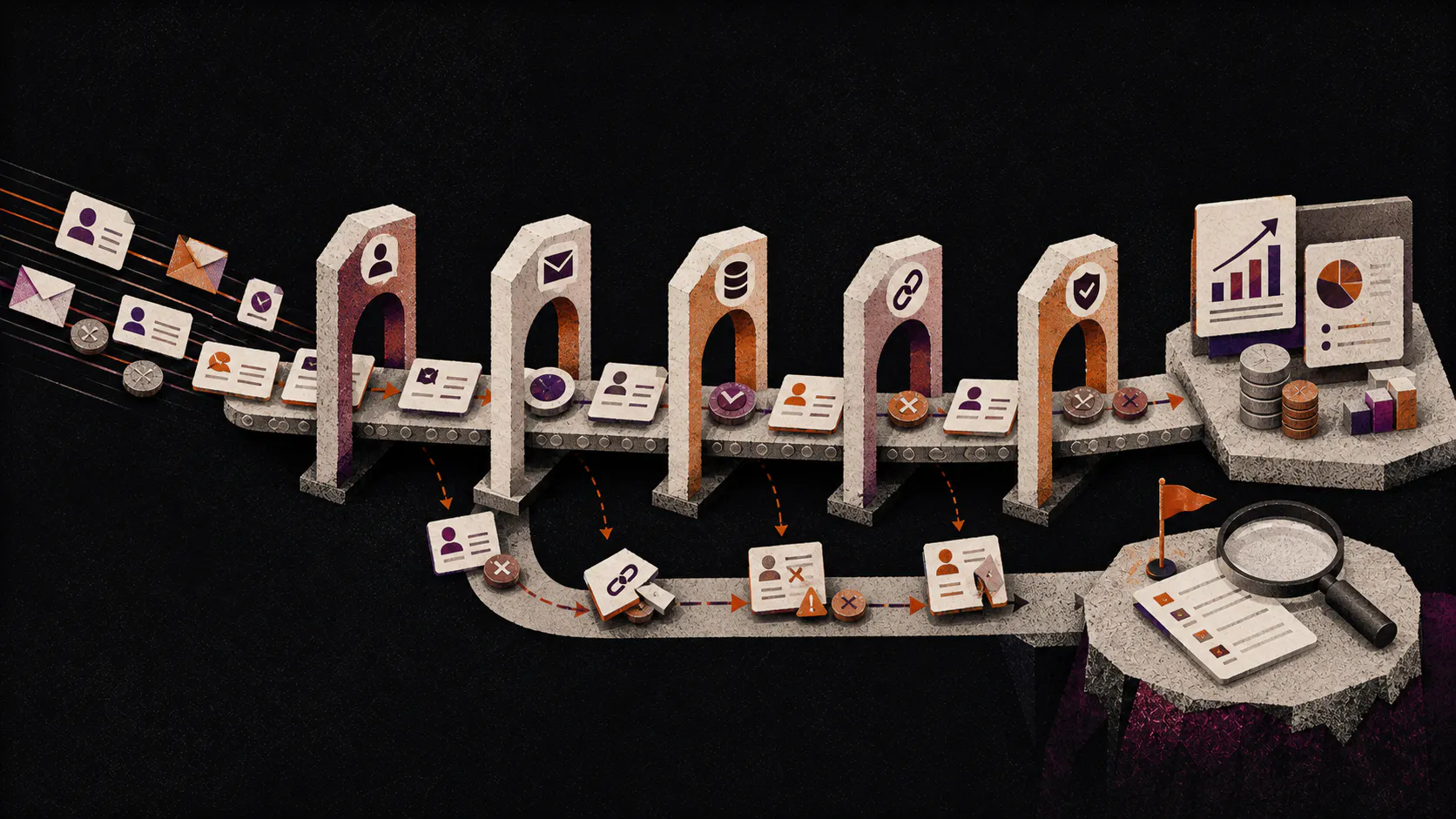
Featured image credit: Original AI-assisted illustration created for this article.
The integration launches on Friday. Contacts sync. Deals update. The ERP receives closed-won orders. Leadership sees a clean dashboard and declares the project finished.
Three months later, nobody can explain why the forecast and finance totals disagree.
Nothing dramatic failed. A dropdown option was renamed. A custom property became the neweld. A webhook retried after a timeout and created a second order. A new business unit installed the app with a broader set of permissions. Each change looked small. Together, they changed the meaning of the system
This is integration drift: the gradual separation between what connected systems were designed to mean and what they now do.
Disclosure: I am the founder and CEO of INSIDEA, an Elite HubSpot Partner. This article reflects practical operating experience and independent research. It is not sponsored by HubSpot or any other company mentioned.
I think enterprises should stop treating an integration as a completed connection. It is a governed production relationship that must keep five contracts intact.
Why successful integrations decay
An API can continue returning 200 OK while the business process is already wrong.
That happens because technical availability and semantic correctness are different things. The endpoint may respond, the access token may be valid, and the queue may be empty. Yet the systems can still disagree about identity, lifecycle stage, revenue amount, consent, territory, or ownership.
Most integration reviews focus on plumbing:
- Can system A authenticate to system B?
- Can the job finish within the expected time?
- Are failed requests retried?
- Is the connector currently online?
Those checks matter, but they do not answer the harder question: does the same event still produce the intended business outcome across every connected system?
HubSpot’s current API usage guidance makes the infrastructure risk visible. Authentication, token refresh, rate limits, API-specific limits, monitoring, caching, batching, and webhooks all need deliberate handling. A reliable design cannot assume one universal limit or one permanent behavior.
The control problem becomes clearer when we separate it into five contracts.
The Five-Contract Integration Control Plane
The Five-Contract Integration Control Plane is a governance model for revenue-critical integrations. Each contract defines one class of truth that must remain stable across systems.
|
Which record represents the same real entity? |
Duplicate companies, split customer history |
Durable cross-system identifier and merge policy |
|
|
What does each field mean? |
A renamed option changes reporting logic |
Versioned field dictionary and compatibility test |
|
|
What happened, once, and in what context? |
A retry creates a duplicate order |
Event identity, idempotency, ordering, and replay rules |
|
|
Which system or role may perform each action? |
Two systems overwrite the same property |
Write ownership, least privilege, and approval tiers |
|
|
How do we detect and repair divergence? |
Silent data mismatch grows for weeks |
Tracing, reconciliation, replay, and rollback procedure |
The model is intentionally cross-functional. RevOps owns business meaning. Technology owns execution and reliability. Security owns access policy. Finance and customer operations validate the outcomes that matter to them. No single team can protect all five contracts alone.
Contract 1: Identity
Identity is the rule that tells every system whether two records represent the same person, company, deal, subscription, or order.
Email is convenient, but it is not always a durable enterprise identity. People change employers. Shared inboxes exist. Acquisitions change domains. One company can have several billing entities. Deals and renewals may need identifiers created outside the CRM.
HubSpot’s Properties API documentation explains that object record IDs are unique within an object type and supports custom properties with unique values. That makes a cross-system key possible, but creating the property is only the first step.
The identity contract should specify:
- The authoritative identifier for each object.
- The matching rules used before creating a record.
- What happens when identifiers conflict.
- Which system may merge records.
- How associations are restored after a merge.
A weak integration asks, “Did the contact sync?” A stronger one asks, “Can we prove this contact, its company, its open opportunity, and its subscription still refer to the intended real-world entities?”
Contract 2: Schema
Schema is more than a list of fields. It is the shared meaning of those fields, their types, allowed values, null behavior, formatting, and ownership.
Consider customer_status. One team may interpret Active as a signed contract. Another may require the first successful payment. A support platform may set it after onboarding. All three systems can store the same word while representing different moments.
The schema contract should record, for every integration-critical property:
- Internal name and human label
- Data type and allowed values
- Business definition
- Authoritative writer
- Downstream consumers
- Null and default behavior
- Deprecation date and replacement field
HubSpot distinguishes the property’s underlying type from how it appears in the interface. Its documentation also covers enumerations, unique identifiers, formatting requirements, and property updates. These details belong in the contract because a field can remain syntactically valid while becoming semantically incompatible.
Every schema change should trigger a compatibility check. If a RevOps admin adds a lifecycle option, the test should reveal which workflows, reports, integration mappings, and event consumers do not recognize it. Production should not be the first place that incompatibility is discovered.
Contract 3: Event
The event contract defines what happened and how consumers can process it safely.
This is where many integrations fail under ordinary network behavior. A request can succeed while the response is lost. The sender retries. The second request creates another invoice, order, task, or timeline event.
Nicolas Fränkel’s HackerNoon article, How To Fix Duplicate API Requests: Understanding Idempotency, provides a useful technical explanation of using unique request keys to prevent duplicate state changes. In a CRM integration, that principle should become a business control.
Each revenue-critical event needs:
- A unique event ID
- An event type and version
- A source system
- The time the event occurred
- The affected object identity
- An idempotency rule
- An ordering assumption
- A retention and replay policy
The CloudEvents specification offers a vendor-neutral model for describing event data with common context. You do not need to adopt every part of the specification to learn from it. Stable event identity,, observe, and evolve
HubSpot’s webhooks journal and management documentation also illustrates why event architecture needs explicit design. Subscriptions, historical event access, object-change actions, required scopes, snapshots, limits, and retry behavior are separate concerns. “We use webhooks” is not an event contract.
Contract 4: Authority
Authority answers two questions: who may act, and which system owns the right to write each value?
An integration often begins with broad permissions because that speeds up development. Over time, more workflows and teams depend on the connection. The original access level becomes invisible infrastructure.
HubSpot’s authentication guidance separates multi-account OAuth from single-account static tokens and ties access to scopes. That is a security mechanism. The business still needs a write-authority model on top of it.
For each critical property or action, define one of four authority modes:
- Authoritative: one system owns the value; others may read it.
- Proposed: another system may suggest a value, but approval is required.
- Conditional: either system may write when a documented rule is satisfied.
- Derived: no human or external service writes it directly; it is calculated.
This prevents the classic ping-pong failure where CRM updates billing, billing updates CRM, and each change triggers the other system again.
Authority should also be tested at the action level. Reading a company record, updating a forecast amount, sending a customer email, deleting an association, and issuing a credit are not equivalent risks. Permissions and approval gates should reflect the consequence of the action.
Contract 5: Recovery
Every integration will eventually encounter a partial failure. The design question is whether the team can see it, contain it, and restore business truth.
Recovery starts with correlation. The W3C Trace Context standard defines common headers for propagating request context across services. A shared trace identifier helps teams follow one transaction through middleware, HubSpot, an ERP, and a data platform instead of comparing unrelated logs by timestamp.
Tracing alone is not enough. A green trace proves that a path executed, not that the final data is correct.
The recovery contract needs four layers:
- Detection: alerts for errors, latency, unusual volume, missing events, and contract violations.
- Reconciliation: scheduled comparisons of identities, amounts, counts, associations, and lifecycle state.
- Replay: a controlled way to process failed or missed events without duplicating completed work.
- Rollback: a documented method to reverse unsafe writes or restore a known-good state.
For revenue systems, reconciliation should use business totals, not just API totals. Compare closed-won value against booked orders. Compare active subscriptions against customer lifecycle state. Compare renewal records against contract dates. Technical success can hide commercial divergence.
A practical operating cadence
The five contracts become useful when they shape routine work.
Before launch
- Name an owner for every contract.
- Publish the field and event dictionaries.
- Run duplicate, permission, retry, and rollback tests.
- Capture the initial reconciliation baseline.
- Define severity levels and decision rights.
Every week
- Review failed and retried operations.
- Inspect identity conflicts and merge activity.
- Reconcile a small set of revenue-critical totals.
- Investigate new scopes, fields, options, and consumers.
Before any material change
- Identify the contracts affected.
- Run backward-compatibility tests.
- Confirm the recovery path still works.
- Communicate the change to downstream owners.
Every quarter
- Remove unused permissions and subscriptions.
- Revalidate system-of-record decisions.
- Retire deprecated mappings.
- Run a production recovery exercise using controlled records.
This cadence turns integration governance into maintenance rather than crisis response.
The launch review I would require
Before approving an enterprise integration for revenue-critical work, I would ask for evidence that each contract is enforceable.
|
Sampled records resolve to the intended cross-system entity |
|
|
Every critical field and option has a known consumer and owner |
|
|
Replaying the same event creates no additional business action |
|
|
Each scope and write action has a documented purpose |
|
|
One transaction can be followed across all participating services |
|
|
The team can replay or reverse a controlled failure within the approved window |
If one of these artifacts is missing, the integration may still be useful. It is not yet governed enough to become invisible infrastructure.
The real finish line
The purpose of an integration is not to move data. It is to preserve business meaning while systems, teams, and processes change.
That requires more than an endpoint, a mapping file, and a successful launch. It requires durable identity, versioned schema, safe events, constrained authority, and tested recovery.
When those five contracts are explicit, integration drift becomes observable and manageable. When they remain implicit, the organization discovers them only after the dashboard, customer experience, or financial record stops making sense.
The integration is not finished when the first record syncs. It is ready when the company can explain what every critical change means, who is allowed to make it, and how to recover when the systems disagree.
