

Front page
InterviewCRM & Data9 Oct 2026 · 6 min read
Your CRM Data Could Hold the Key to AI Differentiation
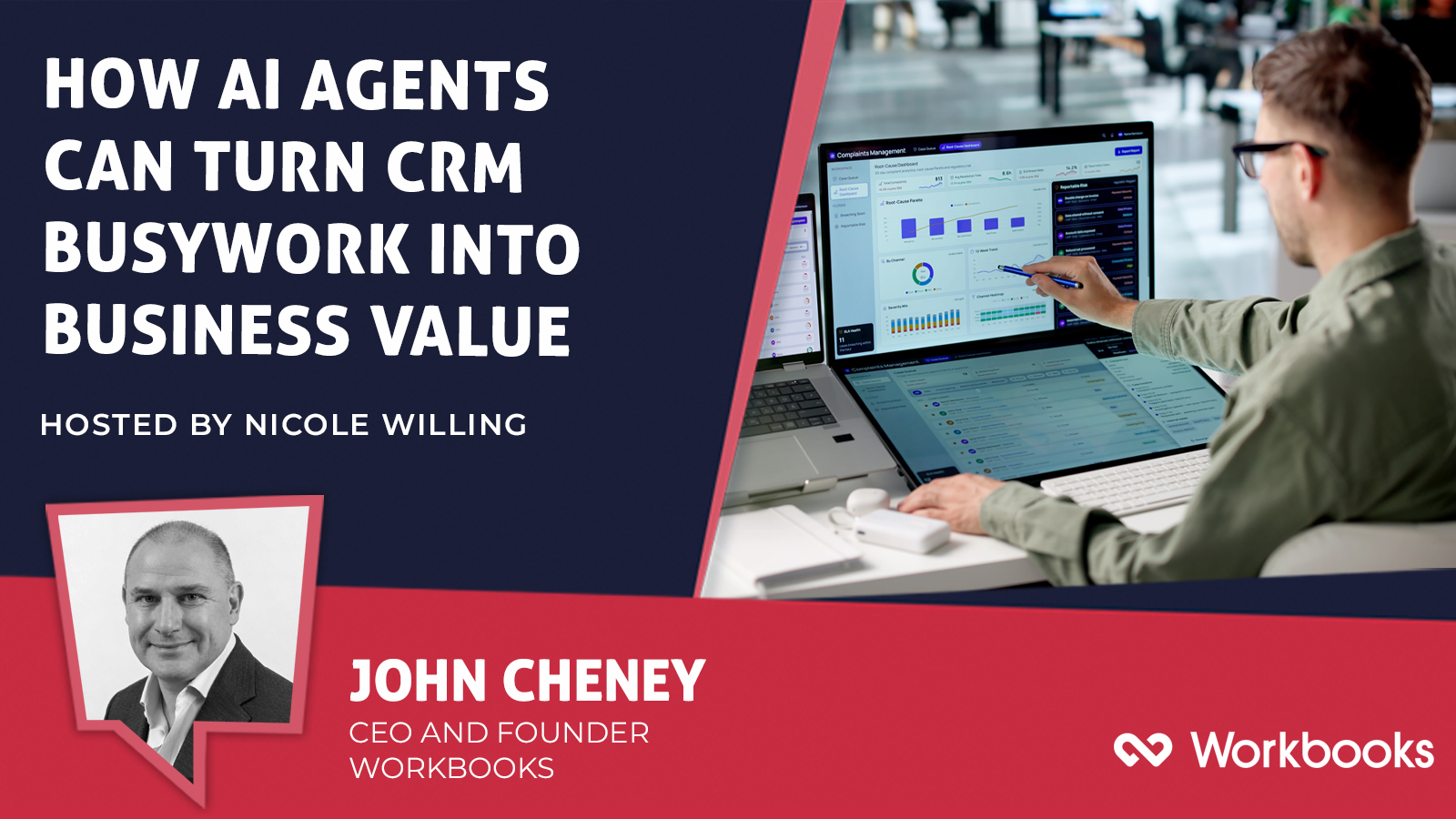
Enterprises may not find their AI advantage in the latest model. It could be buried in years of proprietary CRM data. John Cheney, CEO Founder and Founder at WorkBooks, explained how AI can help businesses clean up that data and turn internal knowledge into a competitive asset.
The availability of foundation large language models (LLMs) and AI tools poses a challenge to enterprises looking for differentiation. If competitors can access broadly similar technology, the model alone may not offer much long-term advantage.
But as AI tools become widely implemented throughout the customer experience, the hard-to-replicate advantage for enterprises may be in what they teach those tools about their own customers and operations based on the data in their customer relationship management (CRM) systems.
Businesses have accumulated years’ worth of customer information across CRM platforms as well as sales and support tools, but much of that data has never been used to its full potential because it is incomplete or trapped in disconnected systems.
AI changes the equation, as it can work across the information, help clean it up and turn customer interactions into a AI around what is unique to business rather than relying on capabilities that competitors can also access, John Cheney, CEO and Founder of Workbooks, told CX Today
“One of the challenges with AI generally is everyone’s got access to the tools, so they reduce the ability for them to be competitive. [But] AI as a tool to create knowledge, I think is a really interesting strategy for businesses because it creates competitive advantage.”
“If you can build knowledge inside your business using AI to help you be more effective and create competitive advantage, that’s a really valuable way of driving an AI strategy that creates value for your business,” Cheney added.
The Data Advantage Starts Inside the CRM
AI is only as useful as the information it can access. A CRM containing little more than contact details and pipeline records provides limited context for an AI agent trying to understand a customer.
“To make AI work well inside CRM, you ideally want all your customer information inside the platform,” Cheney said. “With that much richer data set, AI becomes much more valuable.”
That broader picture can include order and invoice information, sales activity and other records that show how the relationship has developed. “So not just the names and the phone numbers and email addresses, but also order information, invoice information, pipeline data,” Cheney explained.
The challenge is that many businesses are starting from a weaker data position.
“It depends a little bit on the state of the current customer CRM,” Cheney said. “The data quality might be low because they’ll just have, for example, maybe their pipeline data, but they won’t have a complete view of the customer.”
That can restrict what AI can reliably do. An autonomous agent asked to identify an upsell opportunity, summarize an account or recommend the next action will struggle if the customer record is incomplete. As Cheney pointed out:
“CRM with poor quality data can be a real challenge and can limit some of the capabilities of AI.”
When businesses embark on an AI strategy, improving the data foundation becomes part of the implementation rather than a separate housekeeping exercise.
“That would often be our first recommendation,” Cheney said, “that you take a step back, work out what do we need to do to improve the quality of data inside the CRM and AI is definitely a way of doing that.”
AI Can Help Fix the Data Problem
The same technology creating demand for better data can also help organizations prepare it, Cheney said.
“The good news is AI is also incredibly good at helping us clean data.”
AI can help organizations to identify gaps, interpret information and enrich customer records rather than relying entirely on employees to perform repetitive data-management tasks.
“One of the things that we’ve been helping our customers with over the last 12 to 18 months is how do we use AI as a tool itself to improve the quality of data that’s in the platform?”
The potential extends beyond cleaning individual CRM records, as AI agents can connect customer information with other business systems and retrieve information that previously required employees to search manually.
“AI is actually good at helping us connect those different systems together. The technology is still developing rapidly, but there are protocols like MCP that allow AI agents to talk together.” Cheney said. “If the other disconnected system is modern, then it might support MCP. But even if it isn’t, as long as it supports an API, we can build a tool that will go and ask those questions of those other systems.”
The practical benefit is fewer manual searches and a richer
“We’ve now got AI agents that go and do that work for them. So they don’t have to do that looking up in a different system,” Cheney explained.
Customer Conversations Can Become Proprietary Knowledge
CRM data is also expanding beyond structured fields. Sales and service interactions increasingly generate transcripts that AI tools can search and analyze by AI, changing how businesses capture knowledge that previously depended on employees writing accurate notes after every customer conversation.
“AI is in itself improving the quality of data because many of the interactions they have with the customers now are transcribed. Whereas historically, people would have to write down their meeting notes and then remember to transcribe them into the CRM platform. That’s now happening automatically,” Cheney noted.
Those conversations can then become anotherwhat works, coach sales teams and build a deeper picture of the organization
“It allows the AI agents to coach people on the right kind of questions to ask on the calls,” Cheney said. “It also starts building what I describe as an internal knowledge base inside the business.”
The process requires more than connecting an AI agent to every available dataallowed to do, what questions it should answer and where humans should remain involved, Cheney noted
“At what point do we want to hand over control to agents completely versus how much human guidance we want?”
Poor results can sometimes come from the way an AI system has been instructed rather than from the underlying technology. “AI will often spit out an answer that’s not right because we haven’t given it enough guidance on the right way to do the analysis that we’re looking for.”
Human involvement can help businesses test those systems and establish confidence before handing over more responsibility. “I still think at this point we’re in a place where human review is an important part of the process,” Cheney said.
After all, a poorly implemented system can create friction rather than improve the experience.
“If your agents aren’t giving the right kind of answers to your questions, and you then put the agents first and foremost in the client interaction and not the people, then you might actually have the opposite effect of what you’re trying to achieve, which is to improve the customer experience,” Cheney warned.
The speed of AI development creates pressure to experiment quickly, but the business case still needs to come first. “I don’t think you can just leap in. You need some thinking through, you need some planning.”
The payoff could extend beyond automation. AI can help businesses clean the CRM, connect fragmented systems, capture customer conversations and turn that information into institutional knowledge. The companies that make those capabilities useful will have a model of their own business built from years of proprietary customer knowledge, which competitors cannot simply buy from the same AI vendor.
rate this storyhelps rank stories across CX Today
Read nextordered by techtelligence · every pick explained
same beat · CRM & Data
HubSpot Cuts 660 Jobs as AI Strategy Reshapes Business
7 Oct 2026same beat · CRM & DataAI Agents Trigger a New Battle for Customer Data Control6 Oct 2026same beat · CRM & DataCox Fleet’s CRM Lessons for High-Urgency Customer Service2 Oct 2026
More from the CRM & Data desk

The layoffs are part of HubSpot’s strategy to reorganize around AI-powered customer outcomes. The vendor insists the move is not driven by AI efficiencies, but the distinction between AI efficiency and AI-led reorganization may not mean much to employees whose roles have been eliminated.
Rhys Fisher · 7 Oct 2026News
AI Agents Trigger a New Battle for Customer Data Control
As AI agents begin to retrieve, interpret and act on customer information, the CRM and CDP market is shifting from data unification to governed decision-making. Oracle, Microsoft, Braze, SAP and Iterable are competing to control how customer intelligence is used.
Nicole Willing · 6 Oct 2026Case Study
Cox Fleet’s CRM Lessons for High-Urgency Customer Service
When customers are stressed, stranded, or losing revenue, CRM has to do more than hold records. Alex Fraser, VP of Customer Operations at Cox Fleet, explains how connected data, AI, agents and service partners can turn urgent contact into coordinated action and customer advocacy.
Nicole Willing · 2 Oct 2026
