

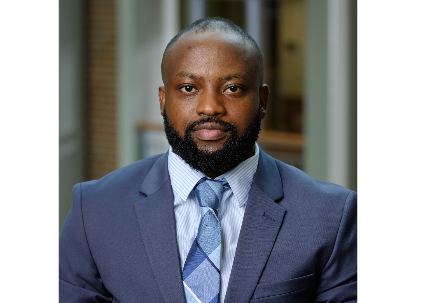
For Wilson Garuba, completing a PhD was not the end of his academic journey. It became the starting point for a new one.
After years of training in analytical chemistry and biomedical research at the University of Tennessee, Knoxville, Garuba began asking a different kind of question: how can scientific discoveries move beyond the laboratory and become practical products with real-world value?
That question led him to pursue an MBA at the University of Tennessee’s Haslam College of Business, with a focus on Entrepreneurship and Innovation.
Garuba’s scientific background spans biomarker science, neurological research, vibrational spectroscopy and machine learning. But as his doctoral work progressed, his interests increasingly shifted toward commercialization, product development and the business decisions required to translate research into useful applications.
“My PhD taught me how to investigate complex scientific problems and generate evidence,” Garuba said. “The MBA is helping me understand how to translate that evidence into customer value, identify the right market and build a pathway toward adoption.”
As part of that transition, Garuba participated in the National Science Foundation I-Corps program, where he tested early assumptions around customer needs and market relevance.
He has since engaged more than 100 researchers, clinicians, laboratory professionals and other healthcare stakeholders, using their feedback to refine the direction of an emerging biomedical venture.
His entrepreneurial work focuses on translating scientific discoveries into tools that can make complex biomedical information more useful to researchers and healthcare stakeholders.
Garuba has recently filed a U.S. patent to protect the intellectual property behind his emerging biomedical technology.
He has also been accepted into Vanderbilt University’s Wond’ry Builder Program, where he is continuing to develop the venture through mentorship and early-stage commercialization support.
He currently serves as an Ambassador for the Anderson Center for Entrepreneurship and Innovation at the University of Tennessee, where he supports the university’s entrepreneurship ecosystem and engages with programs focused on innovation and venture development.
Garuba’s entrepreneurial journey is backed by a growing scientific record. He has authored several peer-reviewed publications, presented at international conferences, and has also contributed to the scientific community through peer review and science-competition judging.
For Garuba, the decision to pursue an MBA after a PhD reflects a desire to connect two worlds that are often treated separately: scientific discovery and business creation.
“I am increasingly interested in what happens after the research is published,” he said. “Can the idea solve a meaningful problem? Can it create value for users? And can it be developed into something people are willing to adopt?”
His next chapter is focused on answering those questions as he works to build a bridge between biomedical research, entrepreneurship and practical innovation.
