

Why Flood-Exposed Economies Need Stronger Public Services to Protect Farm Productivity
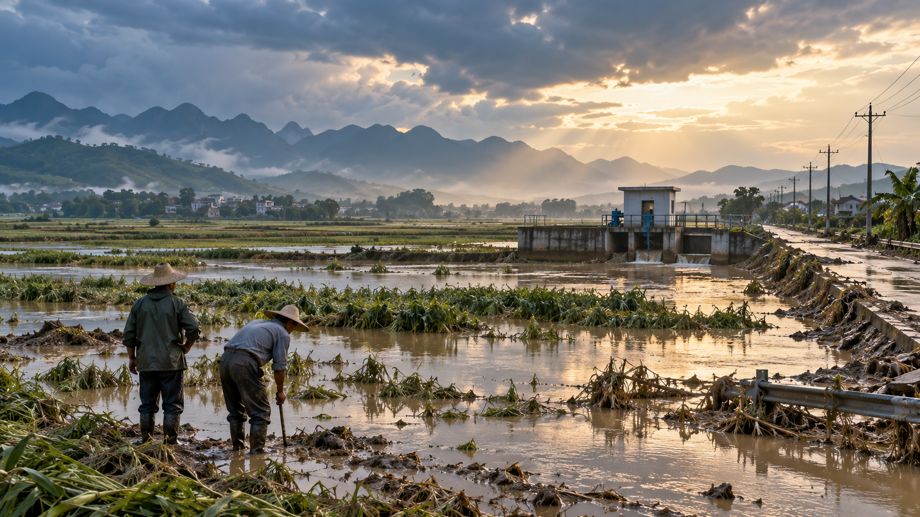
Flood disasters do not stop at damaged fields, lost crops or broken irrigation systems. Their economic effects spread through labor markets, rural infrastructure, storage, transport and public services, reducing the efficiency with which agricultural economies convert land, water, labor and capital into output.
A new study, “Flood Shocks, Public Service Capacity, and Agricultural Total Factor Productivity Change: Evidence from China and ASEAN,” published in the journal Sustainability, examines that wider productivity damage across China and ten ASEAN economies. Jing Wang, Jingyu Wang and Jiancheng Chen analyze more than three decades of evidence to determine whether stronger public services and economic structures can soften the agricultural consequences of severe flooding.
Using annual data from 1993 to 2024, the researchers combine EM-DAT flood records with World Bank indicators covering agriculture, population, public services and industrial structure. Agricultural productivity is assessed through a DEA-Malmquist total factor productivity measure, while two-way fixed-effects models test how flood mortality severity is associated with changes in productivity over time.
Flood exposure damages agricultural performance, but the size of the setback varies with health capacity, energy availability, drinking-water access and industrial development. Countries with weaker resources and heavier historical exposure appear particularly vulnerable.
Floods are hitting agricultural efficiency, not only farm output
Much of the economic discussion around floods focuses on immediate crop destruction. The study shifts attention toward agricultural total factor productivity, which captures how efficiently a production system turns multiple inputs — including land, labor, fertilizer, water and infrastructure — into physical and economic output.
The distinction is significant because a country may recover part of its harvested volume while still operating less efficiently after a disaster. Damaged roads can delay inputs, broken storage facilities can increase post-harvest losses, labor disruption can reduce available working capacity, and damaged irrigation can undermine productivity long after floodwaters recede.
Across the China–ASEAN sample, greater flood mortality severity was associated with lower contemporaneous agricultural TFP change. The baseline coefficient was negative and remained so across alternative inference procedures and sensitivity tests, including specifications excluding the COVID-19 years and tests addressing serial and cross-country dependence.
The evidence is stronger for the year in which the flood occurs than for the <a href="https://bitcomme.com/macys-nps-continues-to-climb-following-store-revamps/” title=”Macy’s NPS continues to climb following store revamps”>following year. A distributed-lag analysis retained the negative contemporaneous association, while the one-year lagged effect was not statistically significant. The authors therefore avoid claiming a persistent delayed productivity effect and explicitly treat the findings as conditional associations rather than causal estimates.
Regional patterns reinforce the same interpretation. Countries experiencing higher flood exposure tended to show lower or more volatile productivity improvements, while those with lower exposure generally recorded more stable gains. Productivity improved across much of the region over time, but substantial national differences remained.
Health systems and energy capacity emerge as powerful resilience buffers
One of the study’s strongest findings concerns what happens outside agriculture itself. Higher health expenditure, energy use, basic drinking-water access and a larger share of medium- and high-technology manufacturing were all associated with a weaker negative relationship between floods and agricultural productivity.
The mechanisms are economically plausible even though the study does not establish them causally. Stronger health systems can reduce illness-related labor shortages and accelerate workforce recovery. Reliable drinking-water services can limit post-flood contamination and disease, while energy availability supports irrigation, cold storage, processing, communications and logistics during periods of disruption.
Energy and health capacity produced the most striking marginal results. At high observed levels of health expenditure and energy use, the estimated association between flood mortality severity and agricultural productivity became positive and statistically significant. Drinking-water access and high-technology manufacturing also weakened the negative association, but their high-level marginal estimates were not statistically distinguishable from zero.
Such differences are important for policy prioritization. The findings do not support treating every form of resilience investment as equally effective, nor do they prove that additional spending will automatically reverse productivity losses. They suggest instead that the economic consequences of climate shocks are conditioned by the systems surrounding agriculture.
For developing economies, the implication is especially relevant. Agricultural resilience cannot be built entirely through better seeds, irrigation or farm machinery. Rural clinics, reliable electricity, safe water, logistics networks and functioning industrial supply chains can influence whether agricultural production systems continue operating when extreme weather disrupts normal conditions.
The weakest economies appear to carry the largest productivity penalty
The average regional result conceals substantial inequality. The negative relationship between flood severity and agricultural productivity was considerably stronger among countries with greater historical flood exposure and among those starting from lower income levels.
In the higher historical-exposure group, the estimated flood coefficient was −0.1478 and statistically significant, compared with a smaller and insignificant estimate in the lower-exposure group. Among lower-initial-income countries, the coefficient was −0.1409 and statistically significant at the 10% level, while the estimate for higher-income countries was far smaller and insignificant.
These subgroup results are suggestive rather than formal proof that one group responds differently from another, a limitation acknowledged by the authors. Even so, the pattern aligns with a familiar development constraint: repeated climate exposure can compound weaknesses in infrastructure, finance, public administration and recovery capacity.
The policy response therefore cannot be uniform. Economies facing frequent flooding and limited fiscal resources may gain more from strengthening basic protection, early-warning systems, drainage, flood-resistant irrigation, emergency logistics and contingency financing, before pursuing more sophisticated adaptation strategies.
Public-service gaps also require different interventions. Weak health systems call for rural medical capacity, disease surveillance and emergency supplies, while poor drinking-water access requires flood-resistant water infrastructure, rapid testing and backup provision. Energy-constrained regions may need decentralized or backup power targeted specifically at irrigation, cold storage, processing and communications.
Climate resilience is becoming a public-service and development strategy
The study broadens the meaning of agricultural adaptation. Protecting productivity under climate stress increasingly requires coordination across health, energy, water, infrastructure and industrial policy rather than isolated investments within the farm sector.
Regional cooperation could also play a larger role. The authors propose shared flood-monitoring systems, interoperable early-warning mechanisms, emergency agricultural trade and logistics arrangements, and technical assistance targeted toward countries with weaker public services and greater exposure. Higher-capacity economies could contribute technology and coordination resources, while more vulnerable countries concentrate on foundational systems.
The findings connect directly with several development priorities, including food security, climate adaptation, resilient infrastructure and access to essential services. They also reinforce the case for viewing SDG 2 on hunger, SDG 3 on health, SDG 6 on water, SDG 7 on energy and SDG 13 on climate action as operationally interconnected rather than separate policy agendas.
Investment opportunities follow from the same logic. Flood-resilient irrigation, decentralized energy, cold-chain systems, digital early-warning networks, water-quality monitoring and climate-resilient logistics can serve both adaptation and productivity objectives. Governments and development financiers, however, need stronger evidence on which combinations generate the highest returns in different country contexts.
Important limitations remain. The analysis uses country-level observational data and cannot fully capture differences among farms, crops, provinces or households. Unobserved changes in vulnerability, reporting quality or disaster-management capacity may influence both recorded mortality and agricultural performance, preventing a definitive causal interpretation.
Future research could move toward farm-level and spatially disaggregated datasets, nonlinear and spatial models, and analysis of droughts, heatwaves and compound climate events. Integrating ecological and socioeconomic information would also help identify where public-service investment produces the greatest agricultural resilience gains.
Countries that invest in health, energy, water, infrastructure and adaptive economic capacity may be better positioned to protect agricultural performance as climate risks intensify. The central challenge is no longer simply rebuilding farms after floods, but ensuring that the institutions and services surrounding them remain strong enough to keep food systems productive under repeated stress.
- FIRST PUBLISHED IN:
- Devdiscourse
