

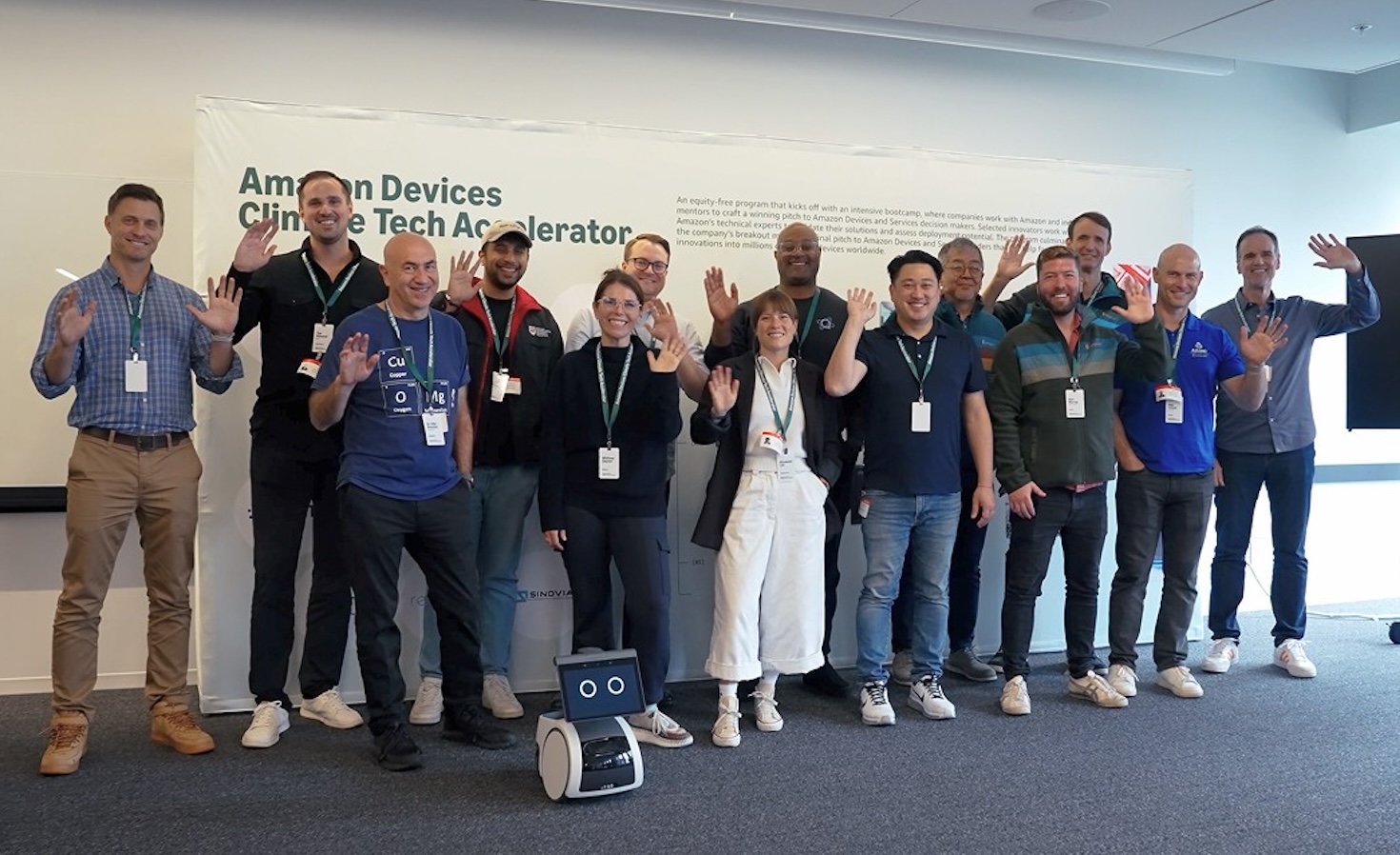
Participants in the 2025 Amazon Devices Climate Tech Accelerator cohort gathered at the program’s kick-off bootcamp
- Amazon’s accelerator is run by technical experts who can help the startups quantify the decarbonization impact of their technology.
- The program seeks lower-carbon materials, energy-efficiency and thermal management breakthroughs, and processes that support material recovery, recycling and reuse.
- Close to 30 companies participated in the two previous cohorts.
Three-quarters of large companies support startup investments that further their strategic goals. What differentiates Amazon’s new “deep tech” initiative is how the company involves line-of-business teams in finding new technologies or materials that could reduce greenhouse gas emissions.
The Amazon Sustainability Deep Tech Accelerator started life in 2025 as an initiative funded by the company’s Devices business unit, which is responsible for Kindle and Alexa devices. The program was updated Nov. 3 to include participation from Amazon Private Brands, which represents more than 100 product lines across home goods, apparel and electronics, and Amazon Web Services, the company’s cloud computing operation.
The initiative is separate from the $2 billion Climate Pledge Fund, which invests in early-stage entrepreneurs.
For one thing, the Amazon sustainability accelerator doesn’t take equity stakes in the participating startups. Rather, its task is to identify technologies, materials and processes that can be scaled and put to use in Amazon’s products or manufacturing processes.
“The outcome we want is a commercial one,” said Maiken Moeller-Hansen, director of energy and sustainability for Amazon Devices & Services.
In that sense, Amazon’s initiative is similar to the approach taken by the 100+ Accelerator, started in 2018 by Anheuser-Busch InBev and now funded by Coca-Cola Co., Colgate-Palmolive, Danone, Mondelēz International and Unilever. The focus is on supporting direct emissions reductions related to products within the companies’ portfolios.
“We just got to a point where we felt like we could be more rigorous and really put more structure around evaluating these opportunities with the goal of really accelerating that process to the benefit of both,” Moeller-Hansen said.
Three areas of focus
Amazon will accept applications for the next startup cohort starting in January, focused on innovation in these areas:
- Lower-carbon materials and manufacturing approaches that reduce the impact of semiconductors, displays, batteries or packaging.
- Energy-efficiency and thermal-management breakthroughs
- Processes that support material recovery, recycling and reuse
All three business units will contribute funding to support six-month engagements with chosen startups, aimed at helping entrepreneurs prototype their ideas, find potential manufacturing resources and create feasible pricing and licensing models.
“We pick what we think are the most likely applications of this technology and then we go super deep with the companies over the next 16 weeks,” Moeller-Hansen said.
Amazon’s accelerator is run by sustainability technical experts who can help the startups quantify the decarbonization impact of their technology, but it’s also supported by broader subject matter experts from within the business units, including product managers, materials scientists and quality engineers.
After six months, the startups in the new cohort will be encouraged to pitch their ideas to senior Amazon business leaders within the participating Amazon divisions.
Close to 30 companies participated in the first two cohorts, and a number have closed funding since, including Elephantech, which is working on more sustainable approaches to producing printed circuit boards; and Amprius Technologies, which is developing high-density battery cells.
Amazon hasn’t yet disclosed which accelerator participants have negotiated commercial contracts with the company, Moeller-Hansen said.
Get real case studies, expert action steps and the latest sustainability trends in a concise morning email.
Featured Reports

Sponsored
From Chemical Risk to Competitive Advantage
Sponsored
Is Your REC Registry Ready for Hourly Matching?
The State of the Sustainability Profession in 2026
Sponsored
Solving for Scope 3: From Data to Action
<img src="https://trellis.net/wp-content/uploads/2026/06/ERM_June2026_Resource_FeaturedImage.jpg.jpg?w=644" alt="Turning Bottlenecks into Advantage: Future-Proofing the AI Infrastructure Value Chain” loading=”lazy”>
Sponsored
Turning Bottlenecks into Advantage: Future-Proofing the AI Infrastructure Value Chain
How to Set Sustainability Strategy in 2025
Sponsored
Data Matters from Sphera, a discussion on LCA data quality
Sponsored
Microsoft’s Carbon Removal Pause Signals a Moment for Buyer Action
The State of Biodiversity and Business 2024
Sponsored
Powering Growth: How Business and Utilities Meet Surging Electricity Demand
Sponsored
From Volatility to Stability: Challenging the Age of Oil-Based Plastics
Track the latest sustainability reports from major companies
Sponsored
What to Look for in Enterprise Carbon Management Software
Sponsored
Understanding the GHG Protocol’s New Scope 2 Granularity Proposal
1,105 corporate sustainability reports published in 2025
