

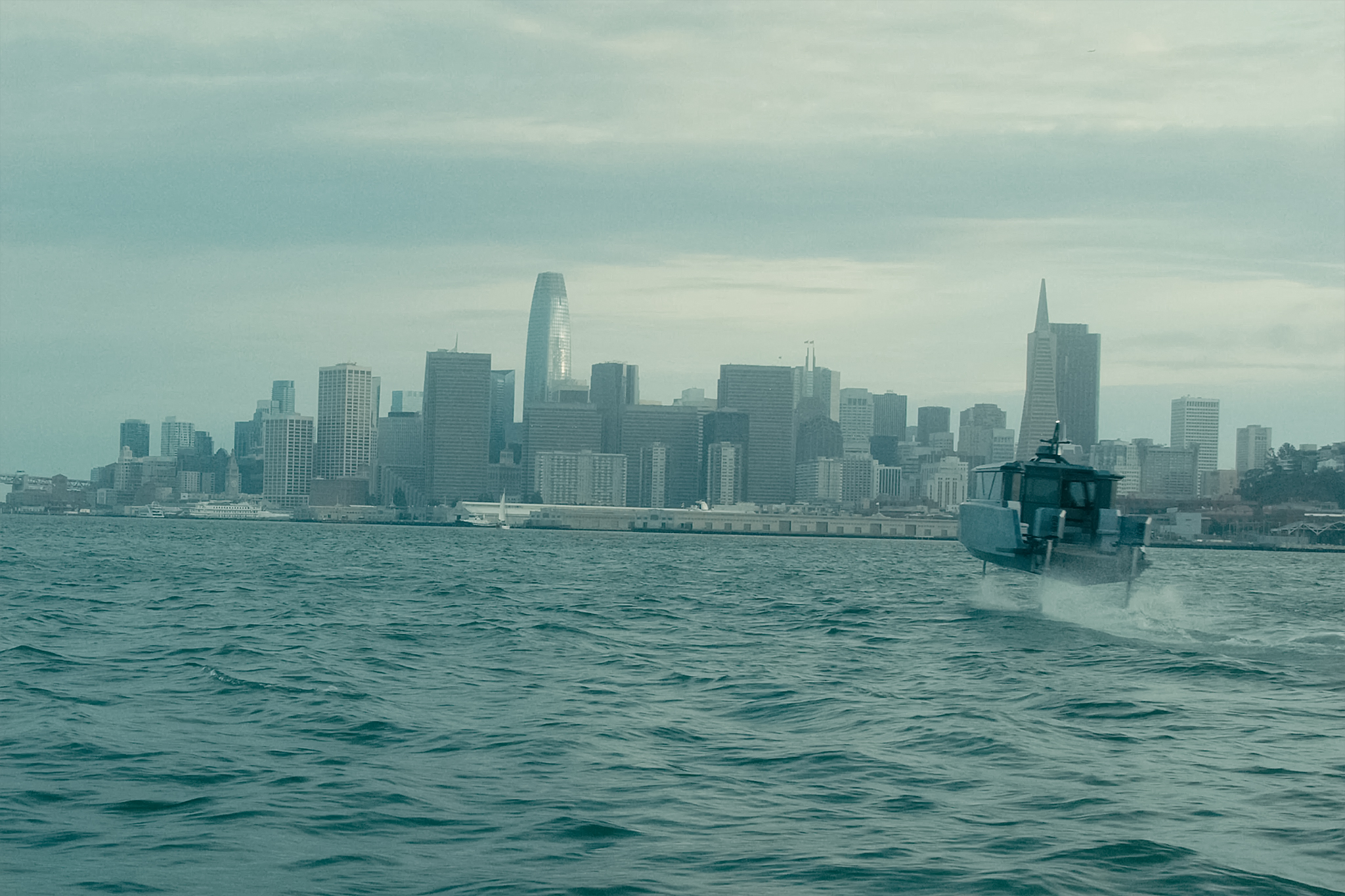
As a tech reporter, my inbox is usually piled high with product pitches claiming to be the first at something. Few really catch my eye, but an offer to “ride the electric boat that flies above water” instantly did.
Navier, an Alameda-based luxury electric yacht startup, uses more than 150-year-old technology to curb one of the biggest problems facing the maritime industry in the Anthropocene era: overreliance on fossil fuel-burning diesel motors.
The vessels use hydrofoils, basically underwater wings, to lift the boat’s hull off the water when it hits a certain speed. It’s the same tech that’s used in ferry systems in Sweden and Greece, and you can even find it in a simpler form on surfboards off Amazon.
Article continues below this ad
The idea is simple: by eliminating the drag from its hull cutting through the water, the boat can travel faster while using a cleaner electric motor. It’s old tech with a modern upgrade, and the company sees it as a game changer for maritime transportation in the future. But for now, its steep price tag is keeping it in richer waters.
Like a Tesla on the water
I met founder and CEO Sampriti Bhattacharyya last month on a gloomy Friday morning at a harbor near Alameda’s Ballena Lookout. A Bay Area summer was on full display — foggy, misty and cold. For the avid summertime boater, it would be a less than ideal day to hit the water. But for Bhattacharyya, it was probably the best opportunity to showcase the tech: The waters were rough, with tides bouncing the parked boats in the harbor. Even just boarding the 30-foot yacht took care and a helping hand to prevent a chilly morning dip.
I boarded Navier’s new N30 model, specifically one owned by Bay Area venture capitalist Tim Draper, one of the company’s financial backers. The luxury yacht can best be described as a Tesla on the water, a comparison that Bhattacharyya has gotten before. The boat’s interior is sleek and minimalist, with cushioned seating lining the inner cabin. Rather than a panel of analog gauges, the controls look more like a digitized airline pilot’s dashboard — an apt design for the tech at play.
The rough chops of the bay were hard to ignore as we started out into the sea at the sluggish harbor speed limit. Waves between 3 and 4 feet slapped the underside of the vessel, rocking us back and forth. I didn’t get seasick, but slapping on a Scopolamine patch before the five-minute stretch leading into open water would be a good idea for anyone prone to mal de mer.
As soon as we passed the last buoy marking the harbor’s limit, it was showtime. A Navier employee lowered the foils into the water with a touch of a control screen and pushed the throttle, and within seconds, the intimidating waters bobbing the boat up and down seemed to disappear. Like taking off on a runway, we were flying above the water.

Bhattacharyya was as laid-back as ever as we gained speed, assuming the same chill demeanor that she showed in a promotional video where she rode one of Navier’s first models while reading a book with a glass of wine. I approach new tech as a skeptic, but I was amused, and the fact that I can still read my handwriting from the notes I took on the boat ride is a reminder of just how smooth the ride was.
When we circled back to Alameda after a 20-minute cruise, Bhattacharyya gave me a tour of Navier’s hangar, which held several yachts, some in the process of being manufactured. Given the flashiness of the $375,000 yacht I rode, branded with the logo of a massive VC fund, it’d be easy to think the company has a huge, modern factory churning out boats. Instead, Navier’s headquarters is a reflection of its Bay Area startup roots: a small team of mostly young engineers working out of a garage with the goal of global influence. To be fair, the garage was much larger than the typical stealthy suburban setup in Silicon Valley, with space for several Navier vessels.
$100 million and 100 boats
The ambition, though, is the same. Bhattacharyya’s goal is to scale up Navier’s tech to change the maritime industry at large. She told me she believes maritime travel in America is especially underutilized due to costs, comfort and convenience, and she sees the wide adoption of her electric hydrofoils as a way to make water commuting more common. For now, though, Navier’s boats are largely catered to those that can afford them, with vessels in Miami, Nantucket and the Hamptons, for example. That will remain the same for its upcoming large-scale deployment.
In June, Navier announced a $100 million partnership with JIH Global Investment, an international luxury hospitality fund, to provide a 100-vessel network of N30 yachts to the Maldives over three years. The South Asian island nation is home to around 1,000 hotels scattered across a vast archipelago in the Indian Ocean and sees over 2,000,000 visitors throughout the year. It also relies heavily on diesel-powered water taxis to transport tourists between islands, with about 3,000 currently operational.
Mohamed Ali Janah, JIH’s chairman and a special advisor to the president of the Maldives, told me it’s going to take more than just building the boats. In order to get the network running, the country needs to beef up its electric charging infrastructure, which at this point is almost nonexistent. Janah said he’s in talks with a British company to build a network of floating charging stations. He insists the nation will be ready when Navier’s boats hit its waters by early next year at the latest.
Aside from the physical infrastructure, the project needs to train people and show them how to actually use the boats. Most yachts do not fly, let alone have high-tech features like automated anchoring, where the vessel’s software uses microadjustments to keep the boat stationary in moving water without a physical anchor.
Access our new app with ad-free reading, curated maps and more.
GET IT NOW
Janah also noted that this isn’t maritime tech that will be in the hands of the everyday person anytime soon, given its luxurious nature. While he said the ultimate goal is to not exclude the general public from the tech, Janah said as entrepreneurs, they have to see if they can make it in their small luxury market first before expanding.
“We cannot exclude the general public, and we cannot exclude that normal person on the street,” Janah said. “So to get there, I think we have to have a successful business model in this luxury sector.”
Work in Silicon Valley and want to talk? Contact tech reporter Matthew Brown securely at matthew.brown@sfgate.com or matthewbrownsfgate.11 on Signal.
— Laid off after 24 years, Bay Area radio host writes scathing farewell
— Calif. driver disappears after surviving 300-foot fall off highway
— 30-year-old who set El Cap speed record dies in climbing accident
— Zuckerberg spokesperson says yacht did not hear call for help
