

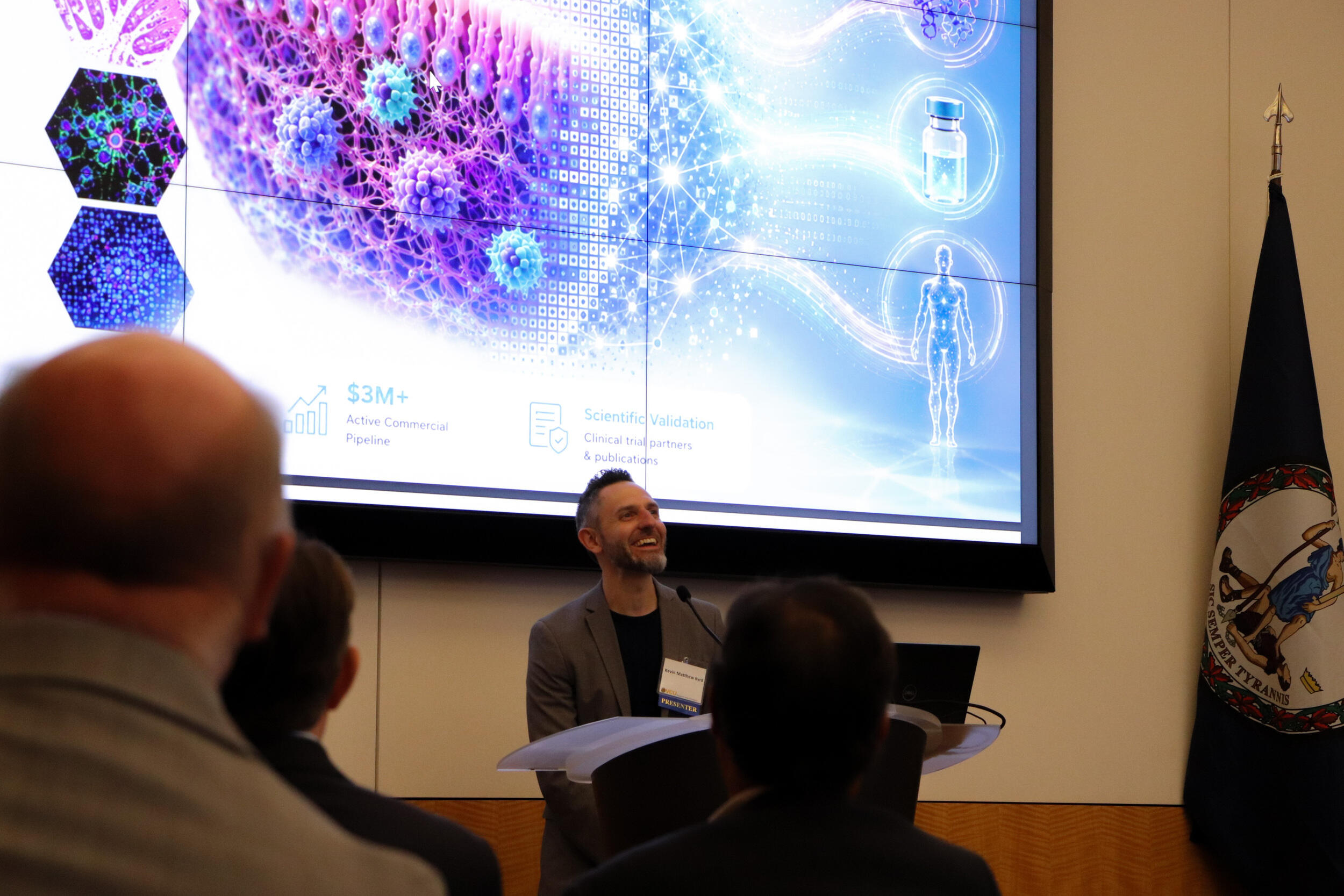
Startup Showcase at the General Assembly Building highlights how VCU discoveries are becoming companies, attracting investment and addressing real-world challenges.
An IV treatment that could buy trauma patients more time. A fingerstick test that could spare patients repeated trips to a lab. A cleaner way to recover minerals critical to national defense.
Virginia lawmakers got an up-close look at technologies and startup companies emerging from Virginia Commonwealth University last week at the inaugural VCU Startup Showcase. Faculty researchers, entrepreneurs and investors gathered at the Virginia State Capitol for a look at what state and federal investment in university innovation can produce — namely, new companies that bring lab discoveries to market.
“These breakthroughs demonstrate the magnitude of what is possible when university research addresses needs that people want addressed,” said VCU President Michael Rao, Ph.D. “VCU is proud to be the commonwealth’s leader in new startups — bridging academic discovery and market reality to improve and save lives. Together, with investors, industry leaders and policymakers, we are helping to ensure that the next generation of life-saving technology is born, scaled and retained in Virginia.”
The event highlighted companies built around intellectual property developed at the university. Innovations spanned precision medicine, cancer treatment, gene therapy, critical minerals, virtual reality in healthcare, advanced materials and other fields representing every VCU college and school.
The message for lawmakers: Research conducted at Virginia’s universities doesn’t have to end with a discovery or scientific publication. With the right support, it can become a product, a company and an economic engine for the state.
The showcase, hosted by the VCU Office of the Vice President for Research and Innovation and its TechTransfer and Ventures team, comes as VCU’s research enterprise continues a period of significant growth. The university received $568 million in sponsored research awards in fiscal 2025, more than double the $271 million received in fiscal 2018. VCU is also ranked among the nation’s top 50 public research universities based on research and development expenditures.
In fiscal 2025 alone, the office reported 111 invention disclosures, 171 patent filings, 20 patents issued and 17 licenses to startups, generating $4.3 million in licensing revenue.
Over the past decade, VCU’s commercialization efforts have helped launch more than 90 startups and bring more than 60 new products to market.
“Ultimately, this funding turns our research and innovation into products, into jobs, into companies and into a competitive advantage for the commonwealth,” said P. Srirama Rao, Ph.D., VCU vice president for research and innovation. “When a discovery becomes a startup, the impact can multiply. It can improve health, address an important societal challenge, attract private capital and create economic opportunity right here in Virginia.”

VCU’s Commercialization Fund illustrates that progression. The university has invested $4.1 million through the fund in 114 projects, helping generate $41 million in follow-on funding and 36 licenses — 31 of them to startups. TechTransfer and Ventures, which works with university researchers to protect intellectual property, license technologies and help create companies, said VCU-backed startups have in total raised nearly $200 million, including more than $100 million during the past year. Ninety percent remain based in Virginia.
Rao said those results demonstrate why state and federal commercialization funding is essential to converting publicly supported research into new products, companies and jobs.
“Every dollar that helps a founder cross from a proof of concept to a potential product is a dollar that keeps that idea and that company in Virginia,” he said.
From the laboratory to the marketplace
During a lightning pitch session, VCU-affiliated startups had three minutes to tout their technologies and potential impact.
Among them was Stratica Biosciences, which is developing artificial intelligence-powered platforms to combine tissue, molecular and clinical data to better understand disease and predict therapy response. Evolyra Therapeutics is pursuing next-generation gene therapies for rare inherited muscle diseases.
Other companies showcased technologies aimed at reducing surgical complications (Pascal Medical), improving DNA sequencing (Evizia), preserving organ function following catastrophic blood loss (Perfusion Medical) and allowing patients with rare endocrine disorders to monitor calcium levels at home (Tralyte Health). BioRE-Element Technologies is using engineered proteins to develop a cleaner method of separating rare earth elements critical to electronics, energy and national defense. ThermaGel Innovations is working to commercialize advanced aerogel insulation that is thinner and lighter than conventional materials while offering superior thermal performance.
“An inventor may have a remarkable technology, but a successful company requires much more than the invention itself,” said Ivelina Metcheva, Ph.D, assistant vice president for innovation and head of VCU TechTransfer and Ventures. “It takes experienced entrepreneurs, investors, industry partners, economic development organizations and public support. Our job is to help connect those pieces so that promising VCU discoveries have the best possible opportunity to become products and companies and to grow here in Virginia.”
A view from both sides
For Del. Lindsey Dougherty, who represents Virginia’s 75th House District and also works as a senior research administrator at VCU, the event connected two parts of her professional life: supporting university research and helping make decisions about Virginia’s priorities as a state legislator.
“When we talk about research funding or economic development in the General Assembly, it’s easy for those conversations to become numbers on a page,” Dougherty said. “Today, lawmakers were able to meet the people behind that work and see what those investments can produce — new technologies, new companies and potentially new jobs for Virginians.”
She said university research can also play an important role in Virginia’s competition with other states for companies, talent and investment.
“We have tremendous intellectual capital right here in the commonwealth,” Dougherty said. “The opportunity is to make sure Virginia creates an environment where those discoveries don’t have to leave the state to become successful companies.”
Virginia Secretary of Commerce and Trade Carrie Chenery said supporting entrepreneurs and university partnerships is part of the Gov. Abigail Spanberger administration’s broader effort to grow the state’s economy.
“So as you’re building up new companies, as you’re building up new partnerships, you’ve got a friend in the administration,” Chenery said. “I’m just excited to see what you build and how we can be a part of it.”
- Entrepreneurship
- Faculty
