

Abstract
Data on vaccinations during pregnancy are lacking in Germany. We aimed to assess the proportion of pregnancies with any vaccination over a 19-year period. Using health claims covering approximately 20% of the German population, we included pregnancies beginning between 2004 and 2022. We determined the proportion of pregnancies with at least one vaccination (any type and specific vaccines). Results were stratified by calendar year, maternal age, federal state of residence, and socioeconomic status. Of 2,801,552 pregnancies included overall, 423,567 (15.1%) were exposed to at least one vaccination. The proportion of pregnancies with influenza vaccination was 2% in 2004–2009 and increased after its recommendation (2010) from 7% in 2010–2014 to 19% in 2020–2022; the proportion of pregnancies with pertussis vaccination was 3% in 2015–2019 and increased after its recommendation (2020) to 37% in 2020–2022. In 2020–2022, about 0.3% of pregnancies were exposed to vaccines against mumps, rubella, and measles, which are contraindicated during pregnancy. Reasons why less than 50% of pregnancies receive recommended vaccinations should be explored, e.g., to what extent this is due to an informed decision or a lack of knowledge.
Subjects
- Diseases
- Health care
- Medical research
Introduction
The use of medicines during pregnancy always requires consideration of the benefits and potential risks to the mother and the unborn child. This also applies to vaccinations during pregnancy. From a global perspective, maternal immunization during pregnancy is important as it offers protection against vaccine-preventable infections and their complications for the mother during pregnancy, the unborn child, and the infants in the first few months of life1,2,3. Accordingly, the World Health Organization (WHO) and the Advisory Committee on Immunization Practices (ACIP) of the Centers for Disease Control and Prevention (CDC) advocate for maternal immunization against influenza, diphtheria, pertussis, tetanus, and coronavirus disease (COVID-19)4,5,6.
In countries with well-developed healthcare systems, most women have already completed age-appropriate routine vaccinations before pregnancy, but some vaccinations are still recommended during pregnancy. In Germany, the National Standing Committee on Vaccination (STIKO) has recommended vaccinations against influenza during every pregnancy since 2010, from the second trimester of pregnancy, or from the first trimester for women with comorbidities, and vaccination against pertussis since 2020 in the third trimester, or the second trimester if there is an increased probability of premature birth. Inactivated vaccines, such as those against tetanus, diphtheria, and hepatitis A and B, are acceptable during pregnancy, although not explicitly recommended by STIKO guidelines7. Vaccination against COVID-19 during pregnancy has been recommended by the STIKO since 2021, if the pregnant woman has no baseline immunity consisting of at least three antigenic contacts (vaccination or infection, with at least one vaccine dose)7. Live vaccines such as those against measles, mumps, rubella, and varicella are contraindicated during pregnancy. To date, there has been no study from Germany that has systematically investigated the proportion of pregnant women exposed to any vaccination and the different types of vaccination.
Therefore, to address this gap, the present study aims to (1) determine the proportion of pregnancies during which the mother received at least one vaccination and (2) to describe the type of vaccinations administered during pregnancy.
Methods
Data source
We used the so-called German Pharmacoepidemiological Research Database (GePaRD), which is based on claims data from four statutory health insurance providers in Germany and currently includes information on approximately 25 million individuals who have been insured with one of the participating providers since 2004 or later8. In addition to demographic data, GePaRD contains information on drug dispensations as well as outpatient (from general practitioners and specialists) and inpatient services and diagnoses. For each calendar year, there is information on approximately 20% of the general population, and all geographical regions of Germany are represented. The German health care system is characterized by statutory health insurances, covering about 90% of the general population, and a uniform access to all levels of care9,10.
In GePaRD, information on vaccinations reimbursed by health insurance is obtained based on codes of the German Uniform Assessment Standard (EBM), which are recorded for each administered vaccination. The COVID-19 vaccine was reimbursed by government funds rather than health insurance during our study period and could therefore not be captured in our data.
Pregnancies were identified using a validated outcome algorithm, which also provides information on the end date of the pregnancy11. Pregnancy onset is estimated using the expected delivery date (EDD), which is available for about 80% of pregnancies in GePaRD. The EDD is based on the last menstrual period (LMP) or early ultrasound and usually coded in the first weeks of pregnancy12. Pregnancy onset is estimated by subtracting 280 days from the EDD. If no (plausible) EDD is available, pregnancy onset is estimated via the median duration of pregnancies with the respective outcome.
Study design and study population
Based on the aforementioned algorithms, we identified pregnancies and included them if they fulfilled the following criteria: (1) mother of childbearing age (13–49 years), (2) pregnancy onset between 2004 and 2022, (3) mother continuously insured from pregnancy onset to the end of pregnancy, (4) residency in Germany at pregnancy onset. A pregnancy was classified as exposed to vaccination if there was at least one EBM vaccination code at any point between the onset and the end of pregnancy.
Data analysis
First, we determined the proportion of pregnancies with at least one vaccination overall and stratified by age group, year of pregnancy onset, federal state of residence, and two indicators of socioeconomic status (SES). One of these SES indicators uses individual information on the highest educational attainment; the other is based on the German Index of Socioeconomic Deprivation (GISD) of the district of residence, which captures socioeconomic disadvantage in defined geographic areas based on data on education, employment, and income. For each pregnancy, GISD information was linked based on the respective year and area of residence. Further information on the GISD is available at https://robert-koch-institut.github.io/German_Index_of_Socioeconomic_Deprivation_GISD/. We conducted this analysis for all pregnancies and for those ending in a live birth. In the next step, we determined the proportion of pregnancies exposed to the different types of vaccination stratified by time period of pregnancy onset: 2004–2009 (i.e. before influenza vaccination was recommended), 2010–2014 (i.e. after influenza vaccination was recommended), 2015–2019 (i.e. before pertussis vaccination was recommended), 2020–2022 (after pertussis vaccination was recommended).
We conducted further analyses focusing on pregnancies with at least one vaccination. Among these, we assessed, for each trimester and overall, the proportion of individual types of vaccinations. In the analyses for the second and third trimester, we only considered those pregnancies reaching the respective trimester in the denominator of the proportion. We conducted all statistical analyses using the software SAS version 9.4, SAS Institute Inc., Cary, North Carolina, USA.
Code availability
The underlying code for this study is available to qualified researchers upon reasonable request to the corresponding author.
Ethics
In Germany, the utilization of health insurance data for scientific research is regulated by the Code of Social Law. All involved health insurance providers, as well as the German Federal Office for Social Security and the Senator for Health, Women and Consumer Protection in Bremen, as their responsible authorities, approved the use of GePaRD data for this study. Informed consent for studies based on claims data is required by law unless obtaining consent appears unacceptable and would bias results, which was the case in this study. According to the Ethics Committee of the University of Bremen, studies based on GePaRD are exempt from institutional review board review.
Results
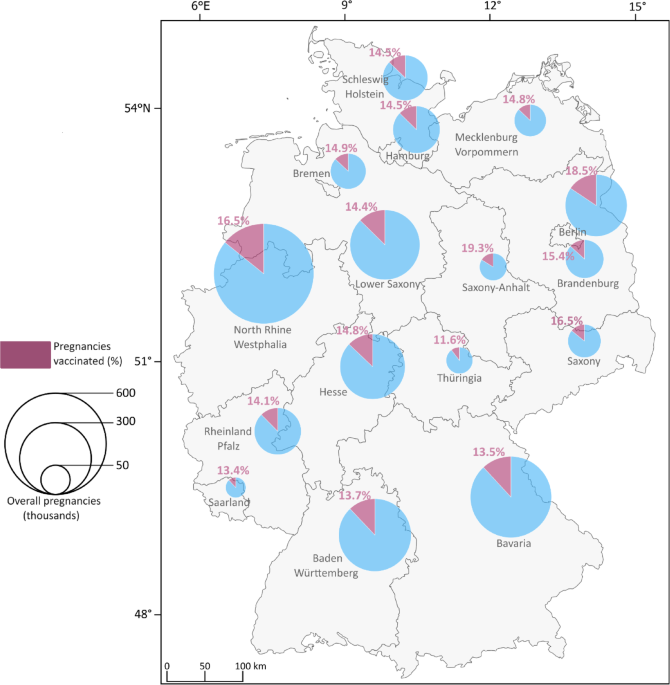
Overall, we included 2,801,552 pregnancies beginning between 2004 and 2022 (Table 1). Of these, 423,567 (15.1%) were classified as being exposed to at least one vaccination during pregnancy (Table 1). Among pregnancies ending in a live birth (N = 2,259,025), 17.4% were exposed to at least one vaccination (Supplementary Table 1). Stratification by age showed that the proportion of pregnancies exposed to at least one vaccination was highest in mothers aged 30–34 years (17.0%) and 35–39 years (16.5%), and lowest in the age group ≤ 24 years (10.2%). The proportion of pregnancies exposed to at least one vaccination increased from 3.6% for pregnancies starting between 2004 and 2009 to 43.6% for those starting between 2020 and 2022. Regarding indicators of socioeconomic status, the proportion with at least one vaccination was higher in those with a higher education (17.7%) as compared to those with basic/secondary education (11.3%) (Table 1). The proportion of pregnancies with at least one vaccination was 19.3% in Saxony-Anhalt, 18.5% in Berlin, and 16.5% in both North Rhine-Westphalia and Saxony (Fig. 1). The patterns observed for all pregnancies were similar to the patterns observed for pregnancies ending in a live birth (Supplementary Table 1 and Supplementary Fig. 1).
Figure 2 shows the proportion of pregnancies exposed to the different types of vaccinations stratified by time period. In the most recent time period (2020–2022), approximately 37% of all pregnancies were exposed to vaccines against pertussis, tetanus, and diphtheria, respectively, while in the time period 2015–2019 this applied to about 3% of pregnancies. The proportion of pregnancies with a vaccination against influenza increased from 2.0% in the period 2004–2009, 7.2% in the period 2010–2014, and 11.7% in the period 2015–2019 to 19.4% in the period 2020–2022 (Fig. 2). Overall, there were 6872 (0.2%) pregnancies exposed to a contraindicated vaccination between 2004 and 2022 (Table 2). The proportion of pregnancies with at least one contraindicated vaccination decreased during the study period (Table 2). In the most recent time period (2020–2022), about 0.3% of pregnancies were exposed to vaccines against mumps, rubella, and measles. For varicella vaccination, the proportion was 0.04%.
Among all pregnancies with at least one vaccination (any type), the proportion with at least one vaccination in the first trimester decreased over time, from 56.1% in 2004–2009 to 10.2% in 2020–2022 (Table 2). A similar pattern was observed for pregnancies ending in live births (Supplementary Table 2).
Discussion
This study, which provides the first comprehensive overview of vaccinations during pregnancy in Germany, shows that the proportion of pregnancies with at least one vaccination has increased substantially during the past 2 decades, from below 4% in the time period 2004–2009 to about 44% in 2020–2022. This reflects that vaccinations against influenza and pertussis during each pregnancy have been recommended since 2010 and 2020, respectively. In the most recent time period, 19% of pregnancies were exposed to an influenza vaccine, and 37% to a pertussis vaccine, showing that the recommendations are often not followed, particularly for influenza. The proportion exposed to vaccines against tetanus and diphtheria was nearly equal to that of pertussis, as these vaccines are mostly given as a combination vaccine with tetanus and diphtheria. For the overall proportion of pregnancies with at least one vaccination, we did not observe major differences according to age, socioeconomic status, or region of residence.
Our findings on the uptake of influenza vaccination during pregnancy are in line with other studies from Germany. For instance, a single-center study in Bavaria utilizing computer-assisted interviews and self-reported questionnaires conducted from 2015 to 2018 reported a proportion of 13% with an influenza vaccination13. The proportion in our study was 12% for the period 2015–2019. Another study using German claims data reported an increase in the proportion from 9% in the 2014 influenza season to 17% in 202014 i.e., the time trend is also consistent with our study. The EU Council considers pregnant women as a high-risk group for severe influenza infection and sets a target of 75% coverage of influenza vaccination during pregnancy15. According to the most recent European Centers for Disease Control and Prevention (ECDC) report, vaccination coverage among pregnant women was reported only from Hungary, Lithuania, Slovenia, and Spain, and ranged from 1.7 to 61.9% during the period 2020–2021, with Spain reporting the highest coverage15. Globally, the highest uptake of influenza vaccination in pregnancy has been reported in Spain, the United Kingdom (UK), and the United States of America (USA)16. In these countries, targeted pregnancy vaccination programs have been implemented, including uptake monitoring16, active provider engagement, reminder and recall systems, or public awareness campaigns; i.e., this goes beyond the approach of merely recommending and reimbursing influenza vaccination during pregnancy.
Regarding vaccination against pertussis, the proportion of exposed pregnancies in our study was 37% in the most recent time period (2020–2022). The increase in the uptake of vaccination against pertussis during pregnancy following its recommendation in 2020 was much sharper compared to the increase in the uptake of influenza vaccination during the past decade. The coming years will show whether there will be a further increase or whether the maximum proportion of pertussis vaccination during pregnancy has already been reached. Similar to influenza vaccination, high uptakes of pertussis vaccination during pregnancy have been reached in countries such as Spain, the UK, and the USA, with proportions of 84%, 71%, and 57% in 2019, respectively16.
To contextualize the observed vaccination uptake proportions in pregnancy, it is interesting to compare influenza and pertussis vaccination uptake with uptake in other population groups for whom these vaccinations are recommended in Germany. In addition to pregnant women, STIKO also recommends influenza vaccination for other high-risk and vulnerable groups, including, for example, adults aged ≥ 60 years and individuals with chronic medical conditions, with a target vaccination coverage of 75%7. Although influenza vaccination uptake in these groups has also remained below the target threshold, it has generally been higher than that observed among pregnant women. For example, during the 2021/22 influenza season, vaccination coverage reached 43.3% among adults aged 60 years or older and 35.4% among individuals with relevant comorbidities17. Pertussis vaccination coverage in the general adult population has also remained suboptimal. In 2022, 49.8% of adults aged 18 years or older had received a pertussis vaccination within the previous 10 years.
Between 2004 and 2022, we observed 6872 pregnancies exposed to at least one contraindicated vaccination, i.e., a vaccination containing a live attenuated virus. Since our data covers approximately 20% of the German population, it can be assumed that approximately 34,400 pregnancies throughout Germany were exposed to such a vaccination during this period. It cannot be ruled out that in some of these pregnancies, the pregnancy onset was not estimated correctly, and the vaccination actually took place before pregnancy. However, it is very unlikely that pregnancy onset was estimated 1 month too early, while the recommendation is that pregnancy should be avoided for at least 1 month after a vaccination with live attenuated virus due to the theoretical risk to the fetus. In practice, the actual risk following exposure to live attenuated vaccines is typically considered to be low. For instance, in a systematic review by Mangtani et al., no cases of congenital rubella syndrome were identified from several studies that evaluated the incidence of congenital rubella syndrome following inadvertent vaccination of pregnant women18. Similarly, in a 19-year study on varicella vaccine during pregnancy in the USA and Canada by Willis et al., no cases of congenital varicella syndrome were identified among liveborn infants of women inadvertently vaccinated against varicella19. However, there is a case report of a baby exposed to measles-mumps-rubella vaccination early in pregnancy, who manifested a phenotype of cardiac and neurologic defects, neurodevelopmental delay, and lymphocytopenia consistent with congenital rubella syndrome20.
The following aspects should be considered when interpreting our study. Strengths of our study include the large database, which is free of recall and non-responder bias. The available data allowed us to assess the uptake of all vaccinations administered during pregnancy over 19 years (except for vaccination against COVID-19). With the sophisticated algorithms developed for GePaRD, misclassification of pregnancy information, including its onset, is minimized; i.e., the proportion of pregnancies classified as exposed to the various types of information can be considered to be very valid. The agreement of the proportions observed in our study for vaccinations against influenza and pertussis with those reported based on other data sources suggests representativeness of our findings. Our study also has limitations. First, vaccination data may be incomplete before 2008, prior to the nationwide implementation of standardized EBM billing codes, which may have resulted in underestimating the proportion of pregnancies with a vaccination in the time period before 2008. Second, we did not have information on COVID-19 vaccination because it was reimbursed by governmental funds rather than by health insurance during our study period. Also, our database does not capture influenza vaccinations provided directly by employers. Since vaccinations in this setting are usually done without detailed pre-treatment consultation, we expect that most pregnant women prefer to be vaccinated by their general practitioners or gynecologists. Third, as we aimed to provide a general overview of vaccinations during pregnancy in Germany, we did not assess the seasonality of vaccination coverage. This is particularly relevant for influenza vaccination, which is recommended by STIKO during the influenza season and typically from the second trimester unless comorbidities are present. Using all pregnancies as the denominator likely underestimates coverage among those actually eligible according to these criteria. However, we do not expect that there is a relevant variation in the seasonal distribution of pregnancies across calendar years, i.e., the comparison between calendar years should not be limited. Forth, although overall representativeness of GePaRD—which covers approximately 20% of the German population—has been shown for drug prescription8, results in the sub-population of pregnant women might be less generalizable. This applies especially to regional differences, as GePaRD does not cover the same proportion of pregnancies in each federal state. Still, it is important to consider in this context that 90% of the German population have statutory health insurance with uniform access to all levels of care.
In conclusion, our study demonstrates that the proportion of pregnancies exposed to vaccinations has substantially increased during the past decade in Germany, following the recommendations to be vaccinated against influenza and pertussis during each pregnancy. Reasons why these proportions are still well below 50% should be explored, e.g., to what extent this is due to an informed decision or a lack of knowledge. Such studies may also assess a potential impact at the provider level and assess the role of parity on vaccination uptake during pregnancy.
Data availability
As we are not the owners of the data, we are not legally entitled to grant access to the data used in this study. In accordance with German data protection regulations, access to the data is granted only to employees of the Leibniz Institute for Prevention Research and Epidemiology (BIPS) on the BIPS premises and in the context of approved research projects.
Abbreviations
Advisory Committee on Immunization Practices
Professional Association of Gynecologists
Centers for Disease Control and Prevention
German Uniform Assessment Standard
European Centers for Disease Control and Prevention
German Pharmacoepidemiological Research Database
German index of socioeconomic deprivation
National Standing Committee on Vaccination
Tetanus, diphtheria, pertussis
References
-
Röbl-Mathieu, M., Kunstein, A., Liese, J., Mertens, T. & Wojcinski, M. Vaccination in pregnancy. Dtsch. Arztebl. Int.118, 262–268 (2021).
-
Etti, M. et al. Maternal vaccination: A review of current evidence and recommendations. Am. J. Obstet. Gynecol.226, 459–474. https://doi.org/10.1016/j.ajog.2021.10.041 (2022).
-
Giles, M. L., Gunatilaka, A., Cole, S. & Kollmann, T. The non-specific effects of maternal immunization on birth outcomes: The evidence, mechanisms, and the implications. Int. J. Gynaecol. Obstet.162, 13–17. https://doi.org/10.1002/ijgo.14795 (2023).
-
Simionescu, A. A. et al. Comprehensive overview of vaccination during pregnancy in Europe. J. Pers. Med.11, 1196 (2021).
-
WHO. The European Immunization Agenda 2030. https://www.who.int/europe/initiatives/the-european-immunization-agenda-2030 (2021).
-
Rasmussen, S. A., Kim, J. & Jamieson, D. J. Vaccines in pregnancy: An update on recommendations from CDC’s Advisory Committee on Immunization Practices. Birth Defects Res.117, e2459. https://doi.org/10.1002/bdr2.2459 (2025).
-
Ständige Impfkommission. Empfehlungen der Ständigen Impfkommission (STIKO) beim Robert Koch-Institut 2025. Epid. Bull.4, 3–68. https://doi.org/10.25646/12971.4 (2023).
-
Haug, U. & Schink, T. German Pharmacoepidemiological Research Database (GePaRD). In Databases for Pharmacoepidemiological Research (eds Sturkenboom, M. & Schink, T.) 119–124 (Springer, 2020).
-
Bundesministerium für Gesundheit. Das deutsche Gesundheitssystem.https://www.bundesgesundheitsministerium.de/fileadmin/Dateien/5_Publikationen/Gesundheit/Broschueren/200629_BMG_Das_deutsche_Gesundheitssystem_DE.pdf. (2020).
-
Statista. Anzahl der Mitglieder und Versicherten der gesetzlichen und privaten Krankenversicherung in den Jahren 2021 bis 2024 (in Millionen). https://de.statista.com/statistik/daten/studie/155823/umfrage/gkv-pkv-mitglieder-und-versichertenzahl-im-vergleich/ (2024).
-
Wentzell, N. et al. Optimizing an algorithm for the identification and classification of pregnancy outcomes in German claims data. Pharmacoepidemiol. Drug Saf.27, 1005–1010. https://doi.org/10.1002/pds.4588 (2018).
-
Schink, T., Wentzell, N., Dathe, K., Onken, M. & Haug, U. Estimating the beginning of pregnancy in German claims data: Development of an algorithm with a focus on the expected delivery date. Front. Public Health8, 350. https://doi.org/10.3389/fpubh.2020.00350 (2020).
-
Brixner, A. et al. Prevalence of and factors associated with receipt of provider recommendation for influenza vaccination and uptake of influenza vaccination during pregnancy: Cross-sectional study. BMC Pregnancy Childbirth21, 723. https://doi.org/10.1186/s12884-021-04182-w (2021).
-
Steffen, A., Rieck, T. & Siedler, A. Monitoring of influenza vaccination coverage among pregnant women in Germany based on nationwide outpatient claims data: Findings for seasons 2014/15 to 2019/20. Vaccines9, 485 (2021).
-
European Centre for Disease Prevention and Control. Seasonal Influenza Vaccination Recommendations and Coverage Rates in EU/EEA Member States—An Overview of Vaccination Recommendations for 2021−22 and Coverage Rates for the 2018–19 to 2020–21 Influenza Seasons.https://www.ecdc.europa.eu/sites/default/files/documents/Seasonal-flu-vacc-recs-coverage-rates-EU-EEA.pdf (2023).
-
Baïssas, T. et al. Vaccination in pregnancy against pertussis and seasonal influenza: Key learnings and components from high-performing vaccine programmes in three countries: The United Kingdom, the United States and Spain. BMC Public Health21, 2182. https://doi.org/10.1186/s12889-021-12198-2 (2021).
-
Koch-Institut, R. Impfquoten bei Erwachsenen in Deutschland. Epidemiol. Bull.49, 1–22 (2022).
-
Mangtani, P. et al. Safety profile of rubella vaccine administered to pregnant women: A systematic review of pregnancy related adverse events following immunisation, including congenital rubella syndrome and congenital rubella infection in the foetus or infant. Vaccine38, 963–978. https://doi.org/10.1016/j.vaccine.2019.11.070 (2020).
-
Willis, E. D. et al. Merck/centers for disease control and prevention varicella vaccine pregnancy registry: 19-year summary of data from inception through closure, 1995–2013. J. Infect. Dis.226, S441–S449. https://doi.org/10.1093/infdis/jiac277 (2022).
-
Bouthry, E., Queinnec, C., Vauzelle, C. & Vauloup-Fellous, C. Congenital rubella syndrome following rubella vaccination during pregnancy. Pediatrics 152, e2022057627. https://doi.org/10.1542/peds.2022-057627 (2023).
Acknowledgements
The authors would like to thank all statutory health insurance providers which provided data for this study, namely AOK Bremen/Bremerhaven, DAK-Gesundheit, Techniker Krankenkasse (TK), and hkk Krankenkasse. We would also like to acknowledge the contribution of Marieke Niemeyer for the double programming and Nour Naaouf for the graphic processing of the illustrations.
Funding
Open Access funding enabled and organized by Projekt DEAL. This work was supported by the German Research Foundation (DFG) in the Prenatal and Childhood Immunization and Childhood Cancer (PRECHIC) project (MA 7739/2-1). The funder played no role in study design, data collection, analysis, interpretation of data, or the writing of the manuscript.
Authors and Affiliations
Contributions
LM, LKB, and UH played key roles in conceptualizing the study and the manuscript. LM wrote the original draft of the manuscript. BK conducted the formal analysis of the data. LM and LKB were responsible for the design and implementation of the data visualizations. All authors interpreted the data, reviewed and edited the manuscript. UH supervised the study. All authors approved the final manuscript.
Ethics declarations
Competing interests
The authors declare no competing interests.
Additional information
Publisher’s note
Springer Nature remains neutral with regard to jurisdictional claims in published maps and institutional affiliations.
Supplementary Information
Below is the link to the electronic supplementary material.
Rights and permissions
Open Access This article is licensed under a Creative Commons Attribution 4.0 International License, which permits use, sharing, adaptation, distribution and reproduction in any medium or format, as long as you give appropriate credit to the original author(s) and the source, provide a link to the Creative Commons licence, and indicate if changes were made. The images or other third party material in this article are included in the article’s Creative Commons licence, unless indicated otherwise in a credit line to the material. If material is not included in the article’s Creative Commons licence and your intended use is not permitted by statutory regulation or exceeds the permitted use, you will need to obtain permission directly from the copyright holder. To view a copy of this licence, visit http://creativecommons.org/licenses/by/4.0/.
About this article
Cite this article
Mulanje, L., Marron, M., Kollhorst, B. et al. Vaccinations during pregnancy in Germany between 2004 and 2022: a claims data analysis.
Sci Rep16, 25897 (2026). https://doi.org/10.1038/s41598-026-61874-z
-
Version of record:18 August 2026
-
DOI
:https://doi.org/10.1038/s41598-026-61874-z
Keywords
- Maternal immunization
- Health insurance data
- Vaccination prevalence
