

August 18, 2026
2 min read
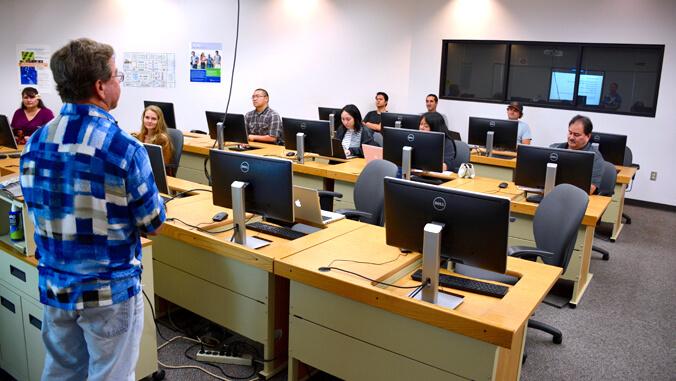
A cybersecurity instructor teaches students at the University of Hawaii Maui College. The college has received more than $660,000 to expand artificial intelligence and cybersecurity education. Photo courtesy UH Maui College
Trending
Facing a nationwide shortage of cybersecurity and artificial intelligence professionals, the University of Hawaii Maui College has secured a three-year, $441,645 National Science Foundation award to launch a new AI and cybersecurity education project.
Led by principal investigator Debasis Bhattacharya and co-investigator Thomas Blamey, the initiative is meant to build on previous NSF-funded efforts and addresses an important local need, as Hawaii currently ranks among the top five states in the nation for unmet cybersecurity workforce demand, according to the college.
“The intersection of AI, data analytics and cybersecurity is a critical frontier for modern digital defense,” said Bhattacharya, who also serves as the director of the Center for Cybersecurity Education and Research.
“With Hawaii facing such a steep challenge in meeting cybersecurity job demands, this grant enables us to build robust, early-career pipelines,” Bhattacharya continued.
The “CyberAI Innovation: AI-Enhanced Cyber Data Analytics Education” project will introduce an AI-integrated curriculum by embedding six new modules — including adversarial machine learning, AI-powered threat detection, secure AI pipelines and CyberAI ethics — across six core computer science courses at UH Maui College.
Additionally, a three-year professional development program will offer statewide faculty training across all seven UH community colleges and Hawaii Department of Education secondary schools.
To cultivate early interest, the college said it will leverage the community of practice created by the NSF Project CSP4Hawaii — a collaboration aimed at improving computer science education at the state level — to expand K-14 academic pathways.
The project also extends beyond IT, developing customized cyberAI micro-modules for non-IT fields such as healthcare and nursing, automotive technology, and accounting and finance.
UH Maui College has also secured a supplement award of $129,190 from the NSF to host two AI camps during the summers of 2027 and 2028 in conjunction with the HIDOE.
These camps will provide middle and high school students with basic AI literacy, safety, well-being, vibe coding (software development utilizing AI) experience and guidance on responsible use.
UH Maui College has been awarded $89,537 to conduct two in-person student summer camps on Oahu and an online student camp during the summer of 2027. More details on all these camps will be available at GenCyber Hawaii at maui.hawaii.edu/gencyber.
