

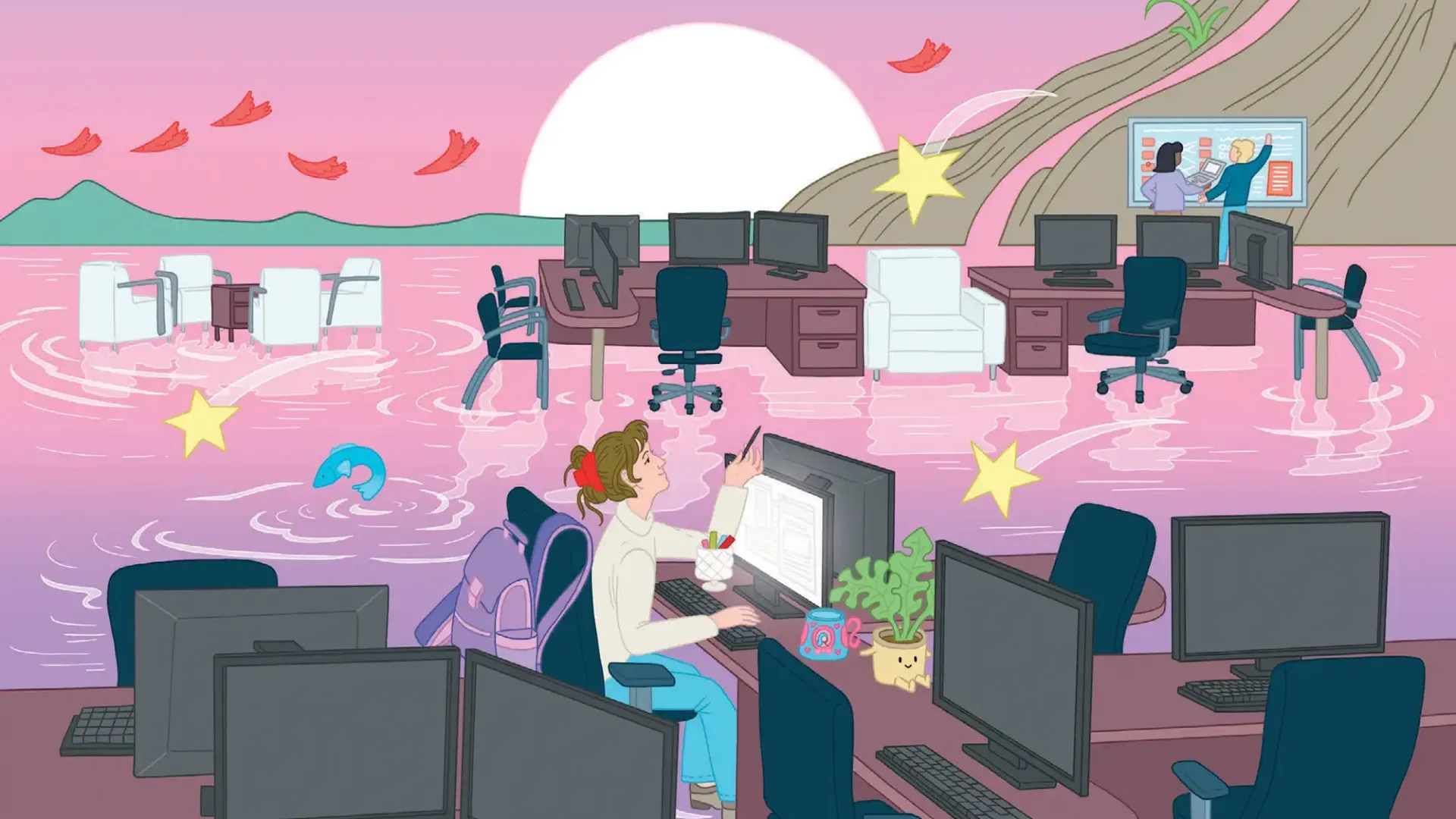
There was exactly one night in elementary school when I was allowed to stay up past my bedtime.
My dad’s consulting company had been remodeling its office building, and his team was finally ready to transition from a temporary space to its permanent workplace. This was 2016, well before the COVID-19 pandemic and the virtual work revolution, so a day spent moving between spaces “meant a day of no productivity,” my dad reminded me recently when I asked him to retell the story.
The solution? Recruiting me and two of my older brothers (all of us younger than 14) to help out with an overnight move. With my parents, we taped down Ethernet wires, plugged in hundreds of monitors and keyboards, and screwed in cord manager baskets underneath desks—all at 1 or 2 o’clock in the morning.
In the eyes of a fifth grader, it was the best night ever.
Dad taught me the power of the corporate building, for both its aesthetics and efficiency. Still, despite how much I adored the soda machine and the sleek, Silicon Valley feel of dry-erase-marker-friendly glass on every spare wall—and despite how much my childhood was orchestrated by family whiteboarding sessions—I still gravitated toward disorder and mild chaos in my personal work habits. My parents teased me for years, to no avail, about how much quicker I’d get my homework done if I sat at the kitchen counter with “noise-cancelling headphones and single-instrument music” instead of sprawled on the couch jamming to Hozier.
But who could blame me? In the age of laptops, “going into the office” is simply out of vogue. Few skills are more expected than the ability to work from anywhere. Especially since 2020, with hybrid or fully remote work now the standard model for many jobs, I’ve found it is often a boon to be able to sneak in a bit of schoolwork from lecture halls, waiting rooms, and car passenger seats.
Meanwhile, when the pandemic kept my dad home, he deliberately brought the spirit of the corporate workspace home with him. The corner of one bedroom in our house held a spotless standing desk with two 32-inch screens, a keyboard and mouse, external speakers, a small fan, and a webcam and ring light for virtual meetings—all practically identical to his office workspace. Even with the comforts of home, my dad said he “couldn’t get back fast enough” to the office once restrictions were lifted a few months later.
Remote work is a fraught topic these days, as many employers have begun reversing pandemic-era practices and calling people back to the office full-time. It’s also ances has included a five-day in-office mandate for College staff as an element of its administrative reorganization plan. The Harvard Union of Clerical and Technical Workers opposes the mandate, which it says is unnecessary and demoralizing
Still, I’m not alone in yearning for an office to go to, at least some of the time. Overall, my generation might agree. Despite people my age often clamoring for comfier spaces and more flexible schedules, a recent Gallup poll found that members of Gen Z are the least likely to select fully remote as their preferred work location compared to older generations. That’s partly because going into the office isn’t as disruptive for them as it can be for millennials or Gen Xers, who are more likely to be juggling work and family life. But I hope it’s also evidence that we’re nostalgic for a separate place where we can learn organically, connect casually, and just get things done.
I recently gained some perspective on this from the shiny new offices of The Harvard Crimson. The newspaper building on 14 Plympton Street, which we refer to as “14P,” reopened in January after a semester-long renovation, and I have spent countless hours there since. I’ve pulled more 4 a.m. nights in 14P trying to keep up with editing responsibilities (and hiding from problem sets and essays due for my classes) than I care to admit.
14P holds a special place in my heart in part because it was my first exposure to the world of journalism. The picture of a newsroom I had in my head before joining theCrimson was informed mostly by movies like Superman and All The President’s Men: fluorescent-lit desks as far as the eye could see, reporters running in and out with notebooks under their arms, and the constant clacking of keyboards and ringing of telephones.
In the ’90s, at least, this aesthetic was fairly accurate to our student newspaper. One of my editors at Harvard Magazine, who was among theCrimson’s leaders at the time, recalled the building being chaotically loud at all hours of the day and night as writers used landlines in the newsroom to gather information and pester sources. Overhearing other reporters’ processes, she told me, was invaluable to her own growth.
Laurence Holland ’09, who reported for theCrimsonas an undergraduate and became the architect who spearheaded 14P’s remodel, remembered that in the mid-2000s students still shared rows of desktop computers, and editors would swivel around in office chairs to give feedback on stories. “Your editor would roll over and basically push you off your keyboard, take over, and just redo your story, and that was such an incredible learning experience for me,” he recalled.
I love the nights when dozens of writers filter through the Crimson’s building, but days can go by with the newsroom close to empty.
It would be overdramatic to say that the culture of 14P is totally different today. Still, things have changed. I love the nights when dozens of writers filter through the building, but days can go by with the newsroom close to empty. Little booths have been installed along one wall, so most phone calls and even conversations among writers happen out of earshot. Revising is sometimes a rather silent activity, with writers and editors collaborating on a Google Doc from their separate devices. No one sits on the floor to sort through piles of documents, like the reporters do in movies like Spotlight and The Post, because there are no physical papers to sift through.
It’s reflective of a much larger shift. Cultural critics perpetually mourn the death of “third places”—environments people frequent outside of their homes and workplaces (which sociologists designate as “first” and “second” places, respectively). But we’re eagerly slashing second places, too. Even though 14P is my closest equivalent to a second place in Cambridge, the job never really requires me to be there.
During the brainstorming phase of 14P’s redesign, Holland told me, the possibility was floated to sell the building entirely. What need did student journalists still have for a physical space? But the idea was never taken very seriously, he said, in part because alumni recognize the Crimson as not just a workspace but also an educational facility and a social club. (Holland said construction workers had to scrape layers of champagne from the ceiling tiles and demolish a wall of a forgotten basement closet that had harbored decades of students’ signatures.)
When designing 14P’s upgrade, Holland leaned into theCrimson’s triple purpose. Nearly half the newsroom is now couches instead of desks. The basement, once dominated by a massive, defunct press from the days when the newspaperprinted six days a week in-house, has been cleared out to make room for a ping pong table, a TV nook, and a flexible workspace that converts to a party locale. (The current once-per-week printing has been outsourced since the pandemic.) Since we’ve moved back in, the walls of the newsroom have been further customized with cartoons and silly notes, and the occasional celebrity cardboard cut-out appears as part of a newsroom prank.
Yet something about the preternaturally tidy newsroom, and the way the building’s scrappy history has literally been stripped from its walls, led a few of my peers to express discomfort about 14P’s “sterile” and “corporate” feel.
I, on the other hand, could not have been more thrilled when I first saw theCrimson’s new newsroom. It felt every bit as sleek and productivity-minded as my dad’s office. I’ve particularly fallen in love with the wall-to-wall whiteboards installed in nearly every room. Reporters have become used to seeing them covered in story outlines and administrative task lists, usually in my handwriting.
These days, I find myself turning up at the office when my to-do list gets particularly dire.During exams this spring, I was slow to complete a final paper. Already exhausted from a week of bouncing between overcrowded libraries to study, and with only five of 25 pages completed by 3 a.m., I dragged myself out of my comfortable dorm and up a few blocks to 14P.
The first thing that happened? I was scared out of my mind by a cardboard cut-out of Australian actor Jacob Elordi, placed just inside the door. Fortunately, the building was empty and no one heard me scream.
The fluorescent lighting and corporate aesthetic kept me alert far past the sunrise, all the way until the bibliography was done.
Then, the second thing happened: I sat down with noise-cancelling headphones playing single-instrument music and wrote an essay more efficiently than I ever have before. The fluorescent lighting and corporate aesthetic kept me alert far past the sunrise, all the way until the bibliography was done. And while I’m hesitant to tally a caffeine-fueled all-nighter as a point in favor of workspaces, the experience reminded me (as I’ve learned many times before) that I truly adore what I’m capable of in the office.
That feeling recently popped up in a surprising place: The Devil Wears Prada 2. The originalDevil Wears Prada, released in 2006, largely villainized the office, depicting a toxic workspace at a magazine with an over-demanding boss played by Meryl Streep. But in the 2026 sequel, Streep’s character is redeemed. By the end of the film, her open plan workspace is depicted as gloriously functional, a team of creators joyfully mapping page layouts together in a scene that could be a stock photo come to life.
And one of Streep’s final lines, which made me tear up in the theater, is, “Boy, I love working. I really do.”
I don’t just love to work, it turns out. I love work—both the tasks themselves, and the places I go to do them.
Published in the
September-October 2026
print issue
under the headline “A Modern Love Letter to the Old-School Office,”
in the
People & Passions
section.
Read more articles by
Kate Kaufman
Related topics
Student Life
Technology
You might also like
For both American and international students, growing up is like learning a new language.
We’re All Harvard Influencers, Like It or Not
In the digital age, it’s hard to avoid playing into the mythology.
Harvard’s Productivity Trap
What happened to doing things for the sake of enjoyment?
Most popular
After a final round of layoffs, University leaders say 165 staff jobs were eliminated across the division.
All That’s Unseen charts the Harvard graduate’s uneasy journey from Appalachia to Cambridge and back.
Court finds the government’s arguments that the University continues to violate civil rights laws unpersuasive.
But it can’t replace human connection.
The 2026-2027 Ledecky and Summer Undergraduate Fellows
The play Spare Parts is a contemporary fable about the quest to live forever.
