

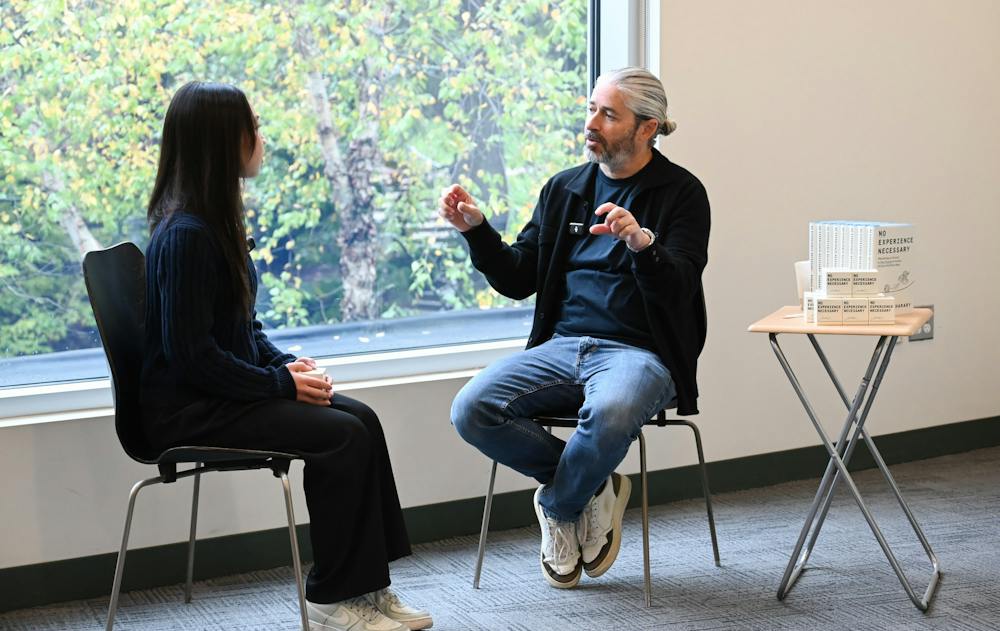
Ronnen Harary brings his entrepreneurship guidance and a pitch competition to campus.
On Oct. 16, Spin Master co-founder Ronnen Harary visited Brandeis as part of a six-week college tour for his new book, “No Experience Necessary.” The visit included a guest appearance in an entrepreneurship and rapid prototyping class, a book signing and a pitch competition run out of the tour’s Airstream trailer, where students could pitch business ideas for a chance at funding.
Despite the rain, students turned out for Harary’s speech, which was often interactive, sharing their business ideas and asking him questions. Later, students lined up enthusiastically to pitch their own ideas.
Harary is the co-founder and chairman of Spin Master, the toy and entertainment company behind “PAW Patrol,” “Bakugan” and “Air Hogs.” He started the company in 1994, when he was 23 years old and living at home with his mother. Today, Spin Master has 28 offices, more than 3,000 employees and billions of dollars in annual revenue.
“I’m a big believer in putting things out into the world, and that’s through verbalizing things,” Harary said in an Oct. 16 interview with The Justice. He wanted students to have the experience of expressing an idea and presenting it to someone who could help them move forward.
After his speech, Harary signed copies of his book, “No Experience Necessary: Why Betting on Yourself in Your Twenties Is the Best Decision You’ll Ever Make” (2026), “No Experience Necessary” is organized around 11 principles. It argues that early adulthood comes with business advantages, such as being less afraid of risk, and that young people lose those advantages if they wait. The book also tells Harary’s personal story and his journey to co-founding Spin Master.
Harary’s entrepreneurial experience began on his very own college campus. While attending the University of Western Ontario, he and his friend Anton Rabie ran a business selling posters to students.
That start helps explain why Harary sees college as the perfect place to experiment. Students have access to potential business partners, people who can offer feedback and a concentrated group of possible customers. An idea can be tested among classmates before its creator attempts to reach a wider audience. “You have a built-in marketplace,” Harary said, “with a lot of density.”
He also emphasized the opportunity to learn through trying. Starting a business while young gives students experience making decisions, responding to problems and figuring out whether an idea works in practice.
At Brandeis, the visit hosted Prof. Aldo Musacchio (BUS) and Prof Ian Roy’s (BUS) BUS 233A Entrepreneurship and Rapid Prototyping class. Debbie Bergman, executive director of Global Academic Programs, helped arrange the event after Harary’s team contacted the University about a possible stop on his book tour.
In an Oct. 15 interview with The Justice, Bergman explained that the class’s emphasis on testing ideas, learning from unsuccessful attempts and making improvements aligned with Harary’s approach to entrepreneurship. His team also provided books for students.
The pitch challenge gave students an opportunity to apply those ideas. Participants could present a concept to Harary for the chance to receive $500, with a larger $25,000 prize also part of the challenge. Students receiving funding were expected to put it toward their ideas within just seven days.
For Harary, that short timeline was deliberate. He explained that people can spend too much time developing an idea without taking the steps needed to bring it to market.
“Many people have similar ideas,” he said. What matters, as Harary explained, is how those ideas are carried out. The challenge’s deadline was intended to get students moving quickly, testing what they could accomplish with limited time and resources. “We’re trying to get people to get in the execution mode,” Harary said.
Even for students who did not receive funding, pitching offered practice explaining a concept clearly and responding to questions. Bergman hoped students would see that process as worthwhile regardless of the financial outcome. “Every idea matters, and … constructive feedback is always helpful,” she said.
Harary has encountered a range of approaches as students present their ideas across campuses. Some arrive feeling confident, while others are nervous about speaking. What has stood out to him is their investment in what they want to create. “The greatest thing is that everybody’s super passionate,” he said. “They want to bring their ideas out into the world.”
He also wanted the opportunity to reach students who might not already consider themselves entrepreneurs. Harary recounteddescribed a woman at Columbia University who happened to walk past the tour’s Airstream trailer, decided to pitch and received funding. For him, having an idea worth exploring was enough reason to join the conversation.
His approach to speaking with students similarly emphasizes participation. Harary said he likes asking questions and drawing ideas out of people, particularly those who may be more introverted.
Those exchanges also give Harary something to take away from his visits. “It’s a two-way experience,” he said after some reflection. “You get to learn from the students as much as you’re sharing with them.”
