

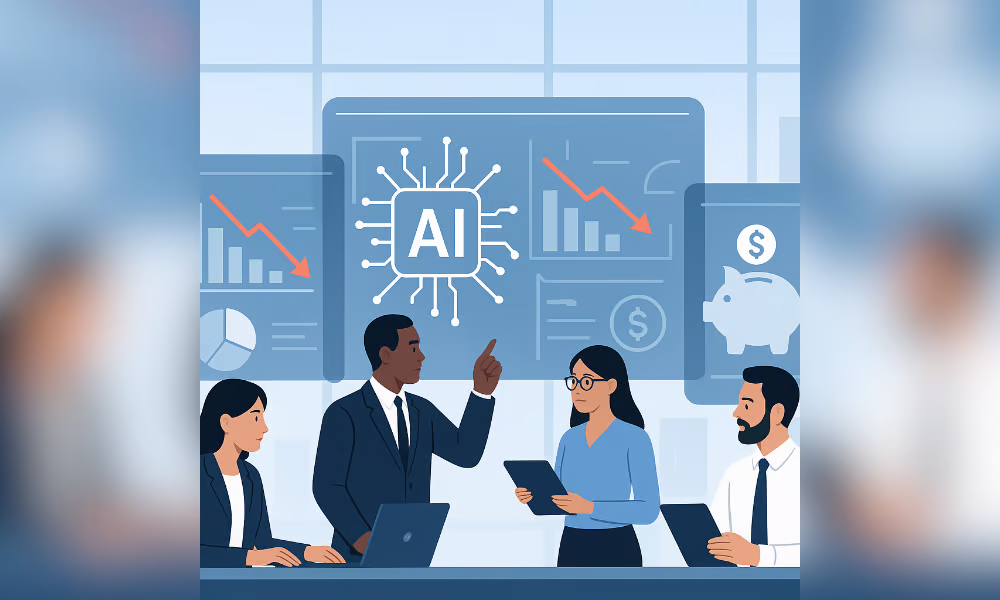
Canadian leaders must decide what AI is really for – and the answer has productivity and retention consequences
Canadian organizations are investing in AI at a pace that’s often outrunning the workforce redesign required to sustain it – and the consequences are showing up in talent trust, retention risk, and the widening gap between what leaders believe AI is delivering and what their people are experiencing.
The strategic choice between treating AI as a workforce investment versus primarily as a cost-cutting tool isn’t philosophical – it produces measurable outcomes in employer brand, talent mobility, and the institutional confidence that holds high-performing teams together, says Brent Dul, Executive Vice-President at Randstad Canada in Toronto.
“Any sort of AI transformation should be treated as an investment in human capability rather than a tool to just slide headcount,” says Dul. “If you treat AI purely as a cost-cutting measure, it’s going to alienate your talent and your workforce — and it’s going to deepen a growing workforce confidence gap.”
That gap is documented in Randstad’s 2026 Work Monitor, which surveyed more than 27,000 workers and 1,225 employers across 35 markets including Canada, and found that 98 per cent of Canadian employers are confident of growing in the next year, yet only 49 per cent of Canadian workers share that optimism. Nearly half of Canadian office workers – 46 per cent – believe AI adoption is designed mainly to benefit companies, not them.
The AI reality gap
The disconnect between organizational confidence and employee experience points to what Dul calls an AI reality gap. Globally, 62 per cent of workers acknowledge AI’s positive impact on their productivity, according to Randstad’s report. In Canada, that figure drops to 57 per cent – and among Canadian employers, only 44 per cent say AI has increased their company’s productivity, compared to 54 per cent globally. Both numbers sit noticeably below the international average, suggesting Canadian workplaces are navigating AI adoption with a trust deficit that their global peers aren’t facing to the same degree. The question of how the AI confidence gap is reshaping workforce strategy for Canadian HR leaders has become a key challenge of 2026.
Despite this, 62 per cent of Canadian talent say they feel confident using the latest technology – a figure Dul believes is encouraging, but he cautions against reading as confirmation that the upskilling work is done. “In order to build trust and secure buy-in for any sort of AI transformation, employers have to actively upskill their people and communicate that AI roadmap transparently,” he says. “Organizations that are doing it well are getting the buy-in and upskilling their talent at the same time as they’re implementing.”
The real price of AI-led headcount cuts
The instinct to use AI primarily as a mechanism to reduce headcount is both short-sighted and financially counterproductive, and the math rarely favours the shortcut
“Cost efficiency is always going to be something that’s important for organizations, whether it’s driven through AI or any other initiatives, but using AI strictly as a headcount cutter is very short-sighted and, I think, financially counterproductive,” he says. “You’re going to see the short-term payroll cuts, but they’re going to be quickly erased by the immense cost of recruitment and losing institutional knowledge, and to a degree you’d see your productivity plummet.”
Dul also says he believes significant staff cuts in favour of AI can create an environment of uncertainty that would push remaining talent to look elsewhere.
The data on retention challenges for organizations adds context to why that risk is particularly acute. Work-life balance is the primary reason Canadian workers stay in their current role – cited by 43 per cent – outranking pay and benefits (26 per cent) and job security (25 per cent). When AI adoption signals instability rather than investment, it strikes directly at the conditions that keep people in place, says Dul. And when employers rehire workers following AI-led workforce reductions, the recovery process is slow and costly.
What redesigning work around AI actually looks like
The distinction Dul draws between adopting AI and genuinely redesigning work around it comes down to whether organizations are investing in their people in parallel with their technology. Two-thirds (65 per cent) of talent globally want to see more investment in AI skills development from their employers, according to the Randstad report. In Canada, two-thirds of executives say they’re moving towards a fully integrated AI-human workforce, according to a KPMG survey released in May 2026.
“The key is doing it hand-in-hand with upskilling – when organizations do that well, they become a market leader,” says Dul. “It doesn’t require massive overhead – it requires a structured, transparent learning path that allows employees to grow alongside the technology, which is going to get your return on investment.”
He points to a manufacturing example that illustrates the payoff. A maintenance team was paired with an AI copilot capable of predictive equipment analysis, turning mechanical technicians into data-literate maintenance experts who could anticipate breakdowns before they occurred, rather than reacting after the fact.
“They didn’t cut their maintenance techs, they just augmented them – and improved productivity in the process,” he says.
The employer brand implications of getting this wrong are lasting, says Dul. “Top companies don’t dominate the market and they aren’t attractive employers because they have state-of-the-art technology,” he says. “They dominate because they pair their technology implementation with the perception of offering strong job security, competitive compensation, and career growth – and if an organization becomes known for using technology systematically just to replace people, their employer brand is going to downgrade, which is going to drive away talent.”
The HR-operations equation
As far as where the accountability for getting this balance right actually sits, it’s not with HR alone, says Dul.
“I don’t know if it’s always HR-led, I think it’s HR in partnership with the operational leaders, and that’s key,” he says. “You have to be able to show a return on your investment, whether you’re investing in technology, productivity, or people.”
An HR engagement strategy that fails to connect with the frontline reality managed by operational leaders will fall flat, according to Dul – and the reverse is equally true. The organizations getting this right are those where the two functions are genuinely interconnected. Understanding how the most effective Canadian HR strategies are pairing AI adoption with people investment begins with precisely that partnership.
“Organizations that have a strong partnership between the two departments and are well interconnected are the ones on the forefront of getting that balance right,” Dul says. “It’s never going to be perfect, but a good day is going to make me want to come back tomorrow. A bad day, if I don’t have good support behind me, might be that trigger that accelerates my exit.”
In Canada’s current labour market, AI deployment without workforce redesign isn’t a technology risk – it’s a people risk, and one that will show up in turnover data well before it appears in a productivity report.
“If leaders approach AI as purely a cost-efficiency tool, they risk triggering widespread anxiety or disengagement,” says Dul. “So your AI strategy has to focus on task augmentation and freeing employees up for strategic higher-value work, so workers can see AI as an enhancer, not a replacement.”
