

Front page
InterviewCX AI3h · 15:01 BST · 5 min read
How Customer Simulations Turn Research Into Valuable Insight
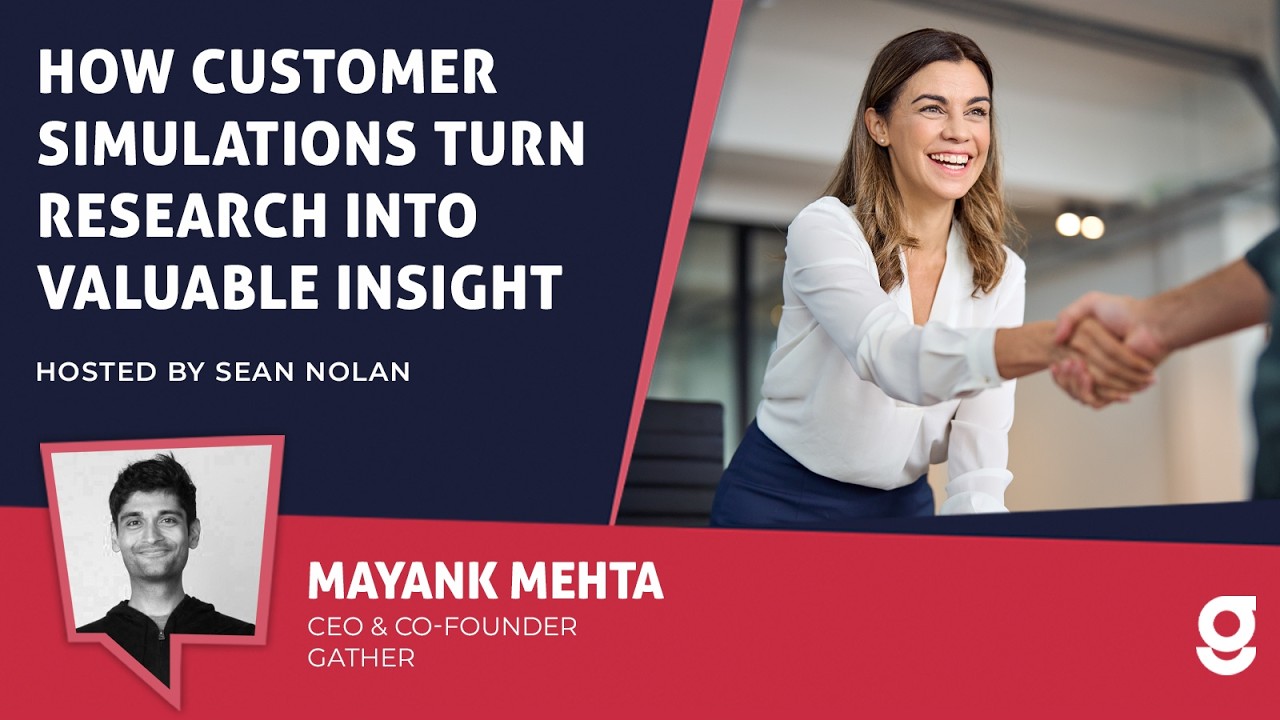
Customer insight has long been limited by traditional research methods, leaving teams to make decisions with an incomplete picture of their buyers. Gather CEO & Co-Founder Mayank Mehta discusses whether AI simulations can make that insight more immediate, without losing the human perspective.
Most marketing teams understand the value of customer research. The problem is that it often arrives too late, or too complicated, to shape the decision it was commissioned to inform.
Mayank Mehta, CEO & Co-Founder of Gather, told CX Today that AI-led customer simulations could offer a different model. Rather than replacing real customer research, the aim is to make customer understanding more continuous, allowing teams to test ideas and sense-check decisions before they go to market.
Can AI Simulations Create a More Usable Customer View?
The promise of customer simulation is not simply that an AI model can generate an answer on demand. Mehta says the model needs to be grounded in research with the people a business is trying to understand, including current customers, former customers, prospects who chose competitors, and people unfamiliar with the brand.
Those inputs can be used to identify common attitudes, motivations, and objections across an ideal customer profile. Teams can then ask simulated versions of those personas how they might respond to a message, price point, or positioning change.
“We’re building a living, breathing understanding of your customer and essentially trying to replicate your ICP, or ideal customer profile, brain.”
That is an ambitious proposition, and one that should be treated with appropriate caution. A simulation cannot perfectly reproduce an individual customer, nor can it eliminate the need for direct conversations with people. But it may offer a practical middle ground between relying on intuition and commissioning a full research project for every decision.
The question for marketing leaders is therefore not whether AI can replace the customer. It is whether it can help the customer’s perspective appear earlier and more often in everyday decision-making.
Why Is Traditional Research Struggling to Keep Up?
Research has always required trade-offs between depth, cost, speed, and sample size. Mehta argues that the traditional workflow has become increasingly difficult to justify when customer preferences and market conditions evolve rapidly.
Teams may need to align multiple stakeholders, appoint an agency, conduct field research, analyze spreadsheets, and translate the findings into a recommendation. The work can be rigorous and valuable, but it is rarely lightweight. He highlights:
“The simplest of projects we’ve seen enterprises take anywhere from four weeks, if you’re lucky, to upward of 12 weeks by the time you actually get to the answers.”
That delay can create a wider problem. Marketing, research, and data teams become bottlenecks, while campaign teams continue moving forward without the clarity they were seeking.
Mehta’s view is that AI can remove some of that administrative burden, helping marketers focus on storytelling, brand work, and strategic decisions rather than extracting insights from raw files. The goal is not to make research less rigorous, but to make it easier to access when a decision is being made.
Where Could Simulations Add the Most Value?
One use case is in complex B2B buying journeys, where the eventual decision may involve technical leaders, business champions, procurement teams, and finance stakeholders with different concerns.
Rather than treating the buyer as a single persona, teams can explore how different roles might respond to a new proposition, product claim, or AI-related concern. That could help shape the questions a sales team prepares for, the objections a campaign addresses, or the proof points a piece of content needs to include.
There is also a more immediate application: testing work before it goes live. Mehta sees simulations becoming part of the go-to-market process, giving marketers a way to assess ads, emails, content, and positioning before they have used up attention with customers and prospects.
“You can test it with how your ICPs would react and then actually not put something out that’s going to underperform.”
This is particularly relevant when the cost of getting the message wrong is high. A major campaign, product launch, or seasonal promotion can require months of planning. If it misses the customer’s priorities once it reaches the market, teams may have limited ability to correct course quickly.
For B2C brands, Mehta also points to market shifts that may not show up in revenue data until it is too late. Businesses need earlier signs of changing habits, emerging concerns, and new expectations, whether those affect messaging, menus, prices, or product development.
What Still Needs a Human View?
Faster insight only matters if people trust its foundations. Mehta’s previous experience building up Gartner Peer Insights has shaped his thinking on that point.
He argues that research tools need to be transparent about the evidence behind their findings and clear about where confidence is high or where a question requires fresh input from real people. He emphasizes:
“Real insights from real people matters a lot.”
That principle is important for customer simulations. A generated answer can be useful as a prompt for better thinking, but it should not become an excuse to stop listening to customers directly. Teams still need to validate consequential decisions, maintain strong research practices, and watch for the blind spots that appear when models are built on incomplete or outdated inputs.
The more useful role for AI may be helping businesses decide what to investigate next, making research more frequent and targeted rather than treating it as an occasional, standalone project.
The Bigger Picture
Mehta expects AI to shift marketing from reacting to market changes toward spotting and preparing for them earlier. Yet he believes the central advantage will remain the same: organizations that stay closest to their customers will be best placed to win.
“Marketers are going to move away from being reactive into being predictive.”
As teams face tighter budgets and pressure to do more, customer simulations may become one way to bring the voice of the customer into more of the GTM process.
The future-facing opportunity is not to automate away customer understanding, but to make it fast enough to influence the choices that shape the customer experience.
Find more insight on customer experience & AI here.
rate this storyhelps rank stories across CX Today
Read nextordered by techtelligence · every pick explained
same beat · CX AI
Why Resolution Is No Longer Enough for Customer Experience Leaders
4hmatches this topic3 Consumer Expectations Defining AI in CX This Week13 Oct 2026matches this topicHow Consumer Attitudes to AI Are Reshaping Contact Centers8 Oct 2026
More from the CX AI desk

Pasquale DeMaio, Vice President at Amazon Connect, explains why mediocre service quietly erodes loyalty, how AI can reveal what customers really experience, and why customer experience leaders must move beyond deflection to build more connected journeys.
Rob Wilkinson · 4hSponsored · Diabolocom
Is Contact Center AI for Augmentation Missing the Opportunity?
89% of contact center leaders expect humans to remain central to customer support. So why are employee training and workforce readiness consistently ranked as the lowest priorities in AI <a href="https://bitcomme.com/senator-bill-cassidy-discusses-proposed-1-5t-social-security-investment-fund/” title=”Senator Bill Cassidy discusses proposed $1.5T Social Security investment fund”>investment decisions? The gap between stated intention and operational reality is striking.
Rhys Fisher · 13 Oct 2026News
3 Consumer Expectations Defining AI in CX This Week
AI is raising customer expectations faster than many CX teams can meet them. New research from Zingtree, NTT DATA and Alchemer shows consumers want speed and convenience, but still expect control, context, and a clear path to human support for complex moments.
