

In late 2021, things were not looking good for Agragene. The startup behind a new gene-editing technique that produces sterile flies as a form of chemical-free insect control had promising technology but was struggling to hit important milestones.
But Agragene’s investors didn’t want to give up. As Bryan Witherbee, the company’s current president and CEO, tells it, Carl Casale, who’d previously been the CFO of Monsanto, went looking for someone who could evaluate the young company’s technology and diagnose what was holding it back. (Casale was an early main investor in the company).
Keep up with local business news and trends
We will never send spam or annoying emails. Unsubscribe anytime.
This site is protected by reCAPTCHA and the Google Privacy Policy and Terms of Service apply.
Witherbee answered that call and remembers traveling to San Diego where Agragene had been based.
“I saw the technology, saw the science, and really fell in love with it,” he says.
Witherbee saw how Agragene’s idea of using CRISPR gene editing chemistry could yield a cheaper way to make many more sterile files. “It was a modern version of sterile insect technique and got around some of the complexity that had always [come] with [that], which is only governments could really do it because of the scale and the costs,” he says.
Armed with funding to cover a couple more months of operations, Witherbee says the company’s head of research was charged with reaching a proof of concept, while Witherbee explored the logistics of a move to the Midwest. The idea was both a way to save money and a way to connect to interested funders.
“They hit the milestones. We moved it here to St. Louis,” Witherbee says. “We got some funding from BioGenerator, also Ospraie Ag Science came back in with more money, and since then we’ve been here.”
The move proved pivotal.
Some four years later, Casale is Agragene’s board chair, and the St. Louis-based company is nearing the launch of its first commercial product next year, which targets Drosophila suzukii, more commonly called the spotted wing drosophila—a nasty little bug that wreaks havoc on blueberries, blackberries, raspberries, cherries, and other fruit with soft flesh.
It’s the top global pest for these kinds of fruit, Witherbee explains: The flies lay their eggs in the fruit, and the maggots that eventually hatch eat and destroy its flesh. Right now, farmers primarily combat spotted wing drosophila by spraying ever more insecticides and pesticides, he adds.
“The growers don’t have enough tools. The opportunity [is] that this tool could be something that decreases their dependence on chemicals,” he says. “It’s something that’s effective against the spotted wing drosophila that should help them increase their yield and hopefully increase the profitability of their farm.”
A modern take on a decades’ old approach
Using sterile male insects as a means to control insect pests dates back decades. It was successfully used in the 1960s in the U.S. to eradicate New World screwworm, a parasitic fly whose larvae feed on warm-blooded animals’ live tissue (there have been recent new detections of the flies in the country this year, though those cases are now falling).
It works because the sterile males, when released into the wild, can still mate with females and complete the reproductive cycle, says Agragene’s director of research and development Stephanie Gamez. But since the sterile males have no sperm, any eggs from females they mate with don’t grow into new flies.
In the past, sterile males were primarily created by exposing flies to a dose of radiation high enough to knock out the sex organs. But Gamez explains Agragene has figured out how to do away with that process and instead use CRISPR gene editing chemistry.
The company actually makes use of the mating process to reliably grow only sterile male flies. Gamez explains they’ve managed to develop female flies with the Cas9 protein (the molecular scissors) and male flies with guide RNA.
“The guide RNA are these molecules that pretty much act as a postal code, so they help find the genes of interest,” she says. “And we’re targeting the genes important for male sterility and female lethality.”
When the two sexes of edited flies come together and mate, they create eggs that will either grow into sterile males or die, Gamez explains.
“It’s really powerful technology. The edit happens in the egg,” she says. “When a female lays an egg, she fertilizes it with the guide RNA male sperm. The moment when the egg and sperm come together, that’s where the magic happens.”
Agragene’s small insectary in Maryland Heights has a few rooms, one for the edited males, including one for the edited females, and one where they come together. They’re kept in takeout containers adapted with mesh on the top where a brown gelatinous diet of water, sugar, and protein sits for the flies to feed on.
This mixture is also where the females will lay their eggs after mating, Gamez says. Once there are enough eggs on a given piece, it’s placed into a box that can be shipped to a grower, who then only has to pop the perforated holes on it to let the sterile flies out in their fields, she adds.
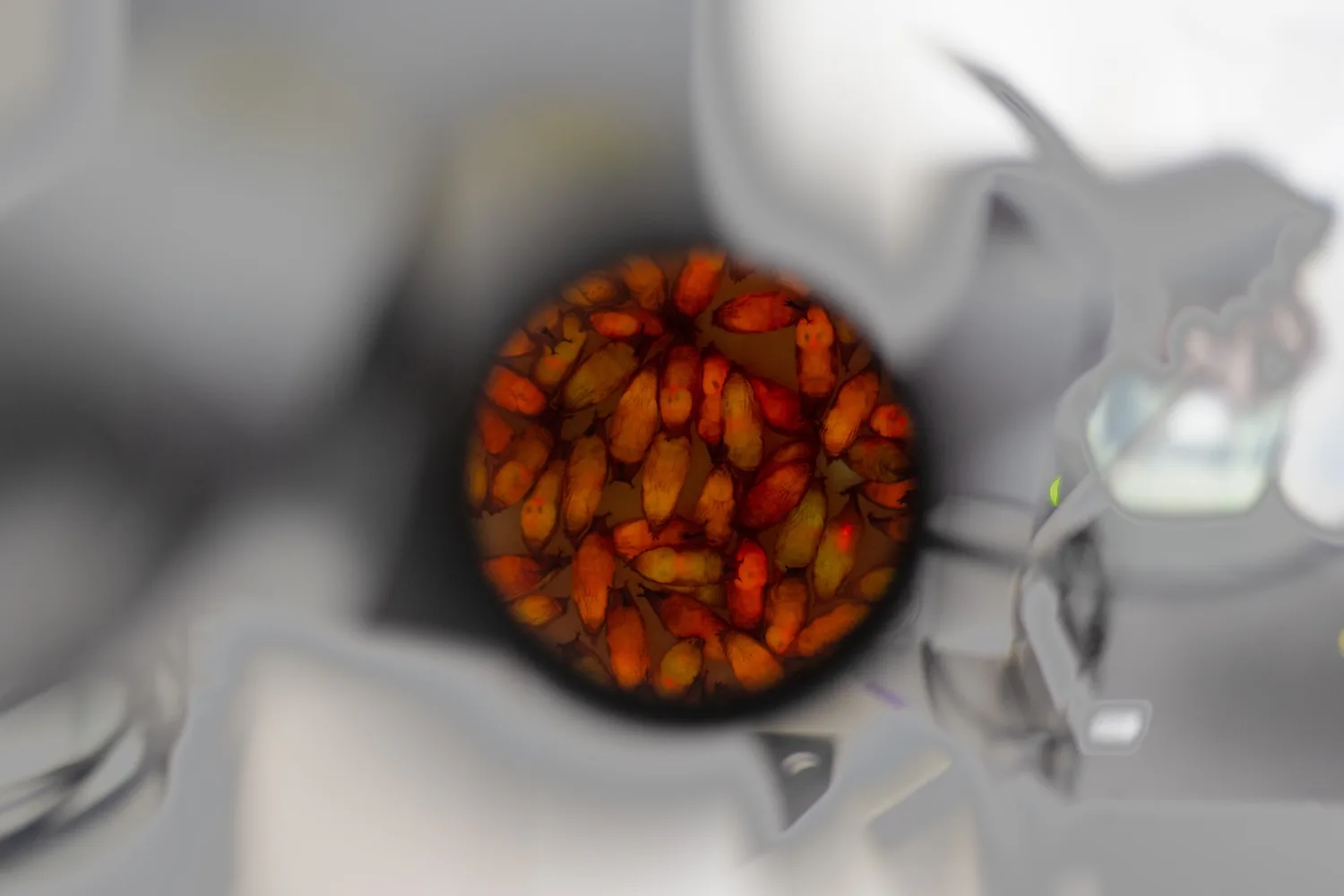
Agragene also must continually replenish the parent flies with the right gene editing chemistry, and has found an effective way to distinguish males and females. Gamez explains they’ve included genetic markers in the guide RNA males and Cas9 females that have them glow red and green, respectively, under a microscope.
Then, when the flies are immobile pupae, they’ll travel across a small conveyer belt where a camera snaps a picture and a computer will use a proprietary machine learning program that looks for the luminescence and then sorts the flies by sex.
“If it’s a male, it’s going to puff to the left. If it’s a female, it’s going to puff to the right,” says Anirudh Eswar, Agragene’s customer operations director. “That’s how we’re automatically sex sorting our gene-edited lines.”
It’s what allows the company to sort thousands of flies in a few hours, when the same process would take a human a whole day of work
St. Louis’ pivotal role in propelling the company
Moving from San Diego to St. Louis proved essential for Agragene’s success, but Gamez says it was initially daunting.
“After I got proof of concept in San Diego, they pretty much asked me if I wanted to come join the company and restart [it] in St. Louis,” she says. “I was scared. Even if you get proof of concept, what if it doesn’t scale in St. Louis? What if something else is wrong with the technology and you’re stuck? That was a very big risk.”
But she couldn’t pass up the chance to use what she learned in graduate school and apply it into the agricultural world, however risky the opportunity.
“If it fails, it fails,” she says. “But at least I get to learn something different along the way.”
Gamez admits the initial relocation was challenging. She had no personal ties to St. Louis, other than some of her husband’s extended family, and he didn’t join her for a few months as he finished his own PhD in California.
“I was here by myself with the cats,” she says. “That was hard.”
But she wasn’t alone that long. Gamez’ mother, Lupe, now works for Agragene as an associate scientist. Gamez says her mom had helped grow mosquitos for some of her research in grad school.
“I thought it would be a really good idea to see if she can help grow these insects because it looks easy, but it’s not,” she says. “It’s been lovely having a familiar face from California be here and actually talk science and work on something that I’m also very passionate about.”
And the St. Louis plant science and agricultural community welcomed her with open arms.
“I really like how St. Louis really invests in the science community by doing all these programs and speaking engagements and the networking events,” she says. “It’s a small community, but it’s such a powerful one. In San Diego, we had none of that. Everybody was just so focused on their companies, and also there wasn’t a lot of agtech, so it made it harder to build a community.”
Another benefit of St. Louis is that money goes further here compared to the coasts. Witherbee estimates the company was able to cut what it was spending by two-thirds, even while retaining the same people and an operating space that was just slightly smaller.
Agragene landed first at the Helix Center on the 39 North Agtech Innovation District campus, before graduating to the Maryland Heights space it’s in now. The region’s affordability offered more time to fully work through the challenges that come with bringing a new piece of agricultural technology to the market.
“We’ve had proof of concept since 2022, but we’ve spent the last four years just doing trials and tests and proving it,” Witherbee says. “Putting that data package together so that there’s a good [amount] to dig through and understand.”
Witherbee says Agragene has been proactive in demonstrating how its technology is safe and effective to state and federal regulatory agencies, including the USDA and EPA, which primarily want to see that the sterile males compete with their wild counterparts and that the technique targets an invasive insect and won’t threaten the ecosystem if its population is eradicated or significantly curbed.
He says the company is poised to clear the regulatory hurdle in the first quarter of next year, and, in preparation for that moment, is now talking with fruit brands and their growers to add acres of fields to further test the product.
“Ensuring that the fields are there, that the growers are going to work with us, that we’ve got folks that are going to go out in the field and release the insects, that we’re going to be able to monitor what’s happening out in the field over time, et cetera,” Witherbee says.
And should their gene-edited solution prove effective in curbing populations of the spotted wing drosophila, that’s not the end: Witherbee expects Agragene will apply the technology to other insect pests in the near future.
