

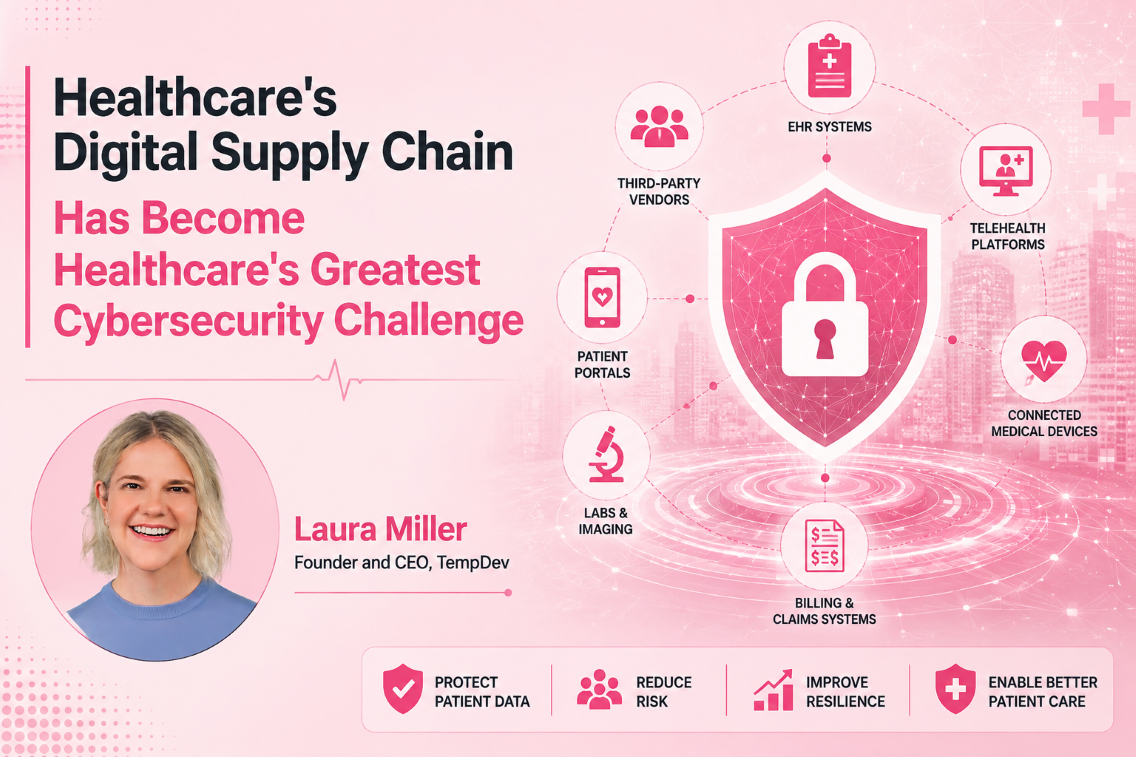
Healthcare has never been more connected. Electronic health records (EHRs), patient portals, telehealth platforms, AI-powered documentation tools, connected medical devices, and third-party billing systems have all transformed how care is delivered. These technologies have created a more seamless experience for providers and patients while improving efficiency across nearly every aspect of healthcare operations. The industry’s continued investment reflects that momentum, with the U.S. healthcare cybersecurity market projected to reach nearly $17.6 billion by 2030 as organizations work to protect increasingly complex digital environments.
While growth is exciting, healthcare becoming more connected means that cybersecurity threats have evolved just as quickly. One of the clearest examples came in 2024 during the Change Healthcare cyberattack, which disrupted claims processing, pharmacy operations, and provider payments across the country. This affected organizations that had no direct relationship with Change Healthcare but relied on vendors and systems that did.
In this environment, healthcare organizations are only as secure as their weakest link. For healthcare executives, operations leaders, and IT teams, that means continuously evaluating every technology, workflow, and vendor relationship that supports patient care.
Every Vendor Relationship Is a Security Relationship
Through experience helping healthcare organizations implement and optimize new systems, one challenge stands out consistently: organizations have far less visibility into external connections than they do their own infrastructure.
While outpatient practices may carefully manage their internal networks, patient information routinely flows between third-party vendors that support everyday operations. This includes organizations that provide claims processing and billing services, patient communication tools and laboratory and imaging services. Each partner plays a critical role in the delivery of care while also creating another connection that organizations must understand and secure.
An estimated 80% of patient records originate from third-party vendors, making healthcare organizations increasingly dependent on systems they do not directly control. Every connection introduces another point where security depends just as much on someone else’s practices as it does its own.
This complexity has only accelerated as healthcare organizations prioritize interoperability and digital transformation. In 2026, patients expect to schedule appointments online, review their test results from their phones, and complete digital intake forms before ever pulling into the parking lot.
These innovations have improved accessibility, convenience, and operational efficiency. However, it has also created a significantly larger attack surface than healthcare organizations managed even a few years ago.
For healthcare companies, the consequences extend far beyond stolen data. When cyberattacks disrupt operations, appointments are delayed, staff lose access to critical clinical information, revenue cycle processes slow, and communication between providers becomes fragmented.
Beyond operational disruption, cybersecurity incidents can erode one of healthcare’s most valuable assets: patient trust. When individuals question whether their personal health information is secure, it can undermine confidence in the organization long after systems have been restored.
Cybersecurity Must Be Part of Operational Strategy
This shift from securing individual systems to managing an interconnected digital ecosystem requires healthcare leaders to rethink how they define organizational risk.
Fortunately, strengthening cybersecurity does not require reinventing existing technology strategies. It requires approaching cybersecurity with the same discipline organizations already apply to compliance and operational performance.
When you’ve spent more than two decades helping healthcare organizations implement and protect technology systems, you see firsthand that every vendor relationship represents an operational dependency deserving oversight.
Security assessments should not end once a contract is signed. Organizations should continuously evaluate how their vendors manage data protection, incident response, business continuity planning, and evolving cybersecurity risks throughout the relationship. Ask questions that relate back to those topics throughout the partnership. If you don’t spend time preparing for failure, you’re failing to prepare.
Visibility is equally important. Most organizations have a limited understanding of how data moves between systems or exactly which third parties have access to sensitive patient information. Mapping those relationships provides a far clearer picture of where vulnerabilities may exist before an incident occurs, allowing organizations to prioritize mitigation efforts before small weaknesses become enterprise-wide problems.
Finally, organizations can’t ignore the fundamentals of cybersecurity. Successful attacks often begin with relatively simple tactics such as phishing emails or compromised user credentials. Implementing multi-factor authentication, investing in employee security awareness training, and reinforcing basic cyber hygiene remain among the most effective ways to proactively reduce preventable risk, regardless of what industry you operate under.
Security Should Enable Care, Not Slow It Down
While it is easy to pursue increasingly restrictive security controls, healthcare organizations must remember that cybersecurity exists to support the business, not restrict it.
Healthcare organizations operate in environments where clinicians, administrative staff, and patients depend on technology to deliver timely care. Security measures that get in the way of employees completing critical workflows can create new operational challenges.
The goal is not to build the most locked-down environment possible. It is to thoughtfully balance risk reduction with business continuity so organizations remain both secure and operational when challenges arise.
Build Cybersecurity Into Every Technology Investment
That same balanced approach should guide future technology investments.
Healthcare leaders should evaluate not only functionality and ROI, but also long-term cybersecurity implications. Security cannot become an afterthought addressed after implementation.
Organizations should also avoid overlooking their legacy infrastructure. With approximately 60% of healthcare organizations still relying on legacy technologies, essential workflows continue to depend on outdated protocols and security standards that no longer meet today’s expectations. Regularly reviewing how these systems interact with newer platforms can uncover unnecessary exposure.
Resilience Is the New Standard
No healthcare organization can eliminate cybersecurity risk entirely, it’s just not possible. Even organizations with the most sophisticated security programs may eventually experience an incident.
What ultimately determines the long-term impact is not whether an attack occurs, but how effectively the organization responds. On average, healthcare organizations take 279 days to identify and contain a data breach, compared with a global average of 241 days across other industries.
Comprehensive disaster recovery planning, clearly defined incident response procedures, and regular tabletop exercises can help organizations recover quickly while maintaining continuity of care during an incident.
