

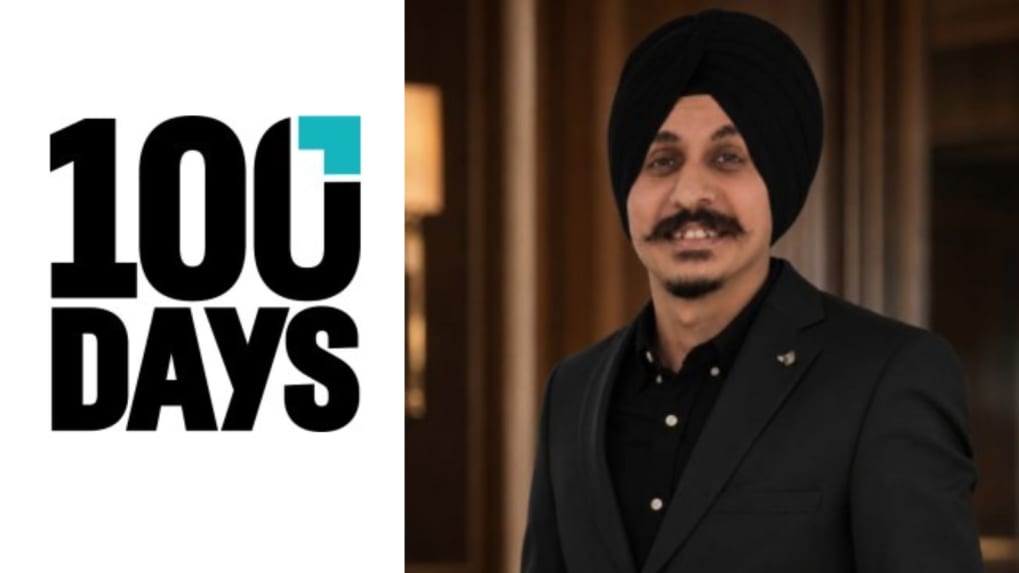
Maninder Singh, Co-Founder and Head of Business at 100Days.co
For years, consumer brands have approached digital commerce like an extension of traditional retail.
First came brand websites. Then came marketplaces. Then came the scramble for Amazon and Flipkart. Today, it’s quick commerce.
The challenge Co-Founder and Head of Business at 100Days.co, is that the rules keep changing while large organisations often remain built for a different era
“Digital commerce has changed three times in the last 10 to 12 years,” Singh tells Storyboard18. “Traditional retail still largely follows the same structure of distributors, regional distributors and sales teams. Digital doesn’t work that way.”
That changing landscape forms the backdrop to 100Days.co’s recent partnership with Colgate-Palmolive India, where the company will manage Palmolive’s e-commerce and D2C operations, content, CRM and customer journey functions.
The scale behind the pitch is significant. Singh says 100Days.co’s network fulfils around 60,000 orders a day across its own brands and partner businesses, while teams run close to 100 experiments every week across campaigns, product pages, websites and commerce advertising.
But Singh insists the firm’s role goes beyond agency work.
“We are not an agency. We become part of the team,” he says. “The leadership often doesn’t know where the client’s team ends and where our team begins.”
A decade ago, brands were fighting for shelf space. Today, they’re fighting for screen space.
According to Singh, brands now have just two seconds to grab a consumer’s attention.
“Earlier, marketers spoke about multiple exposures before a consumer would consider a brand. Today, you have about two seconds to stop that thumb from scrolling,” he says.
That shift has fundamentally changed the role of content in commerce.
Whether a customer eventually buys on Amazon, quick commerce or a brand-owned website, the journey increasingly starts with content.
“Content has become king,” Singh says. “The ability to communicate your message quickly and effectively has become the biggest differentiator.”
Unlike traditional consulting firms, 100Days.co comes with a built-in advantage. Its parent company, Bombay Shaving Company, operates consumer brands of its own.
That means the business isn’t advising partners based solely on theory. It is applying lessons learned from running commerce operations every day.
The company currently works across nearly 20 partner brands spanning beauty, fashion, food and beverages, wellness and personal care. Running almost 100 experiments each week allows it to build a constantly evolving repository of consumer insights.
“The ability to build a high-converting website or optimise a campaign improves when you’re learning across multiple businesses simultaneously,” Singh says.
For large corporations, replicating that level of experimentation internally can be difficult.
“What we bring is speed and execution,” he adds. “Without disrupting what’s already working.”
D2C isn’t dead. It just has a new role
While quick commerce has become the fastest-growing channel in digital retail, Singh believes reports of D2C’s decline are greatly exaggerated.
In fact, he argues that many brands still underestimate its strategic value.
A brand-owned website provides something marketplaces cannot: direct access to customer data.
Brands can understand where customers are coming from, what products they buy together, which offers work and which messages drive conversions.
“It’s a myth that D2C can’t be profitable,” Singh says. “For Bombay Shaving Company, it’s one of the biggest online channels. For many of our partners, it’s profitable too.”
More importantly, D2C serves as a testing ground where brands can launch products faster, experiment with pricing and gather insights without depending on third-party platforms.
The end of pantry loading?
Consumer shopping behaviour is also evolving rapidly.
According to data observed by 100Days.co, the average quick-commerce shopper now purchases products 3.5 to 4 times a month.
That signals a move away from traditional stock-up behaviour.
Consumers are no longer planning weekly or monthly purchases in the way previous generations did. Instead, they’re buying as needs arise.
Yet Singh does not view this as a battle between channels.
Quick commerce, e-commerce, D2C and traditional retail all continue to serve different consumer needs.
“The future isn’t one channel replacing another,” he says. “Every channel will continue to play its role based on the consumer’s use case.”
What happens to the big TV campaign?
If Singh could predict one major shift in the next three to five years, it would be the way brands deploy marketing budgets.
With creators building brands, influencers doubling up as media channels and social platforms becoming commerce destinations, he expects traditional advertising models to face increasing pressure.
“You don’t necessarily need a large TV budget today to build a brand,” he says.
The implication is significant.
For decades, television was the primary vehicle for scale. Today, a creator with a smartphone and a loyal audience can launch a product, acquire customers and build a business.
That doesn’t mean television disappears.
But it does mean brands may begin reallocating budgets toward channels that offer faster feedback, measurable outcomes and direct consumer engagement.
For Singh, that’s the broader lesson behind digital commerce.
<a href="https://www.google.com/preferences/source?q=storyboard18.com” rel=”nofollow noopener” target=”_blank”>Follow Storyboard18 on Google for the latest and breaking brand marketing and industry updates, along with in-depth coverage of digital news. Stay informed with the latest perspectives only on Storyboard18.
Tags
First Published on August 26, 2026, 08:17:08 IST
