

Financial services is another natural early adopter because advertisers typically have extensive customer data and clearly measurable conversion events.
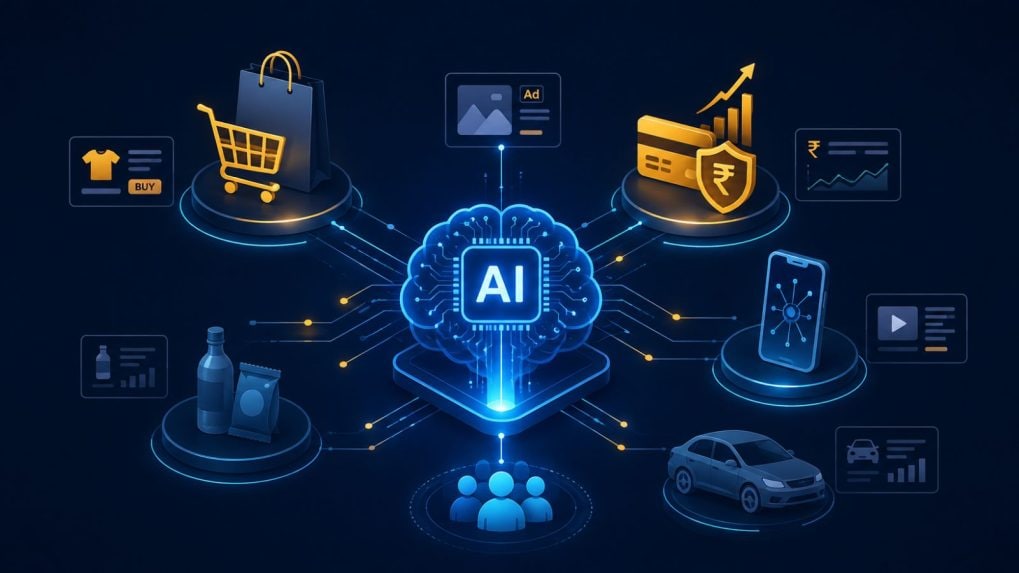
Ecommerce, retail, BFSI, fintech and consumer technology companies are emerging as the fastest adopters of AI-led advertising in India, with brands that combine large digital customer bases, first-party data and measurable transactions moving ahead of more traditional advertisers.
Akshay Mathur, Founder and CEO of Unpromptd, said the fastest adoption is happening in sectors where marketers can connect advertising exposure closely with a transaction or other measurable business outcome.
That puts ecommerce and retail, BFSI and fintech, and consumer internet and technology companies at the front of the adoption curve.
Large FMCG and consumer brands are also increasing their use of AI, particularly across creative adaptation, commerce media and personalisation, while automobile companies are deploying it more aggressively for lead generation and performance marketing.
Rajiv Dingra, Founder and CEO of ReBid, said the larger shift in advertising is that AI adoption is no longer confined to direct spending on AI software.
He estimates that while only around 10-15% of a large advertiser’s digital budget is directly spent on AI tools, platforms and AI-specific capabilities, nearly 40-50% of digital advertising expenditure is already influenced by AI through targeting, bidding, personalisation, dynamic creative and campaign optimisation.
Mathur puts the proportion at around 40-60% for large, digitally mature advertisers.
The distinction is particularly important for sectors such as ecommerce and BFSI, where advertisers have large volumes of customer data and can connect media exposure with a measurable conversion almost immediately.
Digitally native ecommerce companies are therefore often able to move faster than larger but more traditional advertisers because algorithms can learn continuously from transactions, product views, cart additions and other behavioural signals.
Retail is particularly well placed for AI-led advertising because commerce platforms generate large volumes of behavioural, transaction and product-level data.
Mathur cited EY estimates that generative AI could improve productivity in India’s retail sector by 35-37% by 2030, including through data-driven pricing, promotions and customer experiences.
EY estimates cited by Mathur suggest generative AI could improve productivity by 34-40% across parts of India’s financial-services sector by 2030, with adoption already expanding across customer engagement, business intelligence and workflow automation.
For marketers in the category, AI can also be used for audience identification, campaign optimisation and conversion-focused media buying.
FMCG advertisers are moving differently.
Rather than being led primarily by direct-response advertising, adoption in the category is being driven by creative adaptation, commerce media, personalisation and the growing availability of retail and transaction data.
Auto is also moving further into AI-led advertising as lead generation, performance marketing and customer-intent signals become more measurable.
The broader divide, however, may increasingly be determined by a company’s data infrastructure rather than simply its sector.
A digitally native ecommerce player can often connect an ad impression to a transaction almost immediately. A traditional advertiser with weaker first-party data or limited visibility into the final sale may have a much slower feedback loop.
That makes the real dividing line less about whether a brand belongs to ecommerce, BFSI, FMCG or auto, and more about whether it operates like a data-rich, always-on performance advertiser.
As retail media, first-party data and closed-loop measurement expand, that gap could narrow. For now, ecommerce, BFSI, fintech and consumer internet companies remain the best positioned to turn AI from an experimental marketing tool into the infrastructure running everyday advertising decisions.
Follow Storyboard18 on Google for the latest and breaking advertising news and industry updates, along with in-depth coverage of digital media and agency news. Stay informed with the latest perspectives only on Storyboard18.
Tags
First Published on August 20, 2026, 08:44:50 IST
