

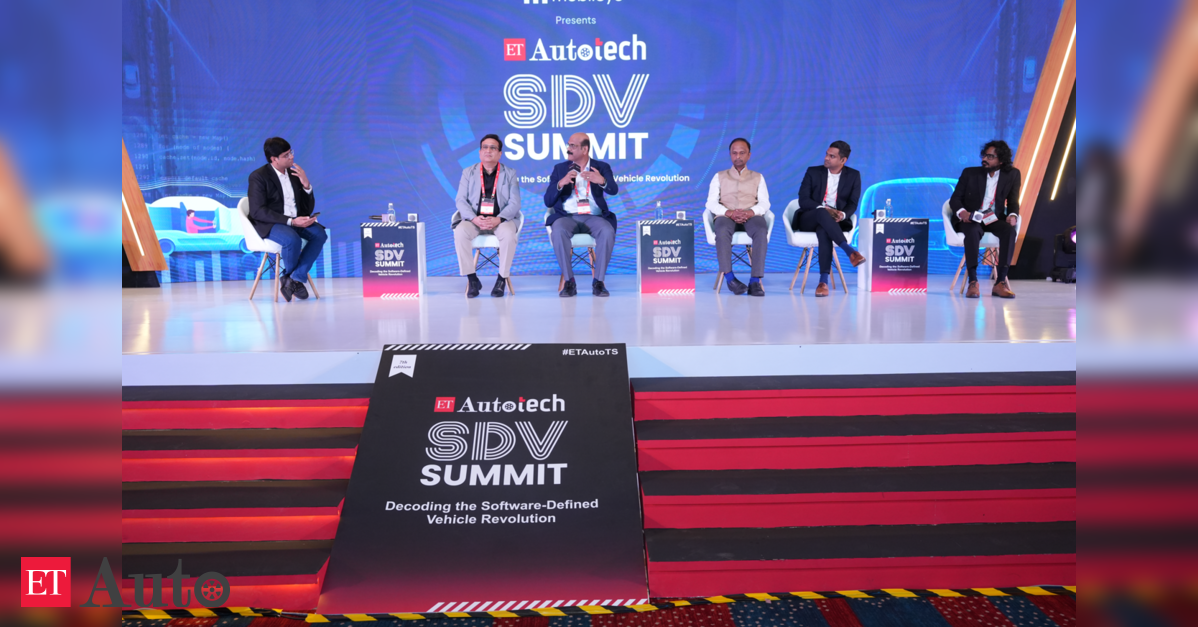
 Alok Jaitley, Sudeep S. Dalvi, Santhosh TG, Santosh Jinugu and Vikash Chaudhary on cybersecurity in SDVs.">
As the automotive industry accelerates towards software-defined vehicles (SDVs), cybersecurity is emerging as a critical determinant of customer trust, safety and regulatory compliance, say industry leaders at the ETAuto Tech Summit 2026. Experts believe that securing future vehicles will require a shift from reactive protection measures to security-by-design principles embedded across the vehicle lifecycle.Alok Jaitley, Executive Officer – Homologation, Maruti Suzuki India, said the industry’s approach to cybersecurity needs to fundamentally change as software becomes central to vehicle functionality.“Cybersecurity is something which will not come once the design is already fixed. The concept needs to be redesigned from the beginning,” he said.According to him, vehicle development teams must incorporate cybersecurity requirements alongside safety, performance and regulatory considerations during the product definition stage itself.Vikash Chaudhary, Founder & CEO, HackersEra India, echoed this view, arguing that many organisations still treat cybersecurity as a compliance requirement rather than a core engineering discipline.“The one thing currently missing from the automotive industry is cybersecurity implementation from the design stage itself,” he said.He added that vulnerability assessments, penetration testing and ethical hacking exercises should become standard practices throughout the development lifecycle to identify weaknesses before vehicles reach customers.Experts at the discussion noted that modern vehicles are increasingly exposed to cyber risks through connected services, mobile applications, telematics systems, charging infrastructure and over-the-air (OTA) software updates. As a result, cybersecurity can no longer be limited to protecting the vehicle alone.
Connected ecosystems create new challenges
As vehicles become integrated into broader digital ecosystems, cybersecurity responsibilities are expanding beyond traditional automotive boundaries.Santhosh TG, Global Chief Digital Officer, Switch Mobility, highlighted how software-defined mobility requires constant data exchange between vehicles, cloud platforms and operational systems.“Today, every fleet operator needs real-time information of the vehicle, its location, battery health and driver efficiency,” he said.While such connectivity creates opportunities for operational optimisation and customer services, it also significantly expands the potential attack surface for cyber threats.According to Santhosh, securing SDVs requires protecting not only vehicle hardware and software but also backend infrastructure, cloud environments, communication networks and third-party integrations.Sudeep S. Dalvi, Director – Technical & Purchase, Toyota Kirloskar Motor, stressed that suppliers play a critical role in this ecosystem and must adhere to common cybersecurity standards.“Regulations are important from the point of view of having a uniform implementation across the industry,” he said.He noted that harmonised standards can help ensure consistent cybersecurity practices across OEMs, suppliers and technology partners, reducing vulnerabilities introduced through fragmented approaches.The discussion also touched upon emerging global regulations such as UNECE cybersecurity requirements, which are increasingly shaping vehicle development and homologation processes worldwide.
Cybersecurity becomes a business and brand issue
Beyond technical considerations, speakers argued that cybersecurity is rapidly becoming a business-critical issue with direct implications for customer trust and brand reputation.Santosh Jinugu, Partner, Deloitte India, said the consequences of cyber incidents extend far beyond data breaches.“Cybersecurity is not just impacting the brand, but also the safety of passengers and the environment,” he said.As vehicles become more connected and autonomous, successful cyberattacks could potentially affect critical vehicle functions, making cybersecurity a safety issue as much as a technology challenge.Executives agreed that customers are becoming increasingly aware of privacy and security concerns, particularly as vehicles collect larger volumes of operational and behavioural data.This shift is making trust a key competitive differentiator in the software-defined era. Consumers may embrace connected services and personalised experiences only if they are confident that their data and vehicles remain secure.Industry leaders also emphasised the need for continuous monitoring and threat intelligence capabilities. Unlike traditional vehicles, SDVs will require ongoing cybersecurity management throughout their operational life, supported by regular software updates and vulnerability remediation.
