

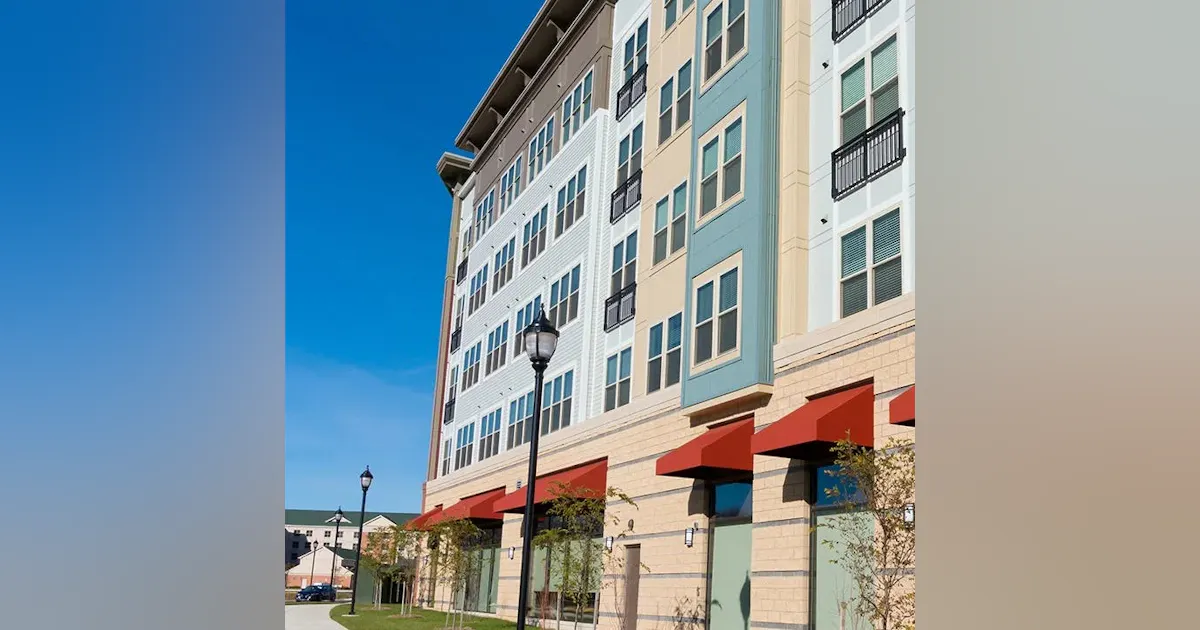
Pacifica Place offers what one would expect in a luxury multi-dwelling unit (MDU) apartment in downtown Irvine, California: a variety of floor plans, access to the Irvine Spectrum Center, and proximity to local freeways.
But the standout feature is that every unit features GFiber’s 3 Gbps symmetrical connectivity.
Through its partnership with Quext, GFiber’s Wi-Fi 7 technology and Smart Home connectivity provide each resident with a personal network

“We have taken the best of G.Fiber, which is multi-gig connectivity to every unit, and merged that with the best pieces of Quext’s smart community solution to come up with an innovative managed Wi-Fi solution for MDU operators,” said Nick Saporito, head of product at GFiber.
In addition to providing seamless coverage throughout each unit and across the community, residents can control locks, thermostats, and other smart devices from anywhere on the property.
Pacifica Place reflects how MDU broadband is no longer just about raw connectivity—it’s a foundation that ensures each resident has reliable service while enabling the property owner to better manage their communities.
MDUs have become an increasingly common housing option for individuals and families. According to the U.S. Census, 27% of the total U.S. housing stock falls into the multifamily category, up from 2021, when just under 25% of the population lived in MDUs with four or more units.
“This expansion, combined with increasing resident expectations and a growing number of managed service providers serving the sector, is driving rapid growth in the MDU connectivity market,” said the Wireless Broadband Alliance (WBA) in its latest report, Connectivity Strategies for Smart Multi-Dwelling Units (MDUs): Convergence for Connected Living at Scale.
Bulk internet, a service model in which a property owner or Homeowners Association (HOA) contracts with a single internet provider to deliver service to an entire building or community, has become a key attraction for Brownfield and Greenfield MDUs.
The bulk approach benefits the service provider and the property owner: ISPs can sell a complete solution to an entire MDU community under a long-term contract from one broadband source.
Maravedis’ Multifamily Rental Connectivity Market Analysis in the United States 2026–2031 projects bulk broadband to grow from 17% to 33% of the U.S. rental stock by 2031.
“Driven by managed Wi-Fi support and bulk internet services, the U.S. multifamily rental connectivity market is entering a defining inflection point,” said Adlane Fellah, chief analyst and founder at Maravedis Research.
Meanwhile, residents receive the service as a lower-priced amenity, gaining cost savings, dedicated customer support, and reliable service.
Parks Associates found several cost differences between retail and bulk internet plans. The average apartment renter pays $79 per month for their residential home internet service. Alternatively, residents with bulk plans pay only $65 per month, representing an average savings of $14 per month.
Service providers see potential with bulk.
Earlier this year, TDS Telecom tapped former Comcast and Cox executive John Cryer Jr. as VP of MDU Sales.
TDS calls MDU bulk a significant growth opportunity, but cautions that it’s not a fit for every property.
“We are prepared to deliver bulk, but it’s not what every HOA or property owner chooses,” he said. “There are some significant advantages to bulk: discounted services are a great benefit for the end user, and now it’s foundational to the property tech that we’re seeing with the internet of things between thermostats and leak detection.”
Alan DiCicco, VP of Solution and Product Marketing for Calix, agreed and noted that 20-25 are in bulk agreement. “Bulk internet is built into the price, and it is a convenient and highly valuable amenity,” he said.
Complementing service providers are consultants like Vitalis Smart Communities, which works with developers to educate them on the best solution in markets like Florida, where there are 18 ISPs in the MDU space.
Vitalis Smart Communities secured a bulk fiber internet and TV agreement for the Sandalwood, Florida townhome development, showing the developer it would be more beneficial than Comcast’s coax-based platform.
“Eighty percent of Sandalwood’s residents were paying over $100 for internet,” said Maz Khan, founder and president of Vitalis. “By bundling internet and TV together, it reduced Sandalwood’s total cost to $60 per unit, with full fiber, multi-gig speeds, but now all of the service calls and technology upgrades are being taken care of in the service contract.”
In considering bulk internet, there are key federal and state regulatory issues worth noting. After becoming chairman of the FCC in 2025, Brendan Carr moved to end its consideration of a 2024 Biden-Harris Administration proposal to regulate bulk billing arrangements.
Carr maintained that bulk-billing programs have enabled families living in apartments and other multi-tenant environments to pay lower prices for Internet service.
“During the Biden-Harris Administration, FCC leadership put forward a ‘bulk billing’ proposal that could have raised the price of Internet service for Americans living in apartments by as much as 50 percent,” he said. “This regulatory overreach from Washington would have hit families right in their pocketbooks when they were already hurting from the last Administration’s inflationary policies.”
Despite the FCC’s action, states like California with its AB 1414, Colorado with its markup restrictions and open-access mandates, and New York with its Affordable Broadband Act challenge the bulk industry.
Meanwhile, Bulk Broadband Alliance, which was co-founded by ACA Connects, the Community Associations Institute, EducationSuperHighway, the National Apartment Association, and the National Multifamily Housing Council, noted that bulk broadband costs are half those of retail agreements.
In its Understanding Bulk Billing Arrangements study, Cartesian said that without a bulk arrangement, consumers would collectively pay an estimated $5.6 billion more each year for retail broadband.
“Our analysis of more than 1,000 active bulk contracts found bulk prices more than 50% below comparable retail, and that MDUs soliciting bulk bids can attract roughly 5.7 facilities-based wireline providers — more than double the 2.2 typically available for retail service,” said Theresa Myers, principal, strategy and analytics, at Cartesian. “Three forces drive these results: more competition, reduced provider costs, and stronger purchasing power.”
Likewise, Zentro—a hybrid wireless and fiber MSP MDU specialist is accelerating deployments across major urban markets with Calix’s SmartMDU (branded as Zentro Bliss). In May 2025, Zentro targeted a high-rise in Atlanta, Georgia, which enabled property managers to spend 30 percent less time resolving Wi-Fi service-related issues.
“Being able to have customers come in and meet their expectations, whether it’s onboarding to new services, reliability on connectivity, bandwidth utilization, and the desire for multi-gig services, are all key in the customer lifecycle and the customer experience, and ultimately drives what we do and gets our name out there,” said Diego Salas, CTO of Zentro.
Having managed Wi-Fi connectivity available throughout a property is only part of what MDU residents expect; they now expect immediate internet access on move-in day.
While low cost is the top priority (60%), a joint Parks Associates and Xfinity Communities study found that over a third of renters (41%) expect broadband service to be activated when they move into a property.
Service providers are responding.
Because it has pre-installed internet equipment in each MDU unit and immediate connectivity on the day of move-in, Xfinity enables residents to sign up for Xfinity Internet upon arrival, lease the Xfinity Wi-Fi Gateway, and get connected immediately.
GFiber, through a partnership with Quext, is delivering managed “Instant On Connectivity” of 3 Gbps to Irvine Company’s Pacifica Place, complemented by property-wide Wi-Fi. Residents download and open the Quext app to securely set up their Personal Area Network (PAN) and get online in seconds.
Their private Wi-Fi network then follows them seamlessly across common areas, providing an always-on connection that allows residents to work or stream securely without interruption.
“The service is already there and waiting to be activated, so it’s simple from the customer experience perspective,” Saporito said. “The other thing that’s unique is we’re doing 3 Gbps to every unit and pairing it with Wi-Fi, but customers with big data demands, like a gamer or a data scientist, can hardwire into the network and get the full 3 Gbps at any time.”
Integrated building intelligence
Equipping an MDU with broadband is not just about residential connectivity but about creating a foundation that supports an entire building’s needs.
Once a provider equips an MDU with broadband, it supports a host of other intelligent home devices and property technology applications, including access control, leak detection, HVAC, IoT sensors, and AI-driven services.
Fellah calls building-intelligence platforms that integrate broadband and property technology “Smart Building as a Service.”
“The industry is moving from disconnected point solutions toward integrated building intelligence, where connectivity, devices, data, and software operate as a single system,” he said.
Parks Associates is seeing a similar trend. In its From Smart Home to Building Intelligence report, it found that integrated systems are transforming multifamily property management through centralized visibility, automation, and data-driven operations. Smart-building solutions deliver a 15-20% improvement across tested metrics, with a 20% average increase in operating efficiencies.
Take GFiber and Quext. Residents can use the Quext app to manage their personal Wi-Fi, control their thermostat, and access their property
Even before they move in, prospective residents can experience the community securely during a self-guided tour—complete with guest Wi-Fi access—thanks to a seamless integration with Irvine Company’s Tour Guide app, built using the Quext API and SDK. For property managers, this one-click integration dramatically simplifies operations while significantly boosting resident satisfaction.
Saporito said this integrated system enables property owners to build a network for proactive operations and to respond quickly in the event of an issue.
“These property management companies can reduce opex with these kinds of solutions, whether they have water sensors in place to detect leaks that can cause a lot of damage, there’s a lot of value,” he said.
Zentro, which uses Calix SmartMDU, noted that visibility is key to proactively mitigating issues. “People used to say the best customer is the one that never calls,” Salas said. “You’ve got to be careful with that, too, because the best customer, he’ll probably be the first one to badmouth you or leave you because your service is not great.”
DiCicco agreed that the broadband MDU system is broken due to a lack of coordination between property managers, owners and service providers.
“You have fragmented responsibility between the property owner, the property manager, the service provider, and not a shared set of tools,” he said. “You have a higher cost of serving tenants in the apartment buildings, which puts financial pressure on the service provider who wants to offload resident enablement and support.”
In terms of paying for the retrofit, it depends on each building.
Pierre Trudeau, President, Positron Access Solutions, said it mainly sells its products to the provider serving the building. “They usually put that as part of their infrastructure cost, and then they charge so many dollars per month, whether it’s a bulk agreement or retail,” he said.
Christian Breidenbach-Kaack, President, Agnoss Telecom, agreed and added that it has seen various models.
“We are working on a project in Massachusetts where the property owner has asked us to pull in fibers and not reuse the copper infrastructure,” he said. “In other projects, we have seen that the MSP has paid us to find the best solution for the budget the building owner has.”
However, in Europe, the mandate to retire copper means fiber is prioritized. “In Europe, more operators are pulling fibers because copper sunset is accelerating,” he said.
Other service providers like Zentro are taking a hybrid approach that combines existing wiring, fiber, and millimeter-wave wireless, allowing them to rapidly expand while creating redundancy.
It built a fiber backbone throughout its properties and overlaid fixed wireless on it, enabling multiple redundant paths. “We originally started as a fixed wireless player and understood that speed to market and being able to deliver services in a timely manner were key,” Salas said. “There wasn’t a lot of fiber available when we first started for players like us.”
But technology is just one part of the equation.
Breidenbach-Kaack said that, based on his experience equipping broadband in European markets, there’s a need to gain a holistic understanding of a building’s unique characteristics.
“One thing I’ve learned is you must do a very precise site visit of every building,” he said. “You cannot just go into this building, take some pictures, but you must check where the risers are, and how I can go into the unit if you’re retrofitting it.”
Given the growth of the MDU broadband market, traditional incumbent cable and telco providers should be the players to beat, but they face a growing group of MDU-centric competitors.
MSPs like Dojo Networks, Gigstreem, Elauwit, Mereo Fiber, Pavlov Media, and Zentro have differentiated themselves by consolidating multiple ISP circuits into one network connection for the entire MDU property. What’s more, these providers can also support an MDU property with a single call center, a single support team, a single bill, and a single point of contact.
In its U.S. Multifamily Managed Connectivity report, Maravedis introduced its Maravedis Market Score (MMS) framework, which evaluates providers across six criteria: Installed Base and Scale (15%), Customer Satisfaction and NPS (20%), Technology Stack and Reliability (15%), Financial Strength and Stability (25%), Go-to-Market Strength (15%), and Business Model Resilience (10%).
Interestingly, Zentro Internet leads Maravedis’ MMS rankings with a score of 4.40.
Similarly, Blue Stream Fiber is achieving a 4.9+/5 satisfaction rating by leveraging Calix’s Smart MDU platform. The Florida-based, multi-state service provider is preparing to add 15+ properties in 2026 to streamline operations across its growing portfolio.
But what about incumbent telcos and cable operators?
Having enjoyed a long lead over traditional telcos that had lagged with slower-speed DSL, the largest cable operators’ grip on the broadband market has slipped over the past several quarters due to strong fiber and FWA competitors.
Parks Associates noted that Comcast, Charter, Spectrum, and Altice narrowed their broadband losses in the first quarter of 2026 to 280,000 subscribers, down from 320,000 in 2025, due to fiber broadband and fixed wireless access competition.
Also, cable MVNOs added approximately 830,000 combined mobile subscriptions, highlighting continued consumer interest in wireless/wireline bundles. Charter lost 120,000 broadband subscribers while residential broadband ARPU remained flat at $70.72.
“The competitive landscape has shifted from winning subscribers at any cost to keeping existing customers through better pricing, simplified service offerings, and integrated connectivity,” said Kristen Hanich, senior Director of Research for Parks Associates. “Providers are investing in strategies that reduce churn while strengthening the value of broadband through mobile bundles and improved customer experiences.”
Telcos have an opportunity to grow their MDU base. Verizon, whose Fios retail MDU presence was mainly centered in its Northeast and Mid-Atlantic footprint, extended that reach into Texas, Florida, and California by acquiring Frontier. Likewise, AT&T expanded its fiber broadband MDU presence when it purchased Lumen’s consumer fiber assets.
Another provider worth noting is T-Mobile. Although its FWA stake in MDU is limited, its Metronet fiber acquisition and, more recently, Greenlight and Gonetspeed, gives T-Mobile a greenfield and retrofit fiber platform it can use to extend into more multifamily deployments.
Dicicco said Tier 1 providers are now looking to enhance their offerings and their customer service capabilities to overcome their reputation for lower customer service.
“The double-edged sword is the large incumbents were very strong but also didn’t always have high customer and property owner satisfaction, so they are looking for a model to avoid a race to the bottom from providing just internet connectivity,” he said.
