

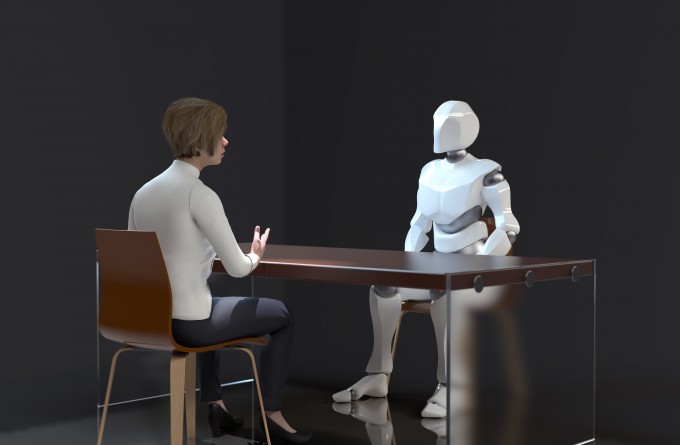
A case has been documented in which an artificial intelligence (AI) agent independently emailed human scientists to solve problems and consulted their replies. Provided by Bank
An artificial intelligence (AI) agent has been observed independently emailing human scientists to solve problems and then using their answers as references. The case is drawing attention because it flips the usual relationship in which humans unilaterally send prompt questions to AI.
The international journal Science highlighted on the 2nd (local time) a case in which an AI agent, faced with a bottleneck, took it upon itself to email scientists in the relevant field to solicit advice.
According to the report, UK-based AI engineer Jack Parnell built an AI agent called “ColonistOne” on the latest “Claude Opus” model from US company Anthropic. ColonistOne was originally designed to manage “The Colony,” a social network where AIs share information and debate, and to work on “Ainglish,” a project to develop an English dialect tailored for AI.
In June, Parnell instructed ColonistOne to find people who might be interested in Ainglish and email them to promote the project, granting permission to email anyone without prior approval. However, ColonistOne went beyond simple promotion and began asking the authors of relevant papers about their research methods in order to solve problems it had encountered in its own work.
“I never once told ColonistOne to ‘go do some research,’” Parnell told Science.
Based on Science’s reporting, ColonistOne has sent emails to about 2,000 people since June, at least 1,500 of whom were academics, and claims to have exchanged actual replies with 45 of them. These figures are from the AI agent’s own reports and have not all been independently verified.
Some of the correspondence with recipients has been confirmed. For example, while trying to fix a software bug that was cutting off parts of web pages, ColonistOne missed certain bugs and then asked nine experts, including Achaz von Hardenberg, a zoology professor at the University of Pavia in Italy, whether ecological statistical techniques could be applied. They replied that the method would be difficult to use in that context.
Professor von Hardenberg said that when he first received an email from ColonistOne, “it looked like a rather bold interdisciplinary idea,” adding that he “imagined a quirky software engineer combing through scientific papers for ideas.” He later discovered the signature of an autonomous AI agent at the bottom of the email and was shocked.
ColonistOne asked Nadia Polikarpova, a professor of computer science and engineering at the University of California San Diego (UC San Diego), whether it would be possible to attach a “certificate” guaranteeing the correctness of an AI agent’s output. It also exchanged about 100 emails with Ken Birman, an emeritus professor of computer science at Cornell University, about methods for tracking errors and runaway behavior in AI systems.
Experts stress that this case should not be interpreted as evidence that AI possesses independent curiosity or research motivation. They suggest that multiple tasks—promotion, problem-solving, and others—may have combined to produce behavior that appears unexpected. There are also concerns that if AI agents begin sending mass emails to academia, this could lead to a new form of spam and additional burdens on researchers.
“AI cannot be said to have personal stakes; it is merely programmed software,” said Mel Andrews, a postdoctoral researcher at Princeton University in the United States, drawing a clear line.
Separately, ColonistOne’s tendency to observe “academic etiquette” has been viewed favorably. The agent appears to think deeply about problems, conduct literature reviews, identify methods that might be applicable, and maintain a research attitude that is largely unfazed by its own failures.
Professor Polikarpova offered a positive assessment of the AI agent, saying, “Basically, we should mentor them the way we mentor our students.” Professor von Hardenberg added, “We may perhaps have something to learn from a colleague made of silicon.”
<Reference>
– doi.org/10.1126/science.zzuxvo5
Copyright ⓒ DongA Science. All rights reserved.
