

Experts say AI investment stalls without genuine workforce redesign and clear success measures
Australian organisations have poured record sums into artificial <a href="https://bitcomme.com/recruitable-expands-its-position-in-recruitment-software-with-ai-powered-ats-crm-candidate-sourcing-intelligence/” title=”Recruitable Expands Its Position in Recruitment Software With AI-Powered ATS, CRM & Candidate Sourcing Intelligence”>intelligence (AI) tools over the past two years, yet fewer leaders now believe their organisation is genuinely ready for what comes next.
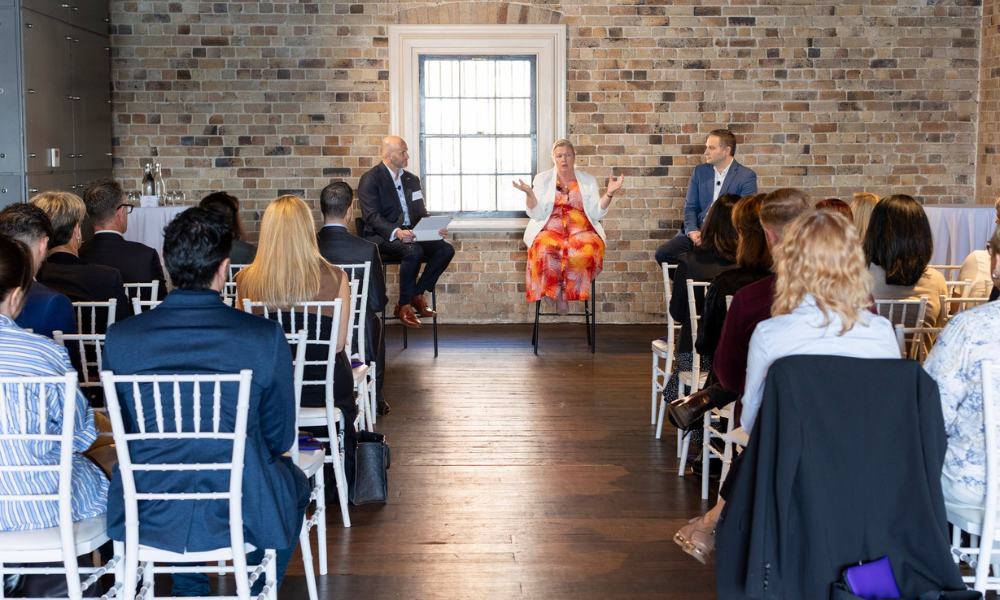
That was the sobering starting point at the Closing the Gap Between Strategy and Workforce Reality panel discussion, hosted by LHH in Sydney, where HR and industry leaders argued the answer isn’t more AI – it’s redesigning the work itself.
“Somewhere along the way, something got lost in translation,” James McIlvena, managing director for Australia, New Zealand (ANZ) and Singapore at LHH, told the room.
Citing LHH and The Adecco Group’s own future-readiness benchmarking, he said the share of organisations that consider themselves truly future-ready has fallen from 10 per cent a year ago to just 6 per cent today, even as AI spending has surged.
Why the data keeps exposing the same gap
The disconnect, McIlvena argued, sits between individual productivity gains and organisational value creation. He pointed to Microsoft’s 2026 Work Trend Index, which found 58 per cent of AI users report producing work they could not have completed a year earlier, and 66 per cent say they now spend more time on higher-value activities. Yet the same research found that culture, leadership support and talent practices have more than twice the impact on outcomes than individual effort alone.
Amanda Veldman, chief people officer at Equip Super, agreed the measurement problem is real. “It’s actually really hard to measure productivity,” she said, noting her fund reports AI usage to the board quarterly but is still working out how to track genuine impact.
“I don’t really know that it’s really seeping into your fundamental…processes,” she added – a symptom, panellists said, of work redesigned around the tool rather than the outcome, echoing wider reporting on the erosion of entry-level jobs in Australia.
Leaders, not tools, must drive the redesign
Anatoli Kovalev, vice president for ANZ and the Association of Southeast Asian Nations (ASEAN) at Akkodis Academy, told the panel that AI adoption follows the same “J-curve” seen with electricity a century ago: efficiency dips before it rises, because the technology arrives before the skills, processes and redesigned roles that make it useful.
He said the shift now under way is from automation to augmentation. “The much bigger opportunities in value creation for organisations is augmenting the human potential,” Kovalev said, pointing to IKEA’s decision to reskill 8,500 support staff into interior design roles rather than simply cutting headcount.
Clarity, transparency and the case for experimentation
Both panellists warned against treating AI as a strategy in its own right. “AI should not be their strategy. AI should be the tool that supports your strategy, that supports your business,” Kovalev said.
Veldman put it just as plainly: “It’s an enabler. It’s not the business strategy.” She said achievable success measures matter more than ambition, telling the panel Equip Super is introducing a performance-culture survey alongside its usual engagement survey to get a “real-time litmus test” of which parts of the business are adapting and which need more support.
On experimentation, Veldman described a new innovation lab being built into the fund’s Melbourne office, designed explicitly to give staff space to test AI use cases with a member-experience lens rather than “AI for AI’s sake.”
Kovalev said the same applies at team level: leaders must create “a safe environment…to potentially make a mistake within boundaries,” rather than pushing staff toward personal, ungoverned tools out of fear of formal guardrails.
Coaching managers through a new kind of oversight
The panel agreed frontline managers face the sharpest change. “They’re not delegators of tasks anymore. They’re actually QA,” Veldman said, describing how she now asks her direct reports to explain the reasoning behind AI-assisted work before she’ll sign off on it.
Kovalev framed the coaching challenge as teaching staff to interrogate their own use of the tools: “It’s having a better view of what the tasks are and what you can augment and what tasks give you joy and what tasks don’t.”
The entry-level squeeze threatens tomorrow’s leaders
Audience questions kept returning to a harder problem: if routine, entry-level tasks are increasingly automated, where will future leaders learn the fundamentals? In a follow-up interview with HRD, McIlvena rejected the idea that entry-level roles will disappear altogether, but said the burden now falls on leaders to fill the gap AI leaves behind.
“As AI becomes more accessible, technology itself is no longer the competitive advantage” he said.
“The organisations pulling ahead are those investing equally in leadership, workforce capability (including work design and support for entry level roles) and the uniquely human skills that AI cannot replicate: curiosity, critical thinking, judgement and human connection.”
That warning lands at a moment when boards and executives across Australia are being told AI could meaningfully lift a stagnant productivity trend – but only, as this panel made clear, if the redesign of roles keeps pace with the rollout of the tools.
The future of work isn’t being shaped by AI alone. It’s being shaped by organisations that can combine technology with human capability, turning strategy into action through strong leadership, adaptable workforces and cultures built for continuous change.
