

Front page
NewsContact Center38m · 20:10 BST · 9 min read
Gartner’s CCaaS MQ Still Sells Influence, Not Outcomes
Gartner’s 2026 CCaaS Magic Quadrant keeps the same Leaders while agentic AI reshapes the sales pitch. Rob Scott asks whether Gartner’s influential chart helps buyers select platforms that deliver trusted automation, real resolution, and measurable customer outcomes.

I have watched enough Magic Quadrants come and go to recognize the annual ritual. Vendors celebrate the dot. Buyers circulate the graphic internally. Sales teams convert a placement into apparent proof. And, for a few weeks, a two-axis chart is treated as an answer to a much harder question: who can genuinely deliver better customer service?
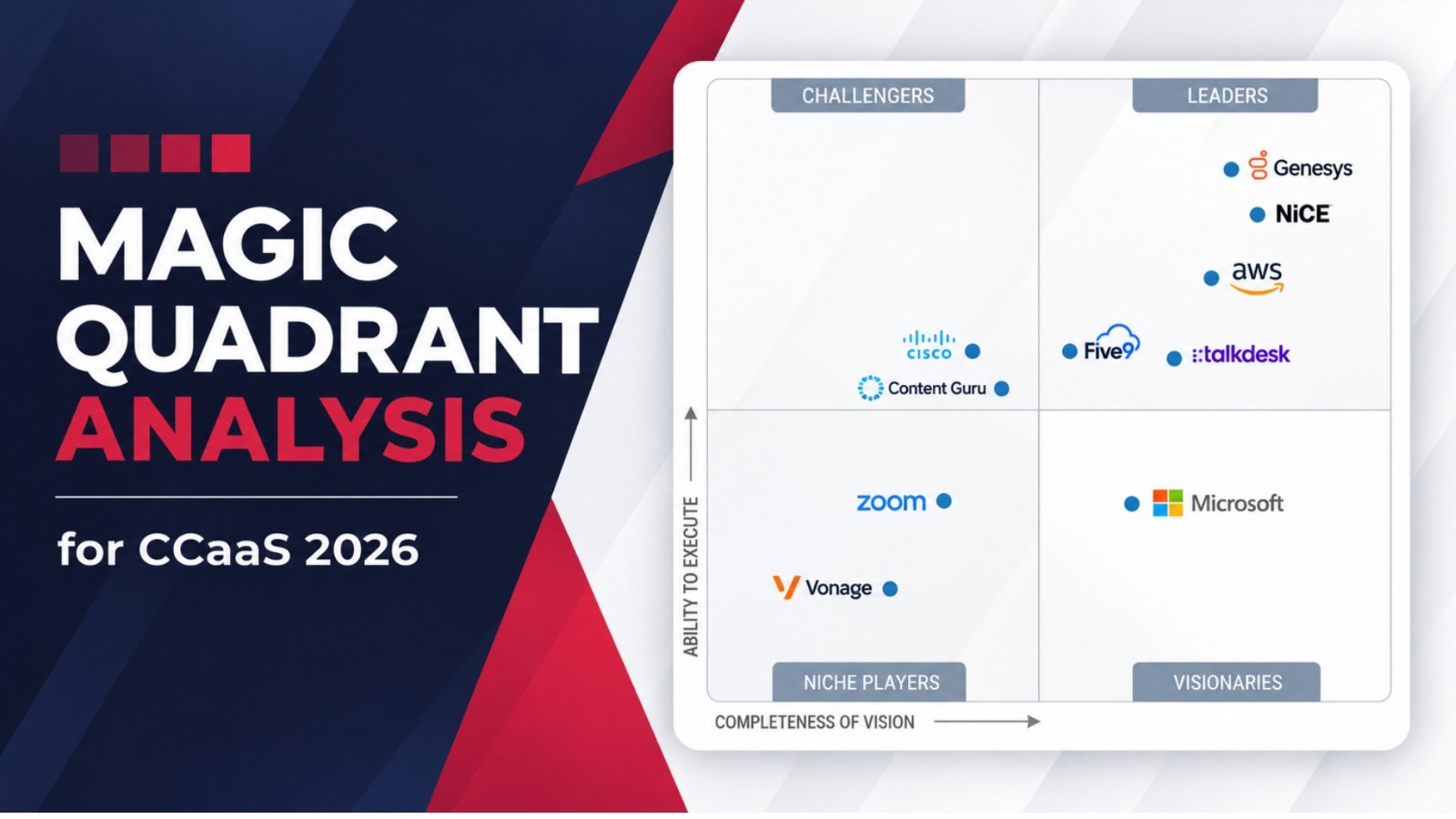
Gartner’s 2026 Magic Quadrant for Contact Center as a Service follows a familiar pattern at the top. Amazon Web Services, Five9, Genesys, NICE, and Talkdesk retain their positions as Leaders. Cisco returns to the Challenger quadrant, alongside Content Guru. Microsoft enters as a Visionary. Vonage and Zoom remain Niche Players.
The headline is not that agentic AI has reordered the CCaaS market. It plainly has not, at least not yet.
“The market has spent the past year telling us that agentic AI changes everything. Gartner’s chart suggests something more prosaic: the vendors with the deepest enterprise footprint, broadest portfolios, and strongest commercial machinery still hold the most valuable real estate.”
That is not an argument that the Leaders are undeserving. It is an argument that buyers need to understand what the Magic Quadrant does—and does not—measure.
The Dot Is Not the Deployment
The most consequential question in CCaaS is no longer whether a provider can demonstrate an AI agent. Nearly every credible vendor can do that now.
The questions buyers should ask are tougher. Can the AI resolve a real customer problem using trustworthy context? Can it take a governed action across a CRM, billing system, knowledge platform, or order-management workflow? Does it recognize when it lacks confidence? Can it transfer the interaction cleanly to a human employee? And can the organization explain why it made a decision?
A Magic Quadrant placement does not answer those questions.
“I have seen too many contact center programs where the buying decision was validated by the analyst chart, while the operational work was deferred. Then the organization discovers its customer data is fragmented, the knowledge is unreliable, and nobody has agreed who owns the outcome when the AI gets it wrong.”
Gartner itself recognizes this gap. Its 2026 report points to rising AI adoption but also poor experiences with AI-facing capabilities, difficulty proving ROI, inconsistent data across systems of record, and a lack of AI-ready knowledge management.
Those are not minor implementation details. They are the difference between an attractive demo and a service model customers can trust.
Why the Leaderboard Barely Moves
The stability of the Leaders quadrant is understandable. AWS, Five9, Genesys, NICE, and Talkdesk have meaningful scale, global delivery capability, platform breadth, established partner ecosystems, and experience supporting complex enterprise environments.
Those attributes matter. Gartner forecasts that CCaaS will account for more than half of all agent licenses globally by the end of 2026. Buyers are not simply purchasing a routing engine or a chatbot replacement. They are making a long-term decision <a href="https://bitcomme.com/real-or-not-teaching-children-about-generative-ai-2/” title=”Real or Not? Teaching Children About Generative AI”>about customer data, workflow orchestration, workforce operations, compliance, integrations, resilience, and service accountability.
But this is also where the Magic Quadrant can exert outsized commercial influence.
“A Gartner Leader position can become a shortcut in procurement. It can reduce perceived risk before a vendor has demonstrated a single workflow against a buyer’s operating reality. That may be commercially useful for the vendor, but it is not necessarily useful for the customer.”
The report’s inclusion criteria reinforce that point. Providers needed at least $85 million in 2025 revenue, at least 10% of that revenue from new-logo clients, and an average deal size above 100 representatives.
Those thresholds make sense if Gartner’s objective is to assess a specific segment of the enterprise CCaaS market. They are not, however, a universal test of relevance, innovation, or customer fit. They can exclude providers with a sharper industry focus, newer architectures, different go-to-market models, or specialist capabilities that may matter more to a particular buyer.
“Not in the Magic Quadrant” should never be read as “not worth evaluating.”
Microsoft’s Entry Exposes the Bigger Shift
Microsoft’s arrival as a Visionary is the most important movement in the 2026 report. It validates a broader market reality: the separation between contact center platforms and CRM-led customer engagement architectures is breaking down.
-
Microsoft launched Contact Center Intelligence (CCI) in October 2026
Dynamics 365 Contact Center brings obvious advantages for organizations already committed to Teams, Dynamics, and Microsoft’s expanding AI portfolio. Gartner flags limitations around third-party CRM optimization, implementation complexity, and the maturity of core routing and reporting capabilities.
Still, the strategic question is larger than Microsoft’s current position on a graph.
“The next contact center buying decision may not start with, ‘Which CCaaS platform should we select?’ It may start with, ‘Where do we want intelligence, workflow, customer context, and AI governance to live?’ Gartner’s quadrant captures part of that shift, but the market is moving faster than the category definition.”
Salesforce’s status as an honorable mention after launching Agentforce Contact Center in 2026 underlines the same tension. A provider’s quadrant status may matter less than whether its platform sits at the center of a company’s customer data, employee workflow, and AI governance model.
Cisco’s Return Puts Security on the Agenda
Cisco’s return to the Challenger quadrant also deserves attention. Its value proposition extends beyond Webex Contact Center functionality into unified communications, global deployments, and an emerging AI security narrative.
Gartner highlights Cisco AI Defense and protections against threats such as prompt injection. As AI systems begin to act across customer interactions and connected enterprise systems, the question is no longer simply what an AI agent can do. It is who governs it, how it is secured, what it can access, and what happens when it makes the wrong call.
“For years, the contact center industry has measured innovation in terms of automation volume and containment. The agentic era should force a more serious standard: can the organization govern action, preserve customer trust, and deliver a competent human handover when the automation reaches its limits?”
Cisco still faces questions around complex digital workflows, third-party integrations, and administrative complexity. But its Challenger placement is a reminder that a secure and operationally coherent architecture may prove more important than an aggressive AI roadmap.
What the CX Awards 2026 Finalists Reveal
The CX Awards 2026 finalists offer another lens on the market—and arguably a more useful one for buyers.
Cisco, Five9, and Genesys are finalists for Best Contact Center Solution (Large). Cisco, Genesys, and Zoom are finalists for Best CX Solution (Large). Talkdesk is a finalist for Best Automation & Orchestration Platform, alongside Content Guru, Cresta, Parloa, Capacity, and CSG / Netcracker.
That competitive set does not look like a neat four-quadrant market. Nor should it.
It brings established CCaaS providers into the same conversation as specialists in orchestration, analytics, intelligence, data platforms, and automation. That is closer to the reality customer experience leaders face: they are assembling an operating model, not simply selecting a contact center vendor.
The awards’ enterprise-impact finalists tell an even more important story. Alaska Airlines, Banco de Occidente, Fabletics, Qunar, and WHOOP are among those recognized in categories focused on measurable ROI, customer experience teams, and AI in practice.
“The right test is not whether an AI feature is available, or whether a vendor has moved right and up on a chart. It is whether a company can show that customers get problems resolved faster and more reliably—and that the business can defend the result in operational and financial terms.”
View the full CX Awards 2026 finalists list here. Winners and Highly Commended organizations will be revealed on November 3, 2026.
What CCaaS Buyers Should Test Instead
The five Gartner Leaders each bring real strengths. AWS offers global scale and customization, but requires buyers to understand developer dependencies and consumption pricing. Five9 has enterprise breadth and robust outbound capabilities, although complex workforce requirements and support responsiveness warrant scrutiny. Genesys brings deep migration expertise and an ambitious AI strategy, while its AI economics and reporting model need close examination. NICE has strengthened its conversational AI proposition through Cognigy, but buyers should test administration complexity and implementation timelines. Talkdesk brings industry-focused AI and data ambitions, but reporting, digital depth, and geographic support should be pressure-tested.
Those are not reasons to dismiss the Leaders. They are reasons to move beyond the chart.
A serious CCaaS evaluation should require vendors to demonstrate a complete, real-world resolution journey against the buyer’s own data, policies, and systems. It should test how the platform manages uncertain intent, poor data, exceptions, escalation, auditability, and human handover. It should expose the commercial model, implementation responsibilities, integration assumptions, ongoing operational workload, and support commitments.
“The danger is not using Gartner research. The danger is allowing Gartner research to substitute for due diligence. The Magic Quadrant should open the buyer’s investigation, not close it.”
A Market Map, Not a Buying Decision
Gartner’s 2026 CCaaS Magic Quadrant remains a useful market map. It explains why the established Leaders continue to have influence, highlights Microsoft’s entry, and signals the importance of security, CRM convergence, and agentic AI.
But it should not become the buyer’s decision-making framework.
The commercial sway of the Magic Quadrant is undeniable because it simplifies a complicated market into an image executives recognize. Yet customer service leaders do not operate in a quadrant. They operate with imperfect data, legacy systems, compliance demands, resource constraints, frustrated employees, and customers who care about one thing above all: whether their problem gets solved.
The CX Awards 2026 finalists point toward a more meaningful conversation—one focused on technologies and organizations demonstrating real outcomes, not simply market position.
That is where this market needs to go next: away from AI theater and analyst-chart certainty, and toward proof that customer experience technology can deliver trusted action, measurable value, and better resolution when the pressure is real.
Frequently Asked Questions
Who are the Leaders in Gartner’s 2026 CCaaS Magic Quadrant?
Gartner placed Amazon Web Services, Five9, Genesys, NICE, and Talkdesk in the Leaders quadrant for the 2026 Magic Quadrant for Contact Center as a Service.
Which company entered Gartner’s 2026 CCaaS Magic Quadrant for the first time?
Microsoft entered Gartner’s 2026 CCaaS Magic Quadrant as a Visionary with Dynamics 365 Contact Center.
Why should buyers look beyond the Gartner Magic Quadrant?
The Magic Quadrant is a useful market-research tool, but it does not validate whether a platform will work with a buyer’s data, workflows, governance requirements, integrations, commercial model, or operating constraints. Buyers should test real customer-resolution journeys before making a decision.
When are the CX Awards 2026 winners announced?
The CX Awards 2026 winners and Highly Commended organizations will be announced on November 3, 2026.
rate this storyhelps rank stories across CX Today
Read nextordered by techtelligence · every pick explained
same beat · Contact Center
Five9, Contact Babel, Arkose Labs: Exposing Contact Center AI Reality
9hsame beat · Contact CenterMicrosoft CCI Challenges the ‘Rip and Replace’ Contact Center Model21 Oct 2026same beat · Contact CenterZoom Targets CX’s Broken Context With Its New AI Layer20 Oct 2026
More from the Contact Center desk
News
As event season fills calendars and research reports start landing in inboxes, Five9, Arkose Labs, and ContactBabel point to the same contact center AI reality: adoption is accelerating, but trust, escalation, accuracy, and workforce readiness now decide what works.
Rob Wilkinson · 9hSponsored · Microsoft
Microsoft CCI Challenges the ‘Rip and Replace’ Contact Center Model
Microsoft has launched Contact Center Intelligence, positioning it as an alternative for organizations that want to modernize service without committing to a lengthy CCaaS replacement. CX Today will be reporting from Microsoft Ignite in November to get under the hood of this announcement.
Rob Scott · 21 Oct 2026News
Zoom Targets CX’s Broken Context With Its New AI Layer
Zoom has unveiled a Unified Context Layer at Zoomtopia 2026, giving virtual and human agents a shared, real-time view of customer history. The move could reduce repeated explanations, while pushing Zoom further into the race to make AI agents genuinely useful.
