

A report published by The New York Times on July 13, titled “Inside Israel’s Secret Operation to Cultivate Ahmadinejad,” claimed that Israel’s intelligence agency Mossad had been running a covert operation to install former Iranian President Mahmoud Ahmadinejad as the country’s new leader.
The report, whether its claims are ultimately proven or not, offered a striking reminder of the reach of an intelligence apparatus: a foreign intelligence agency allegedly working to influence political leadership inside an adversary state.
Intelligence agencies are often described as the government’s eyes and ears. That raises a fundamental question whenever a major national crisis occurs. Where was the intelligence apparatus? What did it know, and what did it do with what it knew? A year after Nepal’s Gen Z movement, those questions remain unresolved.
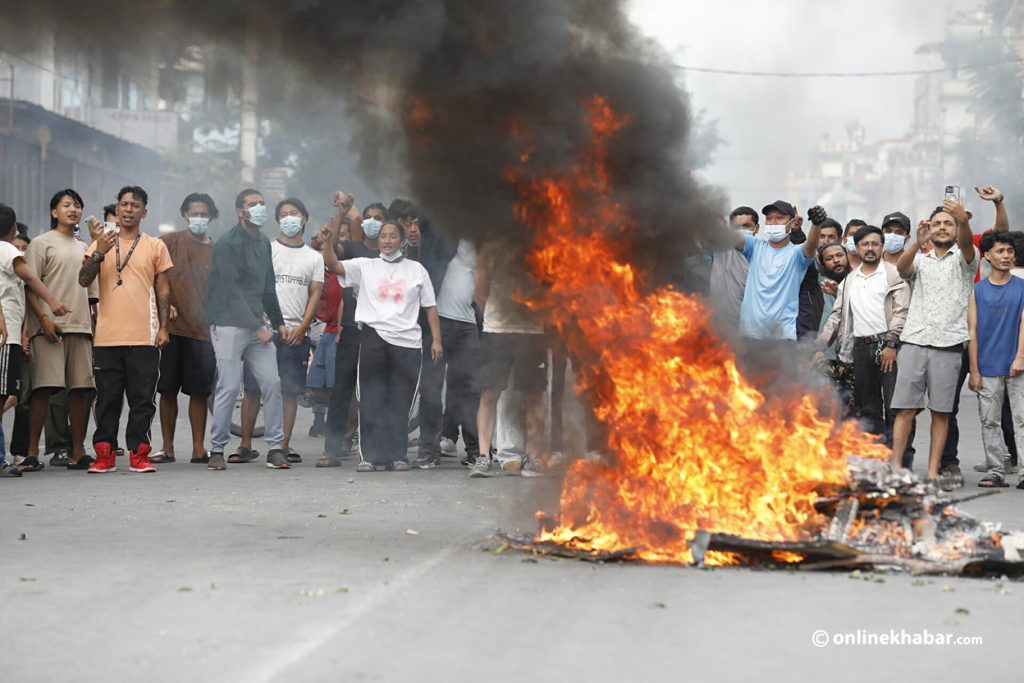
When the executive, legislature and judiciary were engulfed in violence and key state structures were set ablaze, the roles of all four of Nepal’s security agencies—the Nepal Army, Nepal Police, Armed Police Force and National Investigation Department (NID)—came under scrutiny.
The most serious questions were directed at the NID, whose principal responsibility is to collect intelligence and provide early warning.
Information was available—but action was not
Intelligence officials reject the claim that they had no advance information about the Gen Z movement.
Hutaraj Thapa, who was the NID chief at the time, says information collected about the planned protest was reported in writing.
“We submit daily and weekly reports. At that time too, we submitted reports incorporating the information available to us,” Thapa, who has since retired, said.
The NID routinely sends reports to the Prime Minister’s Office, Ministry of Home Affairs, Ministry of Defence, the National Security Council and the Nepal Army. Some of these reports, officials say, are so sensitive that their envelopes are not even opened.
One such report, submitted on September 7, 2025, the day before the main protest, has been obtained by Onlinekhabar.
It contained six points on the Gen Z movement. The report said activists, organisations, groups and individuals were preparing demonstrations in Kathmandu Valley and other districts in opposition to the government’s ban on Facebook, YouTube, Instagram and other social media platforms.
It also recorded that a Gen Z group had held a discussion at Bhimsen Gola in Old Baneshwar, attended by around 10 to 12 people, including Amir Khanal and Khemraj Saud. The group had decided to march from Maitighar Mandala to New Baneshwar from 8 a.m. on September 7, wearing black masks and T-shirts.
The group had also approached the Kathmandu District Administration Office seeking security arrangements.
The intelligence report identified a number of people who could participate, including RSP leader Deepak Bohora, 100 Group’s Bablu Gupta, Khemraj Saud, Som Sharma, Ankit Malla, Routine of Nepal Banda’s Victor Paudel, Pathao’s Asheem Man Singh Basnyat, Nepal Students’ Union’s Binod Deuba and Durga Prasai.
It also noted that then Kathmandu Mayor Balen Shah had expressed support for the Gen Z protest on social media and warned that large numbers of his supporters could participate and that provocative or unruly activities were possible.
The report also identified preparations for protests in major cities including Jhapa, Makwanpur, Hetauda and Pokhara.
Former NID additional chief research director Devraj Bhatta says the information was there, but the analysis of what could follow was inadequate.
“There was general information, but there appears to have been a weakness in analysing it and assessing the risks that could arise,” Bhatta said.
The report did not contain much information that was not already publicly available. But Bhatta argues that the state still failed to take the report seriously enough.
“Even when reports named specific individuals and organisations, the government did not take them seriously. The country had to suffer a huge loss,” he said.
The NID’s own assessment, however, was not sufficiently detailed.
Thapa acknowledged that its reports did not contain an in-depth analysis of the preparations or the potential scale of destruction.
“The intelligence agency’s capacity is limited. But even when information is obtained within that limited capacity, failing to respond to or use it is not only yesterday’s problem; it remains a problem today,” Bhatt said. “Who is the consumer of which intelligence? That question still exists. Our misfortune is that there is no clear responsibility over who must act and when.”
A member of the Gauri Bahadur Karki Commission, which investigated the suppression of the September 8 and 9 protests, similarly said the NID had failed to effectively present the limited information it had, while the agencies receiving the information also appeared not to have examined it seriously.
The missing digital intelligence

The challenge was made more difficult by the fact that the movement was organised almost entirely online.
From September 6, Reddit, TikTok and Discord were filled with calls to protest over the “Nepo Baby” issue and the social media ban.
Yet the intelligence apparatus did not have the technological capacity to fully monitor or analyse the rapidly changing online environment.
Officials acknowledged that the NID lacked both adequate technical expertise and cyber-monitoring tools to track videos, triggers, inflammatory messages and other digital content.
The Kathmandu Valley had been divided into 32 sectors for intelligence collection, under the command of the Valley Operations Division. Its chief at the time, Krishna Khanal, told the Karki Commission that the intelligence assessment was that around 8,000 protesters could attend.
The NID collected information through open sources, its own personnel, undercover staff and informants. But officials acknowledged that the lack of cyber capabilities prevented deeper tracking of the online mobilisation.
The movement’s preparations were not taking place through physical meetings that security agencies could easily observe. They were happening across social media platforms.
According to security analyst Narayan Adhikari, the agencies failed to understand this shift, did not obtain the information in time and could not properly analyse it. Their estimates therefore failed to match what unfolded on the streets.
Reports that reportedly went unread
There was another problem: whether the intelligence reports reached the people who needed to act on them.
A Home Ministry official says the relationship between then Prime Minister KP Sharma Oli and NID chief Thapa had deteriorated badly.
Although the NID formally comes under the Prime Minister’s Office, the official said Thapa had difficulty even getting access to Baluwatar. His reports were allegedly viewed with suspicion, with some questioning his credibility because he came from Rolpa and was perceived as having a Maoist affiliation.
A person familiar with the relationship between Oli and Thapa said the prime minister’s personal assistant, Rajesh Bajracharya, also warned Thapa.
The pressure became so intense that Thapa reportedly responded to Bajracharya: “I may not be transferable outside the country. Send me wherever you want.”
The strained relationship was not limited to the intelligence chief, according to people familiar with the situation. Relations between Oli and other security chiefs were also reportedly poor.
One indication, they argue, was the events of September 9, when the army’s rescue of Oli began only after he resigned.
“Look at what happened on September 9. The Army did not even rescue Oli until he resigned. Relations with the security agencies had completely broken down by then,” one person familiar with the situation said.
No concrete decision at the security committee
The Central Security Committee, chaired by the home minister, includes the home secretary, defence secretary, a Nepal Army general, the chiefs of Nepal Police and the Armed Police Force, and the NID chief.
The committee met on the eve of the Gen Z protest.
But the Karki Commission found no written decision on a concrete security strategy for the protest.
The Commission reviewed decisions from Central Security Committee meetings held between September 5 to 10. Its report says that only attendance records were provided and that no written decision relating to the Gen Z movement was found.
The Kathmandu District Security Committee also met on September 7 and concluded that the overall security situation was normal, while calling for stronger coordination in the coming days.
On the eve of the protest, Oli also met security chiefs. He says he was briefed that around 6,000 to 7,000 protesters were expected and that the demonstration would be peaceful.
In testimony to the Karki Commission, Oli said no security agency had presented concrete information about widespread violence, arson or large-scale vandalism through platforms such as Discord, Reddit and TikTok.
Yet the army chief gave a different account.
Army Chief Ashok Raj Sigdel told the Commission that, during the Central Security Committee meeting on September 7, information had been received from the NID and other security agencies that the protest could become widespread.
Despite this warning, no National Security Council meeting was held before the protest.
The NID chief, meanwhile, assessed that between 3,500 and 5,000 people would attend.
The conflicting accounts point to a deeper problem: the state did not have a common understanding of the scale or nature of the threat.
Different assessments, weak coordination
On September 7, 3,441 police personnel were deployed in Kathmandu Valley, followed by another 505. A command post was established under the chief district officer. After the army was deployed, the command post was moved at around 4:30 p.m. to the Narasingh Dal Battalion in Singha Durbar, from where security coordination continued until the morning of September 10.
The police had prepared for a largely peaceful demonstration.
Former Kathmandu SSP, now DIG, Bishwa Adhikari told the Commission that the assessment had been for between 3,000 and 5,000 protesters. He acknowledged weaknesses in analysing advance intelligence.
Then IGP Chandra Kuber Khapung also said police had information that the demonstration would be peaceful.
But current IGP Dan Bahadur Karki, who was then an AIG, told the Commission that police had information about discussions on Reddit, Discord and X and that security plans had been approved accordingly, with 4,396 police personnel deployed.
Former AIG Siddhi Bikram Shah said he had informed the IGP after information about the movement began spreading rapidly on TikTok, Facebook, Reels and Discord.
The accounts were inconsistent.
The former acting chief of the Kathmandu Valley Police Office, DIG Om Rana, said the movement turned out differently from what had been expected.
The security agencies also struggled to coordinate on the ground.
DIG Bishwa Adhikari said there were sometimes delays in tactical movements between Nepal Police and the Armed Police Force and that command-clearance procedures created coordination challenges.
SP Rishiram Kandel, who was deployed with a special task force around Parliament, was more direct.
“Although the Armed Police Force was nearby on the September 8, it was not active as expected. On the September 9, a 10-to-12-member Army contingent became neutral after attacks intensified from the gate of the police headquarters. This clearly shows the lack of coordination among the security mechanisms,” he said.
Former Kathmandu police chief SP Apilraj Bohora also questioned the roles of the Armed Police Force and the Army.
“Both the APF and Army arrived in the later stages, but the expected professional support, institutional defence and collective coordination were not provided,” Bohora said.
Sigdel, however, told the Commission that he had instructed the security agencies to coordinate and make the necessary preparations after the security situation around Parliament became complicated.
A leadership vacuum inside the intelligence agency
The NID was facing another problem as the protest approached: an internal leadership contest.
Thapa had been appointed intelligence chief on September 13, 2022, and was due to complete his three-year term and retire on September 13, 2025—just five days after the Gen Z protest.
As is common among senior security officials nearing retirement, his activity had reportedly declined. At the same time, two AIGs, Tekendra Karki and Om Joshi, were competing to succeed him.
Joshi was then heading the Administration Department, while Karki led the Provincial Coordination Department and Intelligence Division.
An NID official said the leadership contest affected the agency’s ability to focus on gathering intelligence about the protest.
“The chief was almost on leave, while the two AIGs were competing over who would take over. The kind of effort needed to gather advance intelligence about the internal preparations for the Gen Z movement did not happen,” the official said.
The interim government led by Sushila Karki eventually appointed Tekendra Karki as NID chief on September 21.
Former AIG Bhatta said internal instability can affect intelligence collection.
“Not only the organisation but also the external environment affects intelligence gathering,” he said, adding that this was one reason discussions had begun about appointing intelligence chiefs a month before their predecessors retired.
Nepal Police faced a similar leadership transition. Chandra Kuber Khapung had assumed the post of IGP only on September 4, just days before the protest.
At the same time, the Kathmandu Valley Police Office in Ranipokhari, which commands police operations in the three districts of the Valley, was without a permanent chief. AIG Tek Bahadur Tamang had retired on September 4 and DIG Om Rana was serving as acting chief.
The result was a security apparatus facing simultaneous leadership changes, limited digital intelligence capabilities, weak analysis and poor coordination.
The Human Rights Commission also found that false information circulated through a fake Nepal Police Facebook page claiming that police could not use force against protesters wearing school uniforms. Despite the campaign spreading online, security agencies failed to counter the misinformation or identify those responsible.
A year later, the central question remains less about whether the state received any warning than about what it did with the warnings it had.
The intelligence agencies had information. Security committees met. Police and military leaders discussed the situation.
But there was no unified assessment of the threat, no clear written security strategy and, ultimately, no coordinated response proportionate to what unfolded.
The Gen Z movement exposed not simply an intelligence failure, but a wider failure of the state’s security architecture—from collecting and analysing information to sharing it, making decisions and coordinating those decisions on the ground.
