

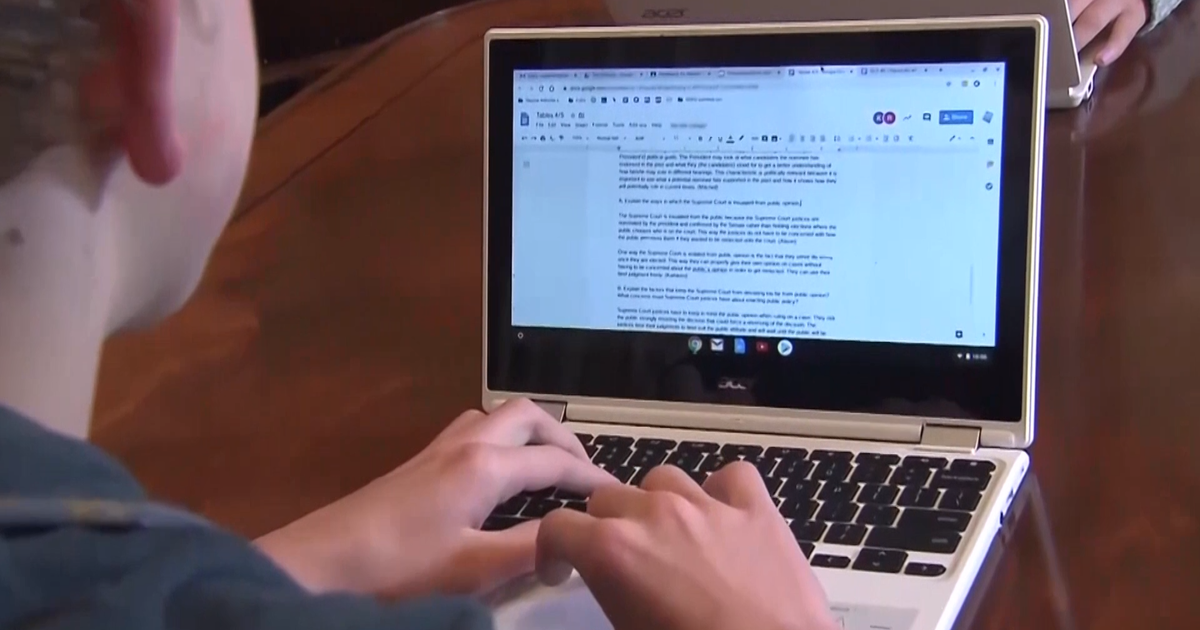
North Carolina educators are trying to navigate one of the most complex technological quandaries facing students in years: How to teach the value and ethical use of artificial intelligence without students becoming so reliant that they don’t learn how to reason for themselves.
Across the state, teachers are grappling with a mishmash of vague guidance and little clear direction. They know that too much AI can lead to cheating. But they know prohibition isn’t the answer.
“School is kind of the perfect place to learn how — before they go off into the real world,” says Karyn Wilson, a librarian at Green Hope High School in Cary. “… It would be doing our students a disservice not to at least bring it up with them.”
Most area school boards now have AI policies. But the policies in most districts consist of the same two paragraphs that commit to teaching AI literacy and treating misuse of AI in the same vein as plagiarism. And they largely don’t explain how any of those things will be done, or how schools will ensure learning and academic integrity in the age of one of the biggest knowledge-based game-changers in education, a WRAL News review of school district policies found.
Wake County, home to the state’s biggest school district, is one of just a few school districts in the greater Triangle region without an artificial intelligence policy. There, leaders hope to have a relatively robust AI policy in place later this fall, reflecting internal documents that explain how AI cheating should be enforced and how AI literacy should be taught.
Similarly, the North Carolina Department of Public Instruction has issued only guidance, though detailed and periodically updated since January 2024.
But guidance doesn’t have the force of a policy. New state law will require the state and school districts to have policies by 2028. Until then, managing and policing the use of artificial intelligence can take on many forms.
For some classrooms, it means laptops are put away and students receive limited homework assignments out of concern that they would use AI to do them.
Other teachers are finding ways to flip schoolwork, having students do assignments that would normally be homework assignments during class, by hand, to ensure they’re not using AI.
Some students think schools need to teach appropriate uses of artificial intelligence.
Wilson tries to teach students how to use AI ethically and safely. Many industries are using AI and expecting applicants to have familiarity with the technology.
Wilson also advises teachers on how to incorporate AI into assignments in a way that doesn’t impede learning. She has taught students how to use AI to create annotated bibliographies, generate images for presentations, and brainstorm ways to conduct research, such as keywords to enter into databases. She has also directed students to print out their sources and highlight them the old-fashioned way. Or to use AI to pull together references and then write their essays by hand.
No matter what, teachers need to check in on students as they progress through assignments and see their work as it unfolds, Wilson said.
“If you just give an assignment and then read the final result, you’re not seeing the way the student is working throughout the whole assignment,” she said. That, intentionally or unintentionally, gives students the space to use AI if they want to. It’s better to give students parameters about when they can and can’t use AI, rather than letting them decide for themselves, she said.
Going paper and pencil?
Academic integrity is at the heart of Wilson’s advice and how other teachers are pulling back on technology to a greater extent.
“Cheating is a big concern,” Wilson said. “A lot of the concerns I’ve heard are just around how do we catch students using AI, and it really isn’t a perfect system.”
AI detection software itself is often powered by AI and doesn’t always accurately guess whether a student used AI.
Some teachers go full paper-and-pencil instruction, and some use extensions for Google Docs that detect how students edited a file, including how long it took them to do it and how they added content to it over time.
Hayden Stephens is one of those teachers who’s shifted to pencil and paper. The third-year Broughton High School teacher says it’s the only approach she’s come up with that she’s confident will keep students from using AI to complete their work for them.
“I just don’t think that students learn if they’re copying answers from AI, or if they’re uploading their assignments and AI is spitting back answers,” Stephens said. “So we are strictly pen and paper, pencil and paper in my classroom. Everything that they do is on paper.”
Stephens recalled being in college when ChatGPT took off and how her classmates used AI to do their homework.
“Then they would turn around and have to do that kind of work on a test, and they’d have no idea how to do it,” she said.
Stephens and her fellow science teachers now see things the same way, she said.
Students didn’t love the no-tech rule in Stephens’ class at first. They’d want to watch something while completing their schoolwork. Stephens would explain they didn’t need that and that it was just a distraction.
But paper and pencil isn’t always the easiest approach. Teachers must still grapple with what happens when the students go home.
So Stephens doesn’t assign homework, aside from unit-long projects for honors students. Students write their papers in class so Stephens can watch them, though sometimes they can use their laptops.
“I don’t think that students are completing their homework honestly anymore, and therefore, it’s not helping them in any way,” Stephen said. “They’re plugging in all the problems into ChatGPT or Gemini, or whatever it is they’re using, and it’s spitting back answers. So it’s just a waste of their time to do, and it’s a waste of my time to grade. So the trade off was: ‘We’re not using technology in here, but you also do not have homework.’”
Since telling students to put their laptops away last year, Stephens has noticed an improvement in students’ schoolwork. Before, when they were trying to watch videos while working, they made careless errors. Now, she can see more critical thinking skills and problem-solving.
“They’re grasping the material so much better, so that then, when they go to do independent work, they have a much easier time completing that work to a higher standard than they were if they were listening to music while I was talking,” Stephens said.
Developing AI policies
In recent months, some Wake students have urged district officials to adopt a comprehensive artificial intelligence policy. That way, they say, the district can curb dishonest use of the technology and inadequate regulation of it.
Wake’s internal guidance says teachers shouldn’t use AI detectors. DPI guidance has urged against their use since January 2024.
In the coming years, the State Board of Education plans to adopt artificial intelligence literacy standards for kindergarten through 12th grades, based on input from university researchers. The Department of Public Instruction plans to adopt a model artificial intelligence policy based on research. Local school boards will be required to adopt an artificial intelligence policy, if they haven’t already, after a review of the model policy, though they aren’t required to mirror the model policy or meet any other requirements for one.
Ann Mary Thomas, a recent graduate of Green Level High School, told WRAL that AI had become a tool for her and that many teachers have been encouraging students to use it responsibly.
“There’s very, very few teachers who don’t think AI should be used,” she said.
Thomas recalled getting media literacy lessons and learning how to search on Google Scholar, an application that helps students search scholarly literature.
“I think the same needs to be done with AI,” she said.
AI literacy is a big piece that Stephens, the Broughton science teacher, is waiting for.
Although Stephens has shifted to mostly paper and pencil, she still believes students should get AI literacy lessons.
“AI literacy is important,” she said. “It’s not going anywhere. It’s just now developing. It’s only going to get bigger and better.”
Telling teachers to teach AI literacy without a clear curriculum would result in teachers all doing it differently, Stephens said. But it also would be challenging to have a uniform method for teachers to incorporate AI into their lessons, given differences in subject areas, she said.
Students also just assume AI is more accurate than it is and need to learn how and when to trust it, Stephens and Wilson said.
“With a lot of people I interact with, there’s this belief that AI is this all-knowing robot, where that’s just not how it works,” Wilson said.
Right now, there’s a tension of either-or when it comes to AI, Wilson said.
She wants students to be able to think for themselves and be skeptical and curious. But she doesn’t want them to be behind society or their peers, not knowing how to use AI responsibly when it becomes expected of them.
“It’s hard to kind of find that balance,” Wilson said. “So I think that’s something that I, as an educator, I really hope to find for them.”
