

A version of this feature ran in the October issue of BRAIN.
HASTINGS, United Kingdom — Victor Sandrin’s 36-year industry experience includes introducing and growing brands in the U.S., most notably Spank in 2013. While Spank had a presence here before his arrival, Sandrin expanded it by creating a distribution network.
With the September announcement of Whyte Bikes re-entering the U.S. market, Sandrin has been tasked as director of North American sales operations with a different strategy: building out a direct-to-dealer program, forgoing the distributor model, and committing to IBD sales. Whyte also will re-enter the German and Austrian markets with a similar direct-to-dealer model.
Whyte Bikes left the U.S. market after four years during COVID when its U.S. partner decided to consolidate brands. The British brand has a loyal following in Europe and was created in 1999 by Jon Whyte, described on the Whyte Bikes website as an “obsessive, maverick, lateral thinking design engineer. Someone for whom building bikes was part science, part instinct — but all emotion.” Before forming the company, Whyte was a Formula 1 engineer who designed the suspension system that helped the Benetton team win the 1994 world championship.
It became apparent if Whyte Bikes returned to the U.S., it would need to change the way it operated, Sandrin said.
“The distributor model works in European markets because the countries are smaller,” said Sandrin, whose first day at Whyte Bikes was Sept. 1. “It’s a more concentrated effort for distributors in those European markets. The U.S. is huge. The only way a distributor model works in the U.S. is either direct-to-consumer or they’re a massive company that already has the network and already has the distribution in place.”
Emphasis on the West and Rockies
Sandrin said in early September that he’s beginning to meet with shops in California, Utah, and Colorado. Whyte’s rollout initially will target the Pacific Northwest, West Coast, and Mountain regions. Its warehouse will be on the West Coast and the brand will establish a 3PL partnership. “We are going to hold some stock for dealers,” he said.
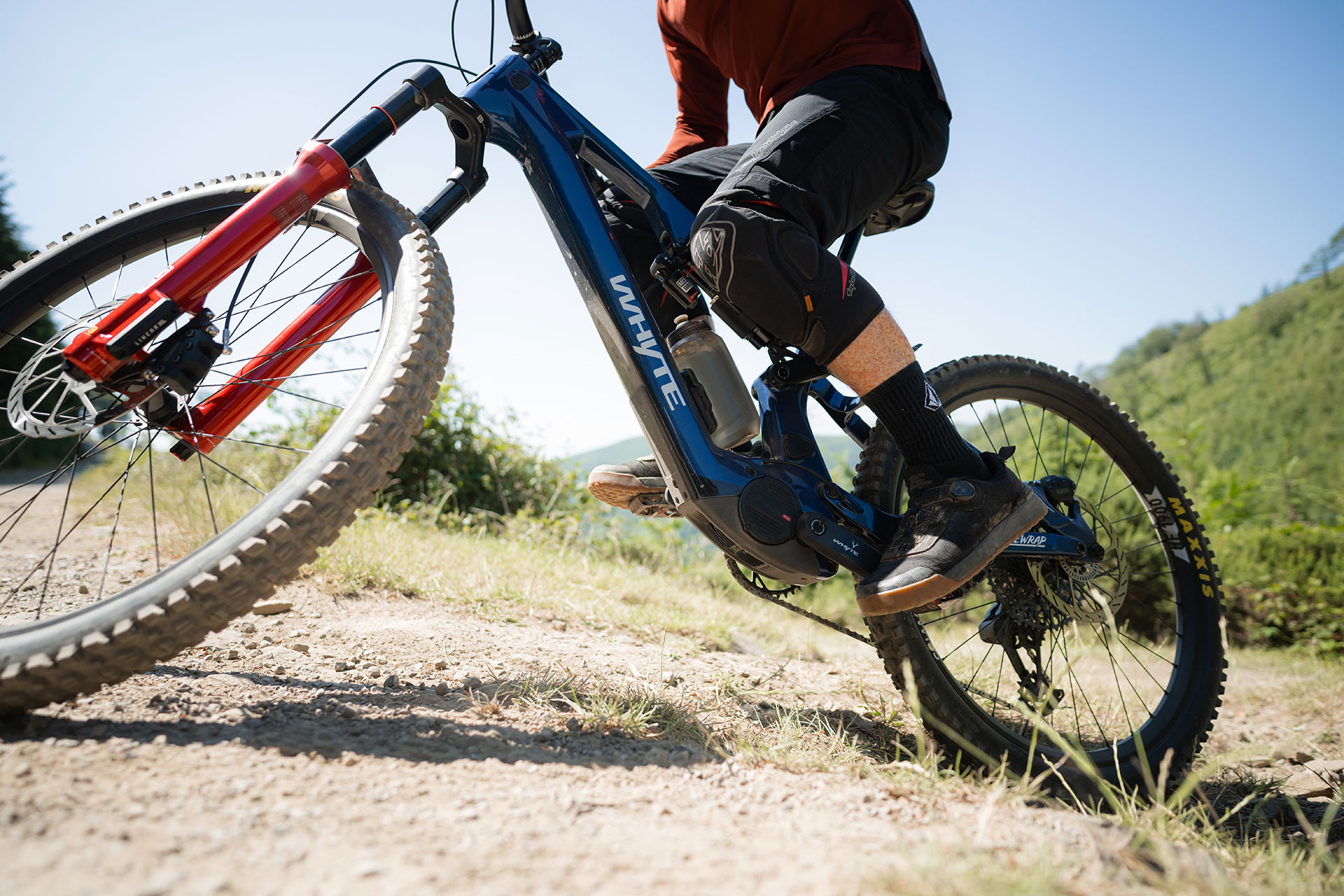
At first, Whyte will make available a limited number of models, highlighted by its new full-suspension carbon fiber e-MTB Karve line with an Avinox motor. The Avinox-powered hardtail Secta-E also will be available in the U.S. along with full-suspension pedal models the enduro Sythe and trail Syphon. Whyte Bikes are manufactured and assembled in Taiwan, Vietnam, Cambodia, with all R&D taking place in the Cotswolds, home to UK’s motorsport, defense, and aerospace industries. With various spec’s available for each, MSRPs for the U.S. lineup start at $2,999 and top out at $10,399.
Last year, Whyte Bikes had an independent audit of its e-bike safety standards and was recognized by getting included in the UK’s inaugural E-Bike Safety Register.
“The audit and the campaign aims to drive up awareness of safe and legally compliant e-bikes, offering consumers a trust mark that confirms that our bikes are rigorously safety-tested and fully U.K. road legal,” said Marketing Director Matt Skinner. “It’s no small undertaking, with a full and thorough audit of all our compliance, testing, and processes to verify that they meet rigorous legal and industry expectations in the responsible procurement and sale of safe and road legal e-bikes. … Our team works diligently and with dedication to make sure we produce e-bikes to the highest international standards for every market we sell in. This is made possible by working exclusively with our partners, such as Bosch and Avinox, to only build bikes with full systems.”
A dealer-sales program is crucial to selling and servicing e-MTBs, Sandrin said.
“E-bikes are a little more complicated. Issues can come up, and where does a customer go? Inevitably, what happens if you’re based on the West Coast? You have a customer down in Florida that has an issue with a bike. They’re on the other side of the country. How do you take care of them? If we do this right with IBDs, and this is where I find the value of IBDs so strong, is that they can take it into their shop. They can have it worked on. They’ve got that expertise where they bought the bike. Our spec’ is good; the price is good. I think that’s going to resonate with customers and for dealers as well.”
Concerning margins, Sandrin said theirs are “strong” and they won’t demand high minimums. “We’re going to be building the brand together,” he said. “We just want to work with great dealers, guys who are interested in building a brand. We won’t lead them astray. We’re here for the long haul, and we’re here to really support them.”
Looking toward Sea Otter
The centerpiece of the consumer launch will be at Sea Otter in April. Skinner said Whyte is investing in media partnerships, paid social, and dedicated U.S. content to bring awareness to the brand’s re-entry. Whyte also will participate in consumer demo events. “Everything we’re doing at the consumer level is designed to put riders into shops with the brand already on their radar,” Skinner said. “IBDs shouldn’t have to do the heavy lifting of explaining who we are — that’s our job, and we’re funding it.”
Whyte is under new ownership since it was last in the U.S. Nearly a year ago, Dublin-based private-equity firm Causeway Capital acquired Whyte Bikes Ltd. CEO Nikki Hawyes said the acquisition has benefited the brand. “The transition has been very smooth. Causeway is a great fit for Whyte Bikes. They believed in our plan from day one, and we have been delivering on everything we promised.”
Hawyes noted highlights include the launch of the Karve range, signing Aspire Sports to distribute the brand across 10 Central European countries.
Sandrin said he’s confident he can attract dealers to Whyte Bikes now that the industry has settled somewhat from the post-COVID turbulence that scarred many brands.
“I think the good thing about Whyte is there’s no baggage,” he said. “We didn’t go through the last five years in the U.S. market of discounting and selling it out everywhere. I feel like we’re starting to get toward the end of the whipsaw of COVID, where supply chains have normalized and all the discounting is starting to recede a little bit. I think people are starting to feel good again about bikes and growth. There are a lot of bigger brands that are going away like Accell Group. So I think there’s some opportunity in the market for a brand like Whyte here.”

