

At a Glance
- 371 sites audited;
- 37.03 average ClinicAI;
- 35 clinics above 50;
- 221 clinics below 40.
The Question Behind the Data
What happens when a clinic does everything the SEO playbook tells it to do and still fails to show up in AI answers?
That was the question I kept coming back to while reviewing our public benchmark data.
The conventional explanation is easy: the clinic probably needs more content, more landing pages, more FAQs, more educational articles, more “topical authority.”
The data points somewhere else.
We looked at 371 clinic websites in one national healthcare market:
- 333 general medical clinics;
- 20 plastic-surgery clinics;
- 18 dental clinics.
The market is Ukraine, so the exact percentages should be read as directional rather than universal.
This is not a study about medical quality, patient outcomes, or who is “the best clinic.” It is a study of AI discoverability: how understandable, attributable, and citable a clinic appears to answer engines and AI assistants.
That distinction matters because AI search is not just another traffic channel. When someone asks an AI assistant where to get dental implants, rhinoplasty, diagnostics, or fertility treatment, they are not just retrieving information. They are outsourcing part of the trust decision. And trust, in healthcare, is where most clinic websites still break.
Scoreboard by Cohort
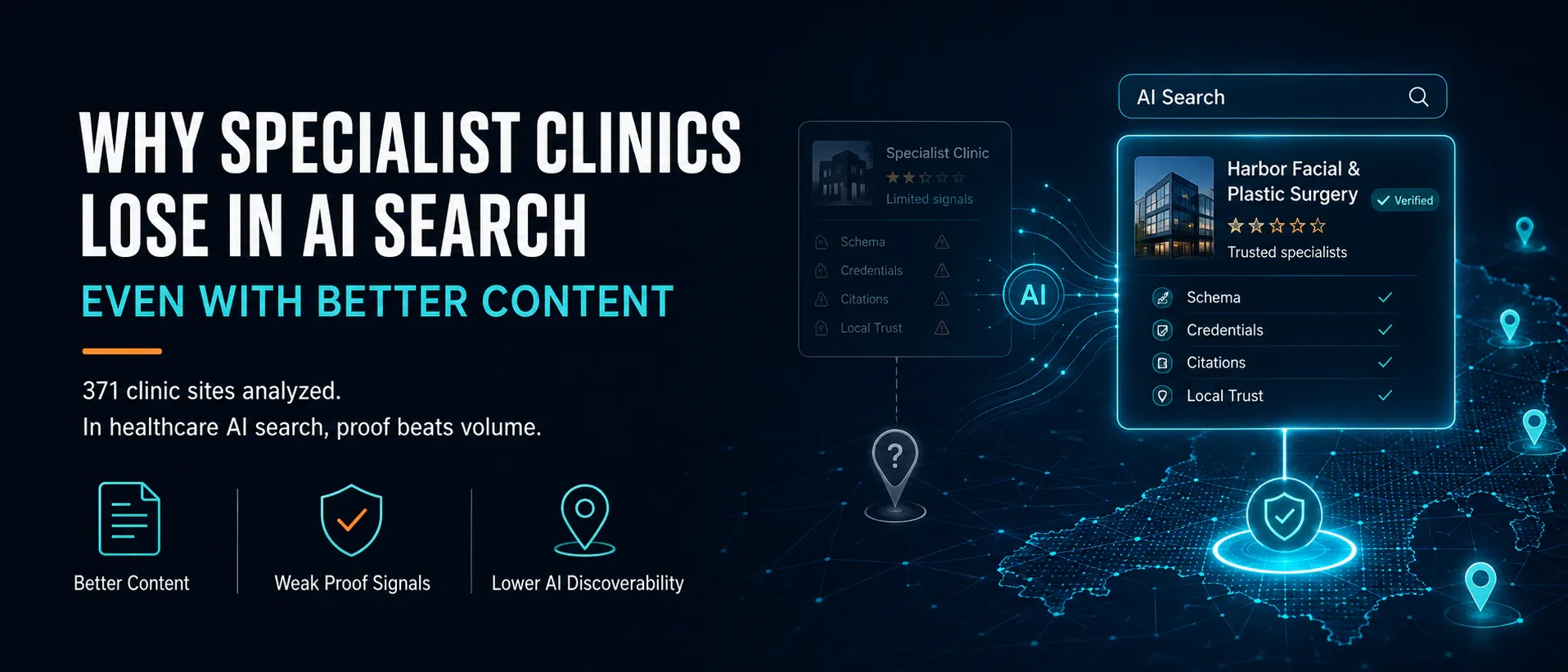
Specialist clinics are not losing because they publish worse content. They are losing because their local and entity proof is dramatically weaker.
The Category Is Earlier Than It Looks
Across all 371 sites, the average ClinicAI score is 37.03 and the median is 38.09. Only 35 clinics scored 50 or higher. Meanwhile, 221 clinics scored below 40.
That is not a mature market. That is an early market pretending to be mature because many sites look “complete” to human eyes. They have service pages. They have a glossy design. Likewise, they often have plenty of content. But from an AI-discoverability perspective, most are still structurally weak.
The benchmark we use is built from four layers:
- Tech;
- Content;
- EEAT;
- Local.
Where the System Breaks
- Content average: 52.62 – Imperfect, but not the main explanation for weak AI visibility;
- EEAT average: 36.92 – The biggest trust gap: weak attribution, weak evidence, and weak visible expertise;
- Local average: 41.24 – Entity grounding remains weak, and specialist clinics collapse here the most;
- Services vs ClinicAI correlation: 0.065 – Publishing more pages alone does not solve the retrieval problem.
This framework matters because AI systems do not simply retrieve pages the way traditional search often did. They retrieve claims from entities they can parse, connect, and trust. If your site says the right things but does not expose enough evidence around those claims, the content may still be useful for a human reader while remaining weak for AI retrieval.
The Biggest Mistake in Clinic GEO Advice
Most GEO advice for clinics still sounds like recycled SEO advice:
- publish more pages;
- answer more questions;
- expand service coverage;
- scale educational content.
That advice is not wrong. It is just incomplete enough to lead teams toward the wrong bottleneck.
Across the full 371-site dataset, average component scores were:
That should immediately shift the conversation. Content is not the weakest layer. EEAT is. And Local is weak enough that it becomes a second major drag on performance, especially for specialist cohorts.
In other words, the average clinic does not mainly suffer from saying too little. It suffers from proving too little.
The practical failure usually looks like this:
- no clear author or medical reviewer;
- no visible credentials behind the page;
- no source links for medical claims;
- no strong entity encoding for the clinic itself;
- no clear local grounding signals that help the model trust place-based recommendations.
That is the difference between content and proof.
More Service Pages Barely Help
If content scale were the main driver of AI visibility, then larger service catalogs should strongly outperform smaller ones. They do not.
Across the full benchmark, the correlation between Services and ClinicAI is just 0.065. That is close to noise.
This matters because many clinic growth teams still treat scale as strategy. The assumption goes like this: if we publish enough service pages, enough city variants, enough educational articles, visibility will eventually follow.
But a site with 120 weakly structured pages is not necessarily more useful to an answer engine than a site with 25 strong pages. Occasionally it is less useful.
At a certain point, more pages stop looking like authority and start looking like clutter:
- repeated templates;
- vague procedure descriptions;
- no explicit expert attribution;
- no source support;
- no clear local/entity proof.
That is why “publish more” is such a seductive but shallow recommendation in healthcare GEO. It treats retrieval like a content-volume contest when, in practice, it behaves more like a credibility filter.
The Real Story Appears When You Separate Specialist Clinics
The most interesting signal in the dataset is not the overall average. It is what happens when you isolate plastic surgery and dentistry from the broader general-clinic market.
Both specialist cohorts underperform the general market on overall ClinicAI. But they do not underperform because their content is weaker.
Specialist clinics outperform general clinics on Content and EEAT, but lose heavily on Local.
Read this table left to right: the specialist story is not “worse content.” It is “better content, weaker grounding.”
That table is the whole article in miniature. Plastic and dental clinics are already doing much of what marketers usually assume is the hard part. They publish more specific treatment content. They often have stronger topic depth. They even outperform general clinics on average EEAT. And still they lose.
Why? Because their Local layer collapses.
The average Content-Local gap is just 8.80 in general clinics. In plastic surgery it jumps to 32.23. In dentistry it reaches 32.74. That is not a normal imbalance. That is a structural disconnect.
The site says, “We know this topic.” The answer engine still cannot fully ground the entity behind the claim.
The Gap That Explains the Whole Problem
Plastic Surgery and Dentistry Break in Different Places
Lumping both specialist cohorts into one diagnosis would miss the more useful insight. They are weak in different ways.
Plastic Surgery: Stronger Editorial Signals, Weaker Local Anchoring
In plastic surgery, 12 of 20 sites score at least 55 on Content while remaining below 35 on Local. That is not what content poverty looks like. That is what trust-architecture incompleteness looks like.
- 45% of plastic clinics lack a valid physical address;
- 95% lack geo coordinates in Schema.
So the clinic may look polished, informed, even premium, while still being weakly encoded as a grounded local healthcare entity. For AI search, that is not a small technical miss. It is a legitimacy gap.
Dentistry: Better Topic Coverage, Thinner Attribution
Dentistry shows a related but slightly different pattern. Here, 13 of 18 sites score at least 55 on Content while staying below 35 on Local.
In the raw-audit subset, only 39% of dental clinics are missing doctor bios, which is materially better than the general cohort. But:
- 94% still lack FAQ schema markup;
- 72% still do not display author credentials.
So the content may explain the treatment. It may even answer the patient’s question. But it still exposes too little evidence about who stands behind the explanation. That is the kind of weakness a human reader may tolerate and an answer engine may not.
The Benchmark’s Most Consistent Pattern: The Evidence Chain Is Broken
The raw audit coverage is currently available for 336 of the benchmarked clinics:
- 298 general clinics;
- 20 plastic clinics;
- 18 dental clinics.
That subset is enough to make the systemic problem obvious.
Technical and Entity Gaps
- 97% lack MedicalProcedure schema;
- 96% lack Physician schema;
- 92% lack LocalBusiness schema;
- 89% lack FAQPage schema.
This is not an edge-case issue. These are foundational medical and entity primitives. When they are absent at this scale, it becomes much harder for AI systems to normalize what the clinic offers, who delivers it, and how the organization should be classified.
Content Structure Gaps
- 86% have no FAQ schema markup on content pages;
- 51% have doctor profiles with no proper bio;
- 22% lack a valid physical address.
Even these more “editorial” issues become more revealing once you split by cohort:
- doctor-bio gaps are 53% in general clinics, 30% in plastic, 39% in dental;
- missing valid addresses rise to 45% in plastic and 33% in dental.
So specialist clinics are often better at the content surface and worse at the grounding layer underneath it.
Trust and Attribution Gaps
- 93% have no terms of service page;
- 89% cite no scientific sources;
- 73% publish articles with no source links;
- 71% have no author blocks;
- 68% do not display author credentials;
- 59% do not display medical licenses.
These numbers matter because healthcare is a high-trust category. If a model is going to echo a clinic’s medical claim, it requires more than prose. It needs attribution, evidence, and traceable expertise.
And the specialist cohorts do not magically escape that problem:
- missing scientific sources reach 95% in plastic and 94% in dental;
- missing author credentials reach 72% in dental.
Local-Grounding Gaps
- 91% lack geo coordinates in Schema;
- 80% omit business hours in Schema.
This is where clinic GEO frequently gets misunderstood. Teams hear “AI search” and assume the work is mostly content strategy. But for healthcare, local entity clarity is part of the trust model. If the clinic is not clearly encoded as a real healthcare entity in a real place, the assistant has less confidence in recommending it for a real care decision.
What Separates the Leaders From Everyone Else
The fastest way to understand what matters is to compare the top and bottom quartiles of the full 371-site dataset.
The biggest separation between leaders and laggards is not publishing volume. It is visible proof.
The largest gap is not content. It is proof.
That is the main strategic takeaway. The leaders are not simply louder. They are easier to verify.
Their sites make it easier for a machine to understand:
- what the clinic does;
- who stands behind the pages;
- what evidence supports the claims;
- where the clinic operates as a real local entity.
That is the progression path from mid-market invisibility to stronger AI visibility. Not more publications. Better proof packaging.
What I Would Fix First If I Ran Clinic Growth
If I were working with a clinic based on this benchmark, I would not start with “publish 100 more pages.” I would start with four moves.
1. Make Expertise Visible
Show authors, reviewers, credentials, licenses, andhidden credibility behaves a lot like missing credibility
2. Rebuild Service Pages for Retrieval
Procedure pages should not read like brochure copy. They should make it easy to answer practical questions:
- what the procedure is;
- who it is for;
- when it is not appropriate;
- how the process works;
- what recovery looks like.
That makes the page more useful for both patients and answer engines.
3. Treat Local Entity Proof as Core GEO Work
Address consistency, Schema, geo coordinates, and business hours are not “cleanup.” They are ranking inputs in any category where recommendations are local and trust-sensitive.
4. Measure AI Visibility Below the Homepage Level
Sitewide averages hide the pages that matter commercially. The real question is not whether the domain is “doing okay.” It is whether the clinic is visible for its highest-value services.
Final Thought
The wrong summary of this benchmark would be: clinics need more content.
The right summary is harsher and more useful.
Clinics lose AI search because they keep mistaking publication for proof. And specialist clinics make that mistake easiest to see.
Plastic surgery and dentistry are already doing much of the editorial work teams assume will solve the problem. What they are missing is the final layer of trust packaging: entity clarity, local grounding, schema completeness, and explicit attribution.
In healthcare, retrieval is a credibility contest. If a model cannot verify who you are, who stands behind the page, what evidence supports the claims, and whether you are a real local medical entity, it cannot safely recommend you.
That is why the next winners in clinic GEO probably will not be the teams that publish the most. They will be the teams that make expertise easiest to trust.
If you want to inspect the public benchmark behind these numbers, the live country view is here: ClinGEO Ukraine Clinic Rating
.
