

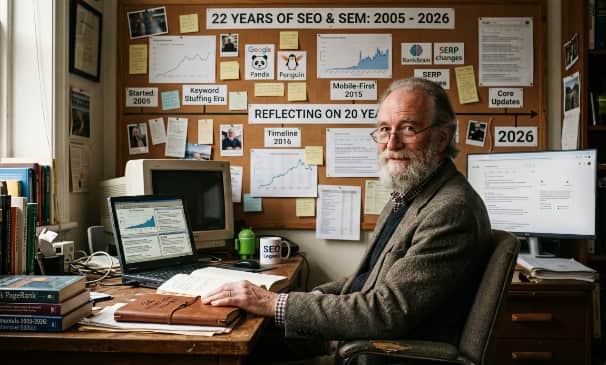
It is the time of year when I tend to reminisce as Browser Media is rapidly approaching its 21st birthday.
When I launched Browser Media back in September 2005, the world was very different. A stuttering dial-up connection was still a thing. The iPhone didn’t exist. There was no Facebook advertising, no Google Analytics as most people know it, and no such thing as a “content strategist”.
If you wanted your website to be found, the accepted wisdom was to stuff your keyword into the meta keywords tag, repeat it a bazillion times in the body copy, submit your site to a few hundred directories, and swap reciprocal links with anyone who would have you.
Unfortunately, that did actually work. For a while.
Two decades on, search is unrecognisable at surface level. The ten blue links have been squeezed by map packs, shopping carousels, video results, featured snippets, People Also Ask boxes and now AI-generated summaries sitting above everything else. Most searches happen on a phone. A growing share of them end without a click at all. The industry has renamed itself several times over, from SEO to inbound to content marketing to digital PR to, apparently, GEO.
But…….. if you ask me what actually changed, the honest answer is: not much.
The essence of search engine marketing
A search engine has one commercial problem to solve. If people type a question in and get rubbish back, they will eventually go somewhere else. Everything Google, Bing and now the AI assistants do flows from that. They are trying to work out which page best serves the person asking, and they are trying to do it at enormous scale without being gamed.
Which makes our job fairly simple to describe, if not simple to do. Be the thing that best serves whatever it is that a person is looking for.
That was true in 2005 and it is true now. What has changed is the accuracy with which the machines can tell the difference. In 2005 they were easy to fool because they were reading fairly crude signals: words on a page, links pointing at it. Today they are far better at assessing whether a page genuinely satisfies someone, whether a brand is actually known and trusted, and whether a piece of content was written by someone who is actually experienced in whatever it is they are writing about.
The bar has not actually moved – it is the measurement that has got a lot better.
A pattern of repeated (failed) shortcuts
In my humble opinion, there is a clear pattern that has repeated, without meaningful variation, for twenty years.
Someone finds a gap between what the algorithm can measure and what it is trying to measure. They exploit that gap at volume. It works, sometimes spectacularly. An entire cottage industry springs up around it, complete with case studies, webinars and tools sold by the month. Then the search engines close the gap, the rankings evaporate overnight, and everyone who built their business on it has a very bad quarter.
Keyword stuffing. Doorway pages. Article directories. Link farms. Paid link networks. Exact match domains. Spun content. Guest posting at scale. Private blog networks. Parasite SEO. Most recently, it has been hosing thousands of AI-generated pages onto a domain and hoping volume does the work.
Every time, the response was the same, because spam is not a moral issue for a search engine, it is an existential one. This is worth being clear about: the vast majority of algorithm updates that people agonise over are not attempts to invent a new definition of quality. They are attempts to stop people gaming the old one. The target has almost always been the spam, not you.
Which is why the sites that got hurt by update after update tend to be the sites that were trying to game the algorithm. It really was that simple.
What is good SEO?
Strip out the fashionable buzzwords and the latest fads, you are left with a short list that has not changed since we started:
Knowing who you are actually talking to
Not a persona document that nobody reads, but a real understanding of what your customers are worried about, what they are comparing you against, what would make them pick up the phone, and what language they use when they describe the problem. Keyword research, done properly, has always been one of the most potent forms of customer research.
Answering the question better than anyone else
Fully, honestly, without making people hunt for it. If someone lands on your page and gets what they came for, almost everything else takes care of itself.
Making the site easy to use and easy to crawl
Fast, clean, logical, accessible, no barriers between the visitor (whether a bot or a human) and what they wanted. The technical specifics have evolved over time but the principle has not.
Earning your reputation rather than buying it
Being cited, recommended, mentioned and linked to because you are worth citing. That was the original insight behind PageRank and it remains the thing the AI models are effectively doing when they decide which brands to name.
To be honest, none of this is glamorous. It does not make for a very exciting conference talk, but I am long enough in the tooth and have enough grey hairs to know that it works.
Is the AI era the exception?
Plenty of people will tell you that generative search changes everything and that you now need an entirely new discipline to survive it. I am not convinced… What actually gets pulled into an AI answer is clear, credible, well-structured content from a brand that has some standing, on a site that a machine can read without a fight.
If that sounds familiar, it should. It is the same list that we have applied to SEO for so long.
The one thing that has genuinely shifted is the premium on being a brand people know and ask for by name. When the results page gives you less room and fewer clicks, being the business a customer was already looking for matters more, not less. Which is, again, an argument for delighting your audience rather than optimising for a crawler.
TL;DR
If I could give one piece of advice to a business owner starting out today, it would be the same one I would have given in 2005.
Don’t chase the algorithm. You will always be a step behind it, you will spend a fortune on tactics with a shelf life, and the day the update lands you will discover you were renting your rankings rather than owning them.
Aim to delight your target audience instead. Understand them properly, be genuinely useful to them, and make it easy for them to buy from you.
The algorithm has been getting steadily better at spotting exactly that for twenty years, which means the gap between “what works in search” and “what is good for your customers” narrows a little more every year.
That is not a trend. It is intelligent marketing, and it always was.
