

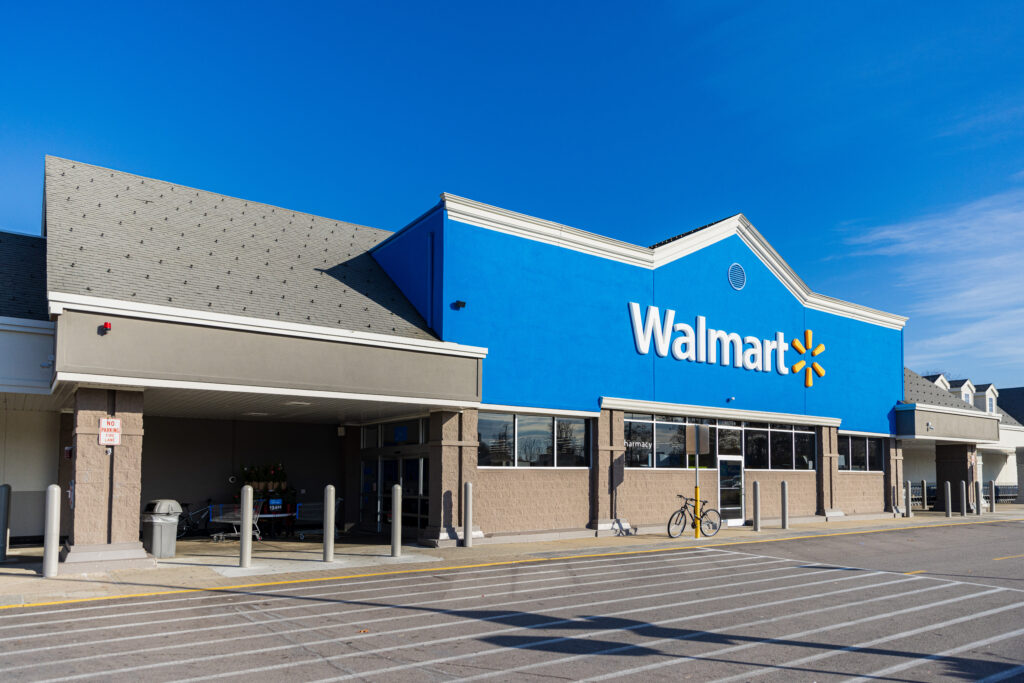
Walmart online sales growth in the U.S. exceeded 20% for the 10th consecutive quarter in its fiscal Q2 2027.
That far outpaced its total sales growth. In its fiscal Q2 2027 — which ended July 31, 2026 — Walmart total revenue reached about $187.94 billion. That was 5.9% year-over-year growth from $177.40 billion.
Walmart net sales in Q2 accounted for $186.10 billion of that revenue, with membership and other income comprising the remaining $1.84 billion. Total sales grew at the same rate as revenue, at 5.9%, up from $175.75 billion the prior year.
Membership and other income grew 11.2% from $1.65 billion the year before. Walmart+ members spend four times as much as nonmembers, according to the retailer.
CEO John Furner attributed Walmart’s Q2 growth to its omnichannel approach and its price reduction. He said the retailer benefited from receiving IEEPA tariff refunds during the quarter, which it then invested into lowering product prices.
Walmart was eligible for about $2.9 billion in tariff refunds during Q2, or about 0.5% of its annual U.S. net sales. Chief financial officer John David Rainey said the retailer has “received substantially all of” those refunds to date.
“Customers tell us they’re still feeling some pressure, but it’s clear,” Furner said on the retailer’s earnings call. “Customers are looking for value and convenience and they want things fast, and that’s where Walmart shines.”
Walmart ranks No. 2 in Digital Commerce 360’s Top 1000 Database. The market research tool tracks North America’s largest online retailers by their annual ecommerce sales.
Walmart is No. 37 in Digital Commerce 360’s all-new AI Rankings. That set of rankings is available in the Top 1000 Pro with AI Database.
Walmart online sales in Q2 2027
In its fiscal Q2 2027, Walmart global online sales increased 23% year over year. The retailer attributed that to store-fulfilled pickup and delivery, as well as growth in the Walmart marketplace.
Globally, that marked six consecutive quarters of Walmart ecommerce sales increasing by at least 20% year over year.
In the U.S., specifically, Walmart ecommerce sales increased 24% in Q2. Meanwhile, international Walmart ecommerce sales grew 19% year over year in Q2.
At Sam’s Club in the U.S., online sales increased 26% year over year in Q2. Delivery from Sam’s Club locations increased triple digits following its launch of one-hour delivery in April.
The Walmart Marketplace also grew 52% year over year in Q2.
“The sustained growth we’ve seen in ecommerce across the company over multiple years points to more than a digital success story,” Furner said. “It’s evidence that customers and members increasingly choose Walmart because they know we combine low prices across a broad assortment with speed and convenience.”
He noted that 30% of Walmart International sales now come from ecommerce channels. Canada, China and India saw strong ecommerce growth in Q2, he added.
Furner said the number of customers using Walmart’s Sparky AI agent increased 70% year over year in Q2.
Walmart customers using Sparky for shopping spend 40% more per order than those who don’t, he noted.
Walmart delivery speeds in Q2
Furner said Walmart’s fast delivery in the U.S. grew 48% year over year in Q2.
“Speed matters, and we have a significant competitive advantage,” Furner said. “Our physical footprint, fulfillment infrastructure and local delivery capabilities allow us to move closer to customers while maintaining an attractive cost structure.”
Walmart has now expanded its under-30-minute delivery offering into 38 markets within the U.S.
“And speed isn’t simply a fulfillment metric; it’s an acquisition strategy,” Furner said. “Customers who use fast delivery shop with us more frequently, they deepen engagement with us, and they’re more likely to become Walmart+ members.”
He also noted that Walmart has invested in automation, technology, fulfillment capacity and its physical network. Those investments allow Walmart to move inventory more efficiently, deliver faster, help with in-stock levels and support its first-party and marketplace businesses, he added.
“They also strengthen the economics of our omnichannel model,” Furner said. “And as we improve density and utilization across our network, speed and profitability reinforce one another.”
Rainey said fee-based fast deliveries represented “an all-time high” of 37% of deliveries Walmart fulfilled through its stores in Q2.
Additionally, 3,100 of Walmart’s U.S. stores use automated freight to some capacity. The retailer now processes more than half of its ecommerce fulfillment volume through automated facilities
Percentages may not align due to rounding. Check back for more earnings reports. See our previous article on Walmart online sales.
Do you rank in our databases?
Submit your data and we’ll see where you fit in our next ranking update.
Stay on top of the latest developments in the online retail industry. Sign up for a complimentary subscription to Digital Commerce 360 Retail News. Follow us on LinkedIn, X (formerly Twitter), Facebook and YouTube. Be the first to know when Digital Commerce 360 publishes news content.
