

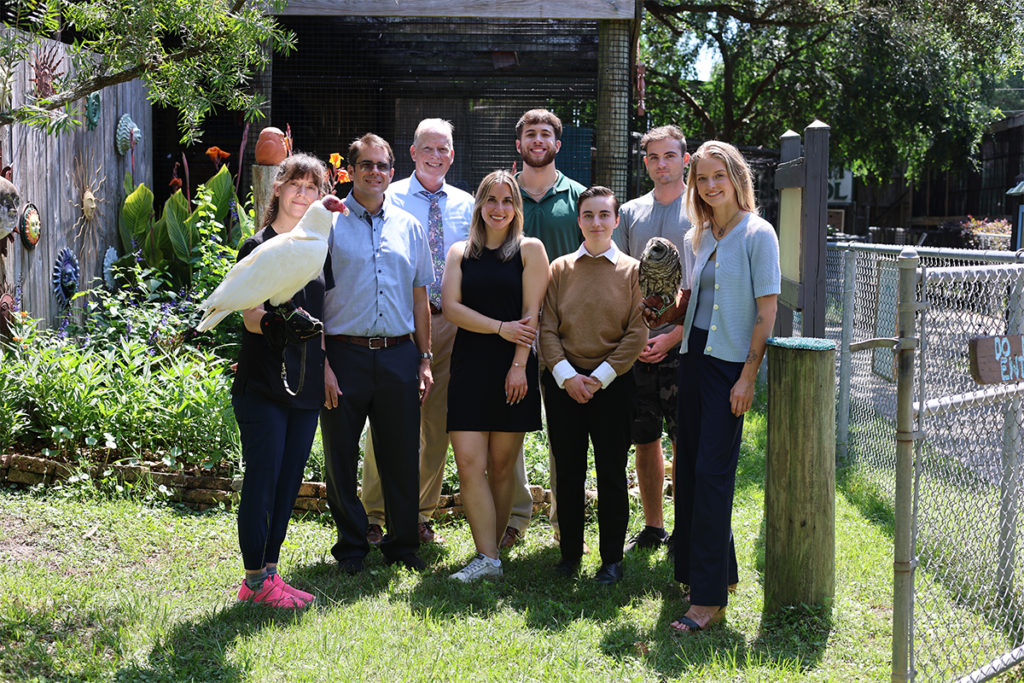
University of West Florida marketing students put classroom knowledge into practice by conducting professional-level research for The Wildlife Sanctuary of Northwest Florida, helping the organization evaluate community support for a proposed major capital campaign to relocate its facility out of a chronic flood zone.
Undergraduate students in a Spring 2026 Marketing Research class taught by Dr. James Mead, chair of the Department of Commerce and professor of marketing, designed and conducted a capital campaign feasibility study for The Wildlife Sanctuary. Working with real-world survey data, the students examined community awareness and mission alignment, donor profiles, willingness to give, responses to potential campaign messages, and which features of a proposed new facility most motivate potential donors.
The students designed and fielded a Qualtrics survey to residents and supporters across Escambia and Santa Rosa counties, collecting data through multiple methods. They then used statistical analysis, including regression analysis and donor segmentation, to translate the findings into strategic recommendations for The Wildlife Sanctuary.
The research found that the community has the capacity to support The Wildlife Sanctuary’s capital campaign, particularly when the campaign strategically targets donors rather than relying primarily on broad-based giving. Prior supporters were significantly more likely to give and to give at higher levels than individuals who were newly introduced to the organization.
Students also found that emotional, animal-centered storytelling was more effective than transactional appeals. Among the messages tested were “Amelia’s Story,” – Amelia is a bald eagle who was rescued by volunteers during a major flood with a gunshot wound and now has a forever home at the sanctuary – “A Center for You” and “Buy 1 Square Foot of Dry Ground.” The research further identified the donor segments most likely to contribute and the factors that statistically predict giving.
Based on their findings, students recommended that The Wildlife Sanctuary focus its campaign on prior donors while using social media and other outreach to engage the broader community. They also recommended leading with emotional, story-driven messaging centered on individual animals and the need to move the Sanctuary out of a flood zone, as well as prioritizing facility features that most strongly motivated higher-value donors, including a wildlife hospital.
The Wildlife Sanctuary has since launched its capital campaign and applied for an additional grant to support relocation to a new, purpose-built 10-acre campus.
“This is what we want a business education to look like. Our students took on a real client with a real decision to make, and the Wildlife Sanctuary walked away with research it could actually use. That’s a win for the students and genuine impact for the community,” Mead said. “I’m proud of this class. These were undergraduates producing professional-grade research. Such work would cost $50K+ if performed by a marketing research firm.”
For Ashley Alexander, one of the UWF students who worked on the project, the experience has continued beyond the classroom. Alexander now serves as a long-term intern with The Wildlife Sanctuary, where she is applying the research findings through social media outreach, donor engagement and grant writing.
“Conducting research through Dr. Mead’s Marketing Analytics course provided strengths I needed to use the sanctuary’s Customer Relationship Management System,” Alexander said. “Researching this donor base in the classroom gave insight to the target audience I am now marketing towards and communicating with at the Wildlife Sanctuary. These are skills that I will take with me for my future career and have been made possible through the UWF Lewis Bear Jr. College of Business.”
The research is also strengthening The Wildlife Sanctuary’s efforts to secure outside grant funding. The study demonstrates to funding agencies that the community both supports the organization’s mission and can self-fund much of its own needs, reflecting the reputation and trust the Sanctuary has earned locally. That evidence of community backing positions grant funding not as a lifeline, but to take an already successful organization to the next level.
“The feasibility study has already been used in meetings when discussing relocation with various partners to show that we are desired and supported by the community from a financial perspective,” said Leah Schultz, development coordinator at The Wildlife Sanctuary of Northwest Florida. “Proving that we as an organization have a mission that our community believes in will be highly important moving forward.”
The project reflects the Lewis Bear Jr. College of Business’ commitment to experiential learning that connects students with organizations and businesses throughout Northwest Florida. By working with a live client, students gained hands-on experience with research methods and strategic decision-making while producing work with tangible value for a community organization.
To learn more about the Lewis Bear Jr. College of Business, visit uwf.edu/lbjcob. To learn more about The Wildlife Sanctuary of Northwest Florida, visit pensacolawildlife.com.
