

Abstract
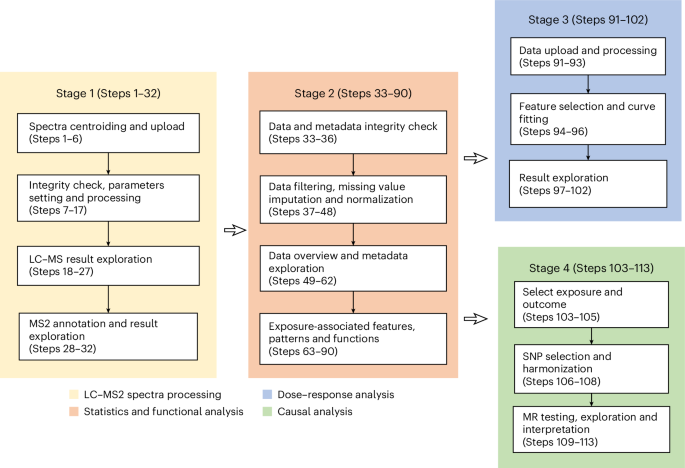
Exposomics is an emerging field of research that aims to comprehensively investigate individuals’ environmental exposures and how these exposures relate to health outcomes. Liquid chromatography–tandem mass spectrometry is widely used in exposomics studies. MetaboAnalyst (https://www.metaboanalyst.ca/) is a widely used platform for statistical and functional analysis of metabolomics data. The current MetaboAnalyst 6.0 release incorporates updates to meet the needs of exposomics studies, including improved support for tandem mass spectrometry compound identification, exposome annotation, dose–response analysis and linking to genetics and functions. Here we extend our 2022 Nature Protocol by providing step-by-step instructions on how to use MetaboAnalyst 6.0 for exposomics data analysis, including: liquid chromatography–tandem mass spectrometry spectra processing and compound identification (Stage 1), exposomics data processing and exploratory analysis (Stage 2), dose–response modeling to study metabolic responses to exposure levels (Stage 3) and leveraging known genetic associations for causal inference (Stage 4). We demonstrate Stages 1–3 using data from a recent blood exposomics study concerning electronic waste exposure. Stage 4 is illustrated through an investigation of the potential causal link between ʟ-isoleucine and type 2 diabetes. Stage 1 may take ~2 h to complete depending on server load, and the remaining stages may be executed in a total of ~90 min.
Key points
-
This protocol provides instructions for four key tasks in liquid chromatography–tandem mass spectrometry-based exposomics studies: (1) raw spectra processing—enables sensitive peak detection and compound annotation; (2) exploratory data analysis—provides quality control, data cleaning, statistical analysis and visualization; (3) dose–response analysis—quantifies the relationship between exposure levels and biological or phenotypic effects; and (4) causal inference—estimates causal relationships between exposures and health outcomes using genetic variants as instrumental variables.
This is a preview of subscription content, access
Access options
- Purchase on SpringerLink
- Instant access to the full article PDF.
Prices may be subject to local taxes which are calculated during checkout
Subjects
- Computational platforms and environments
- Medical research
- Software
Data availability
All data supporting this Protocol are available within the Protocol and its Supplementary Information. The original dataset and metadata table used as the e-waste example in this Protocol are available from our previously published paper13.
Code availability
MetaboAnalyst 6.0 is freely available at https://metaboanalyst.ca/. The underlying R package is available via GitHub at https://github.com/xia-lab/MetaboAnalystR. The current protocol is based on MetaboAnalystR v4.2.0 available via GitHub at https://github.com/xia-lab/MetaboAnalystR/releases/tag/v4.2.0. It is available via Zenodo at https://doi.org/10.5281/zenodo.17393838 (ref. 67). MetaboAnalyst-Pro Enterprise Solution is available for local installation at https://www.xialab.ai/protools.xhtml.
References
-
Abdellaoui, A., Yengo, L., Verweij, K. J. H. & Visscher, P. M. 15 years of GWAS discovery: realizing the promise. Am. J. Hum. Genet.110, 179–194 (2023).
-
Wild, C. P. Complementing the genome with an ‘exposome’: the outstanding challenge of environmental exposure measurement in molecular epidemiology. Cancer Epidemiol. Biomarkers Prev.14, 1847–1850 (2005).
-
Vermeulen, R., Schymanski, E. L., Barabási, A. L. & Miller, G. W. The exposome and health: where chemistry meets biology. Science367, 392–396 (2020).
-
Escher, B. I. et al. From the exposome to mechanistic understanding of chemical-induced adverse effects. Environ. Int.99, 97–106 (2017).
-
Hu, X. et al. A scalable workflow to characterize the human exposome. Nat. Commun.12, 5575 (2021).
-
Maitre, L. et al. Multi-omics signatures of the human early life exposome. Nat. Commun.13, 7024 (2022).
-
Xia, J., Mandal, R., Sinelnikov, I. V., Broadhurst, D. & Wishart, D. S. MetaboAnalyst 2.0-a comprehensive server for metabolomic data analysis. Nucleic Acids Res.40, W127–W133 (2012).
-
Xia, J., Sinelnikov, I. V., Han, B. & Wishart, D. S. MetaboAnalyst 3.0-making metabolomics more meaningful. Nucleic Acids Res.43, W251–W257 (2015).
-
Chong, J. et al. MetaboAnalyst 4.0: towards more transparent and integrative metabolomics analysis. Nucleic Acids Res.46, W486–W494 (2018).
-
Pang, Z. et al. MetaboAnalyst 5.0: narrowing the gap between raw spectra and functional insights. Nucleic Acids Res.49, W388–W396 (2021).
-
Xia, J., Psychogios, N., Young, N. & Wishart, D. S. MetaboAnalyst: a web server for metabolomic data analysis and interpretation. Nucleic Acids Res.37, W652–W660 (2009).
-
Li, S., Siddiqa, A., Thapa, M., Chi, Y. & Zheng, S. Trackable and scalable LC–MS metabolomics data processing using asari. Nat. Commun.14, 4113 (2023).
-
Pang, Z., Viau, C., Fobil, J. N., Basu, N. & Xia, J. Comprehensive blood metabolome and exposome analysis, annotation, and interpretation in E-Waste workers. Metabolites14, 671 (2024).
-
Pang, Z. et al. MetaboAnalystR 4.0: a unified LC–MS workflow for global metabolomics. Nat. Commun.15, 3675 (2024).
-
Holland-Letz, T. & Kopp-Schneider, A. Optimal experimental designs for dose–response studies with continuous endpoints. Arch. Toxicol.89, 2059–2068 (2015).
-
Ewald, J., Soufan, O., Xia, J. & Basu, N. FastBMD: an online tool for rapid benchmark dose–response analysis of transcriptomics data. Bioinformatics37, 1035–1036 (2021).
-
Phillips, J. R. et al. BMDExpress 2: enhanced transcriptomic dose–response analysis workflow. Bioinformatics35, 1780–1782 (2019).
-
Yao, C. H. et al. Dose–response Metabolomics to understand biochemical mechanisms and off-target drug effects with the TOXcms Software. Anal. Chem.92, 1856–1864 (2020).
-
Sanderson, E. et al. Mendelian randomization. Nat. Rev. Methods Primershttps://doi.org/10.1038/s43586-021-00092-5 (2022).
-
Misra, B. B. Advances in high resolution GC-MS technology: a focus on the application of GC-Orbitrap-MS in metabolomics and exposomics for FAIR practices. Anal. Methods13, 2265–2282 (2021).
-
Tsugawa, H. et al. A lipidome atlas in MS-DIAL 4. Nat. Biotechnol.38, 1159–1163 (2020).
-
Tsugawa, H. et al. Hydrogen rearrangement rules: computational MS/MS fragmentation and structure elucidation using MS-FINDER software. Anal. Chem.88, 7946–7958 (2016).
-
Schmid, R. et al. Integrative analysis of multimodal mass spectrometry data in MZmine 3. Nat. Biotechnol.41, 447–449 (2023).
-
Williams, A. J. et al. The CompTox Chemistry Dashboard: a community data resource for environmental chemistry. J. Cheminform.9, 61 (2017).
-
Glüge, J., McNeill, K. & Scheringer, M. Getting the SMILES right: identifying inconsistent chemical identities in the ECHA database, PubChem and the CompTox Chemicals Dashboard. Environ. Sci. Adv.2, 612–621 (2023).
-
Sanderson, E. Multivariable Mendelian randomization and mediation. Cold Spring Harb. Perspect. Med. https://doi.org/10.1101/cshperspect.a038984 (2021).
-
Talavera Andújar, B. et al. Exploring environmental modifiers of LRRK2-associated Parkinson’s disease penetrance: an exposomics and metagenomics pilot study on household dust. Environ. Int.194, 109151 (2024).
-
Huang, Z. et al. Longitudinal mapping of personal biotic and abiotic exposomes and transcriptome in underwater confined space using wearable passive samplers. Environ. Sci. Technol.58, 5229–5243 (2024).
-
Ewald, J. D. et al. Web-based multi-omics integration using the Analyst software suite. Nat. Protoc.19, 1467–1497 (2024).
-
Zhou, G., Ewald, J. & Xia, J. OmicsAnalyst: a comprehensive web-based platform for visual analytics of multi-omics data. Nucleic Acids Res.49, W476–W482 (2021).
-
Lu, Y. et al. MicrobiomeAnalyst 2.0: comprehensive statistical, functional and integrative analysis of microbiome data. Nucleic Acids Res.51, W310–W318 (2023).
-
Liu, P. et al. ExpressAnalyst: a unified platform for RNA-sequencing analysis in non-model species. Nat. Commun.14, 2995 (2023).
-
Srigboh, R. K. et al. Multiple elemental exposures amongst workers at the Agbogbloshie electronic waste (e-waste) site in Ghana. Chemosphere164, 68–74 (2016).
-
Vanweert, F., Schrauwen, P. & Phielix, E. Role of branched-chain amino acid metabolism in the pathogenesis of obesity and type 2 diabetes-related metabolic disturbances BCAA metabolism in type 2 diabetes. Nutr. Diabetes12, 35 (2022).
-
Yu, D. et al. The adverse metabolic effects of branched-chain amino acids are mediated by isoleucine and valine. Cell Metab.33, 905–922 (2021).
-
Liu, R. et al. Gut microbiome and serum metabolome alterations in obesity and after weight-loss intervention. Nat. Med.23, 859–868 (2017).
-
Pedersen, H. K. et al. Human gut microbes impact host serum metabolome and insulin sensitivity. Nature535, 376–381 (2016).
-
Kessner, D., Chambers, M., Burke, R., Agus, D. & Mallick, P. ProteoWizard: openics24, 2534–2536 (2008)
-
Pang, Z. et al. Using MetaboAnalyst 5.0 for LC-HRMS spectra processing, multi-omics integration and covariate adjustment of global metabolomics data. Nat. Protoc.17, 1735–1761 (2022).
-
Pang, Z., Chong, J., Li, S. & Xia, J. MetaboAnalystR 3.0: toward an optimized workflow for global metabolomics. Metabolites10, 186 (2020).
-
Tautenhahn, R., Böttcher, C. & Neumann, S. Highly sensitive feature detection for high resolution LC/MS. BMC Bioinformatics9, 504 (2008).
-
Wishart, D. S. et al. HMDB 5.0: the Human Metabolome Database for 2022. Nucleic Acids Res.50, D622–D631 (2021).
-
Mohammed Taha, H. et al. The NORMAN Suspect List Exchange (NORMAN-SLE): facilitating European and worldwide collaboration on suspect screening in high resolution mass spectrometry. Environ. Sci. Eur.34, 104 (2022).
-
Bourgon, R., Gentleman, R. & Huber, W. Independent filtering increases detection power for high-throughput experiments. Proc. Natl Acad. Sci. USA107, 9546–9551 (2010).
-
Chi, Y. et al. Constructing a consensus serum metabolome. Preprint at bioRxivhttps://doi.org/10.1101/2025.05.07.652782 (2025).
-
Mahieu, N. G. & Patti, G. J. Systems-level annotation of a metabolomics data set reduces 25000 features to fewer than 1000 unique metabolites. Anal. Chem.89, 10397–10406 (2017).
-
Wei, R. et al. Missing value imputation approach for mass spectrometry-based metabolomics data. Sci. Rep.8, 663 (2018).
-
Li, B. et al. Performance evaluation and online realization of data-driven normalization methods used in LC/MS based untargeted metabolomics analysis. Sci. Rep.6, 38881 (2016).
-
Kim, J. et al. Smoking and passive smoking increases mortality through mediation effect of cadmium exposure in the United States. Sci. Rep.13, 3878 (2023).
-
Xu, M. Y. et al. Metabolomics analysis and biomarker identification for brains of rats exposed subchronically to the mixtures of low-dose cadmium and chlorpyrifos. Chem. Res. Toxicol.28, 1216–1223 (2015).
-
Ritchie, M. E. et al. Limma powers differential expression analyses for RNA-sequencing and microarray studies. Nucleic Acids Res.43, e47 (2015).
-
Ritz, C., Baty, F., Streibig, J. C. & Gerhard, D. Dose–response analysis using R. PLoS ONE10, e0146021 (2015).
-
Akbar, A. et al. Exogenous menadione sodium bisulphite alleviates detrimental effects of alkaline stress on wheat (Triticum aestivum L.). Physiol. Mol. Biol. Plants28, 1889–1903 (2022).
-
Rasheed, R., Arslan Ashraf, M., Kamran, S., Iqbal, M. & Hussain, I. Menadione sodium bisulphite mediated growth, secondary metabolism, nutrient uptake and oxidative defense in okra (Abelmoschus esculentus Moench) under cadmium stress. J. Hazard. Mater.360, 604–614 (2018).
-
Rebrin, I. & Sohal, R. S. Pro-oxidant shift in glutathione redox state during aging. Adv. Drug Deliv. Rev.60, 1545–1552 (2008).
-
Uthayakumar, B. et al. Age-associated change in pyruvate metabolism investigated with hyperpolarized (13) C-MRI of the human brain. Hum. Brain Mapp.44, 4052–4063 (2023).
-
Chang, L., Zhou, G. & Xia, J. mGWAS-Explorer 2.0: causal analysis and interpretation of metabolite-phenotype associations. Metaboliteshttps://doi.org/10.3390/metabo13070826 (2023).
-
Elsworth, B. et al. The MRC IEU OpenGWAS data infrastructure. Preprint at bioRxivhttps://doi.org/10.1101/2020.08.10.244293 (2020).
-
Hemani, G., Tilling, K. & Davey Smith, G. Orienting the causal relationship between imprecisely measured traits using GWAS summary data. PLoS Genet.13, e1007081 (2017).
-
Burgess, S. & Thompson, S. G. Interpreting findings from Mendelian randomization using the MR-Egger method. Eur. J. Epidemiol.32, 377–389 (2017).
-
Ito, K., Bahry, M. A., Hui, Y., Furuse, M. & Chowdhury, V. S. Acute heat stress up-regulates neuropeptide Y precursor mRNA expression and alters brain and plasma concentrations of free amino acids in chicks. Comp. Biochem. Physiol. A187, 13–19 (2015).
-
Shibata, T., Takaguri, A., Ichihara, K. & Satoh, K. Inhibition of the TNF-α-induced serine phosphorylation of IRS-1 at 636/639 by AICAR. J. Pharmacol. Sci.122, 93–102 (2013).
-
Awazawa, M. et al. A microRNA screen reveals that elevated hepatic ectodysplasin A expression contributes to obesity-induced insulin resistance in skeletal muscle. Nat. Med.23, 1466–1473 (2017).
-
Avsec, Z. et al. Advancing regulatory variant effect prediction with AlphaGenome. Nature649, 1206–1218 (2026).
-
Lawlor, D. A., Tilling, K. & Davey Smith, G. Triangulation in aetiological epidemiology. Int. J. Epidemiol.45, 1866–1886 (2016).
-
Elsworth, B. & Gaunt, T. R. MELODI Presto: a fast and agile tool to explore semantic triples derived from biomedical literature. Bioinformatics37, 583–585 (2020).
-
Pang, Z. et al. xia-lab/MetaboAnalystR: MetaboAnalystR 4.2: a unified LC–MS/MS workflow for global metabolomics and exposomics. Zenodohttps://doi.org/10.5281/zenodo.17393838 (2025).
-
Broeckling, C. D. et al. Current practices in LC–MS untargeted metabolomics: a scoping review on the use of pooled quality control samples. Anal. Chem.95, 18645–18654 (2023).
-
Adusumilli, R. & Mallick, P. Data conversion with ProteoWizard msConvert. Methods Mol. Biol.1550, 339–368 (2017).
-
Kuhl, C., Tautenhahn, R., Böttcher, C., Larson, T. R. & Neumann, S. CAMERA: an integrated strategy for compound spectra extraction and annotation of liquid chromatography/mass spectrometry data sets. Anal. Chem.84, 283–289 (2012).
-
Giné, R. et al. HERMES: a molecular-formula-oriented method to target the metabolome. Nat. Methods18, 1370–1376 (2021).
-
Li, S. & Zheng, S. Generalized tree structure to annotate untargeted metabolomics and stable isotope tracing data. Anal. Chem.95, 6212–6217 (2023).
-
Li, Y. et al. Spectral entropy outperforms MS/MS dot product similarity for small-molecule compound identification. Nat. Methods18, 1524–1531 (2021).
-
Tsugawa, H. et al. MS-DIAL: data-independent MS/MS deconvolution for comprehensive metabolome analysis. Nat. Methods12, 523–526 (2015).
-
Sumner, L. W. et al. Proposed minimum reporting standards for chemical analysis Chemical Analysis Working Group (CAWG) Metabolomics Standards Initiative (MSI). Metabolomics3, 211–221 (2007).
-
van den Berg, R. A., Hoefsloot, H. C., Westerhuis, J. A., Smilde, A. K. & van der Werf, M. J. Centering, scaling, and transformations: improving the biological information content of metabolomics data. BMC Genomics7, 142 (2006).
-
Farmahin, R. et al. Recommended approaches in the application of toxicogenomics to derive points of departure for chemical risk assessment. Arch. Toxicol.91, 2045–2065 (2017).
-
Hemani, G. et al. The MR-Base platform supports systematic causal inference across the human phenome. eLifehttps://doi.org/10.7554/eLife.34408 (2018).
-
Chang, L., Zhou, G., Ou, H. & Xia, J. mGWAS-Explorer: linking SNPs, genes, metabolites, and diseases for functional insights. Metaboliteshttps://doi.org/10.3390/metabo12060526 (2022).
Acknowledgements
This work is supported by the Canadian Foundation for Innovation (CFI), Genome Canada, the Natural Sciences and Engineering Research Council of Canada (NSERC), the Canadian Institutes of Health Research (CIHR), the Canada Research Chairs (CRC) program, the IVADO Postdoctoral Research Funding Program and the Kyoto-McGill International Collaborative Program. We are grateful to S. Barnes (University of Alabama at Birmingham) and his team for evaluating the protocol with their real world exposomics data and for their valuable feedback, which helped improve the MetaboAnalyst workflow and interface.
Authors and Affiliations
Contributions
Z.P., G.Z., Y.L. and J.X. developed and updated MetaboAnalyst and MetaboAnalystR tools. Z.P., G.Z., Y.L. and J.X. designed the protocols and performed the data analysis. Z.P., G.Z., Y.L., H.O., C.V. and J.X. tested the entire workflow. Z.P., G.Z., Y.L. and J.X. wrote the manuscript. H.O., C.V. and F.M. provided critical comments for the manuscript. N.B. helped with the preparation of example data. J.X. supervised the study. All authors read and approved the final manuscript.
Ethics declarations
Competing interests
J.X. is the founder of XiaLab Analytics, a startup created to support the long-term maintenance and sustainability of MetaboAnalyst and related omics tools. The other authors declare no competing interests.
Peer review
Peer review information
Nature Protocols thanks Xiaotao Shen, who co-reviewed with Yijiang Liu; Stephen Barnes; Ethan Stancliffe; and the other, anonymous, reviewer(s) for their contribution to the peer review of this work.
Additional information
Key references
Pang, Z. et al. Nucleic Acids Res. 52, W398–W406 (2024): https://doi.org/10.1093/nar/gkae253
Pang, Z. et al. Nat. Commun. 15, 3675 (2024): https://doi.org/10.1038/s41467-024-48009-6
Chang, L. et al. Exposome. 4, osae005 (2024): https://doi.org/10.1093/exposome/osae005
Pang, Z. et al. Metabolites14, 671 (2024): https://doi.org/10.3390/metabo14120671
This Protocol is an extension to: Nat. Protoc. 17, 1735–1761 (2022): https://www.nature.com/articles/s41596-022-00710-w.
Extended data
Extended Data Fig. 1 Workflow of raw spectral processing.
It includes MS1 peak profiling and MS2 compound annotation.
Extended Data Fig. 2 Metabolome class details.
The metabolome dialog includes complete chemical classification information of all compounds in the specific metabolome class.
Extended Data Fig. 3 Exposome class details.
The exposome dialog contains detailed information on the exposome class, including Category name, number of compounds in the category, sum of peak intensity, biological groups, compound names, as well as a compound list for downloading.
Extended Data Fig. 4 PCA overview coupled with PERMANOVA results.
Numbers in upper right panels are PERMANOVA p-values for group separation along each component pair.
Extended Data Fig. 5 Dose–response analysis.
A screenshot showing the available statistical models for curve fitting.
Extended Data Fig. 6 SNP selection and harmonization for Mendelian randomization.
The table displays candidate genetic instruments for ʟ-isoleucine, including SNP IDs, nearest genes and p-values for both exposure and outcome. Metadata regarding biofluid, population andcheckboxes indicate the final subset of SNPs selected after harmonization and QC filtering
Extended Data Fig. 7 Supporting evidence for causal inference.
A) Literature-based triangulation from the MelodiPresto knowledge base identifies curated mechanistic pathways linking ʟ-isoleucine to type 2 diabetes through intermediate biological entities such as serine, IRS1 and defensins. Each path is supported by published studies with links to PubMed identifiers for manual verification. B) Variant functional evidence from querying AlphaGenome reveals the predicted regulatory consequences of each instrumental SNP at single-base resolution. A larger quantile score indicates stronger evidence for the functional impact of the SNP.
Rights and permissions
Springer Nature or its licensor (e.g. a society or other partner) holds exclusive rights to this article under a publishing agreement with the author(s) or other rightsholder(s); author self-archiving of the accepted manuscript version of this article is solely governed by the terms of such publishing agreement and applicable law.
About this article
Cite this article
Pang, Z., Lu, Y., Zhou, G. et al. Using MetaboAnalyst 6.0 for exposomics data analysis—from LC–MS2 spectra processing to dose–response modeling and causal inference.
Nat Protoc (2026). https://doi.org/10.1038/s41596-026-01415-0
-
Version of record:17 August 2026
-
DOI
:https://doi.org/10.1038/s41596-026-01415-0
