

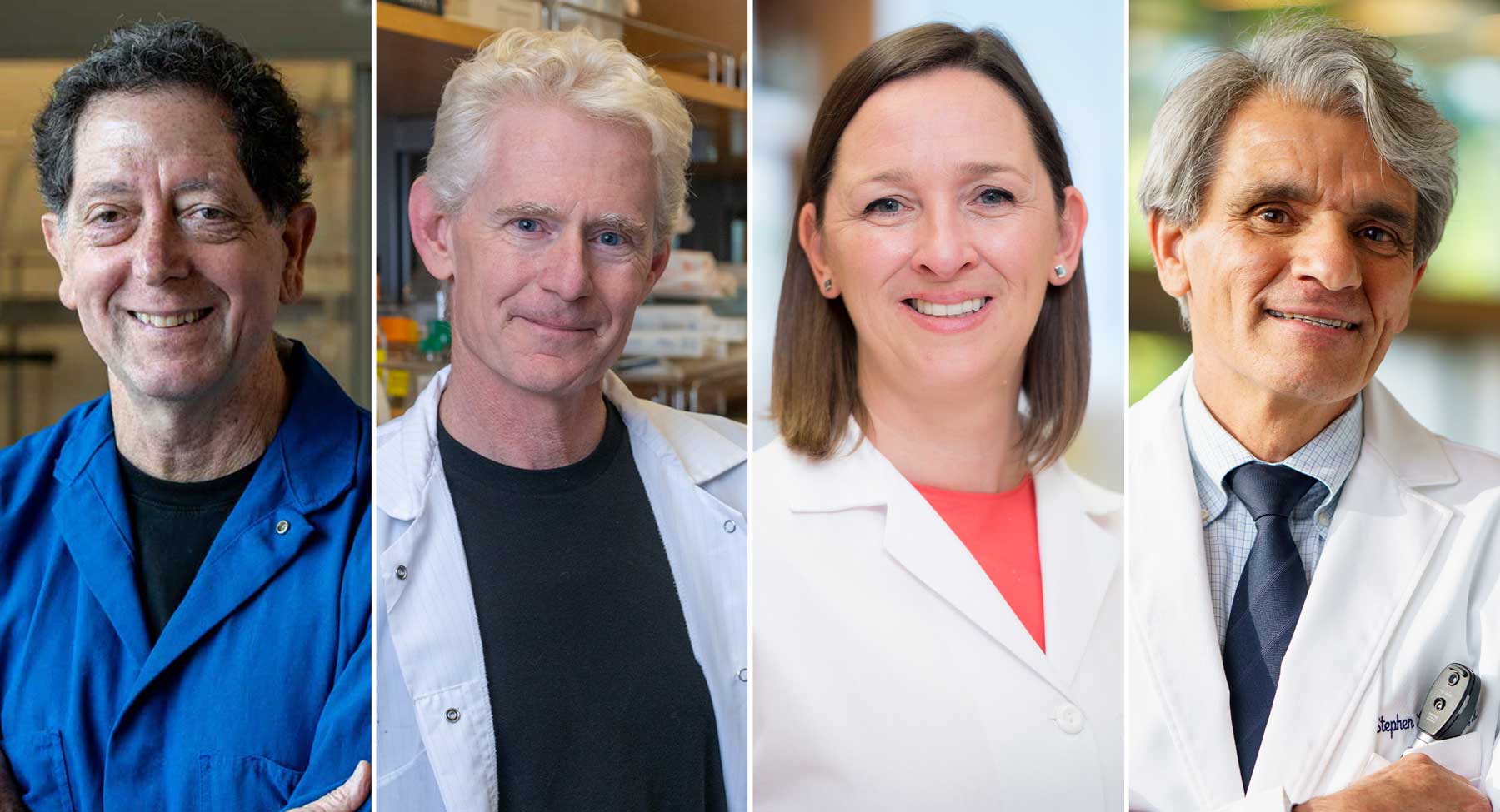
Four UC San Francisco professors received UC Regents Innovation Awards on Sept. 16, celebrating their accomplishments transforming multiple sclerosis care, advancing faster disease diagnostics, pioneering microbiome-based disease prevention, and developing new approaches to precision cancer therapies.
Presented at a dinner at the UCLA Luskin Conference Center, Kevan Shokat, PhD, won the Gamechanger Award; Joseph DeRisi, PhD, won the Best Startup Award; Susan Lynch, PhD, won the Disruptive Research Award; and Steven Hauser, MD, won the Distinguished Lifetime Achievement Award.
This is the inaugural year of the UC Regents Innovation Awards, which honor faculty and researchers who turn groundbreaking research into practical solutions that address pressing challenges and improve people’s lives. Each year, three winners are selected from UC’s 10 campuses and three national laboratories in the categories: Gamechanger Award, Disruptive Research Award, Best Startup Award, Community Changemaker Award, and Distinguished Lifetime Achievement Award.
The winners of the Gamechanger, Disruptive Research, and Best Startup awards each receive a cash prize of at least $10,000.
Stops cancer cells from growing
Kevan M. Shokat, PhD, professor of cellular and molecular pharmacology, received the Gamechanger Award, which recognizes the most impactful product brought to market. Shokat pioneered a new way to target KRAS, a protein produced by a mutated gene that drives roughly 20% to 30% of cancers, including many lung, colorectal, and pancreatic tumors. His achievements are reshaping cancer drug development and creating a new generation of precision cancer treatments.

For decades, KRAS was considered “undruggable” because scientists could not find a way for drugs to attach to the protein without also affecting healthy cells. Shokat and his team discovered a previously hidden pocket in a mutated form of KRAS called G12C, creating a way to target cancer cells while largely sparing normal cells.
Their breakthrough enabled the development of drugs that block the mutated KRAS protein and stop cancer cells from growing. One such drug, sotorasib, became the first FDA-approved treatment to target KRAS G12C, giving some patients with advanced lung cancer a new treatment option. Now, more than 50 KRAS-targeting drugs are in clinical development.
Shokat’s work also helped establish a broader principle in drug discovery: proteins once considered impossible to target may have hidden vulnerabilities that can be exploited with precisely designed medicines. His research has earned numerous national and international honors, including the National Academy of Sciences Award for Scientific Discovery and the Sjöberg Prize. He co-founded several biotechnology companies, including Revolution Medicines, Kura Oncology, and Araxes Pharma — all to develop new therapies against KRAS and related cancer targets.
Startup slashes diagnostic test times to 48 hours
Joseph DeRisi, PhD, the Gordon M. Tomkins Professor of Medicine and Howard Hughes Investigator, received the Best Startup Award, recognizing a new company that uses UC research to develop technologies, products, or services with significant societal impact.
DeRisi is a co-founder of Delve Bio, alongside fellow UCSF physician-scientists Michael Wilson, MD, and Charles Chiu, MD, PhD. The company developed Delve Detect, a diagnostic metagenomic sequencing test that rapidly identifies bacteria, viruses, fungi, and parasites that can cause meningitis and encephalitis.
Unlike conventional testing, which may require multiple tests and procedures, Delve Detect comprehensively searches for infectious pathogens, or germs, using a single sample of cerebrospinal fluid — fluid that flows within and around the brain and spinal cord and is most frequently collected through a lumbar puncture, also called a spinal tap.
Delve Detect’s rapid turnaround is critical to treating neurological disease, where every hour of uncertainty can impact outcomes and the length of hospital stays. Delve delivers results in under 48 hours, providing care teams with timely, actionable information, unlike many conventional send-out tests, which can take significantly longer. Delve Detect is expected to reduce three important metrics: hospital stays by an average of seven to 10 days, overall diagnostic tests needed by more than 60%, and the number of required lumbar punctures by at least one per patient.
DeRisi aims to make Delve Detect’s diagnostics available to community hospitals so they can deliver the same level of diagnostic insight as large academic medical centers, ensuring this breakthrough benefits safety‑net and underserved populations.
A shift from treating disease after it develops to preventing it
Susan Lynch, PhD, professor and co-founder of Siolta Therapeutics Inc., received the Disruptive Research Award, which recognizes groundbreaking research with exceptional potential. Lynch was honored for pioneering a new approach to disease prevention: shaping the infant gut microbiome — the community of bacteria and other microorganisms, or microbes, living in the digestive system — to support healthy immune development and reduce the risk of disease in childhood.
Lynch’s research helped transform our understanding of childhood allergies, asthma, and other inflammatory diseases. She and her team found that infants who later develop allergies often lack key microbes and the substances they produce. She showed that these changes can alter how the developing immune system learns to distinguish between harmless and harmful substances, increasing the risk of disease.
Building on these discoveries, Lynch developed a carefully selected combination of beneficial bacterial strains designed to support healthy immune development. Siolta Therapeutics translated this approach into the STMC-103H treatment, an oral live microbial therapy given daily during a baby’s first year, when the immune system is especially adaptable.
Lynch’s work leads an important shift from treating disease after it develops to preventing it by influencing early-life biology. Her research also provides a potential framework for addressing other chronic diseases linked to early disruptions in the gut microbiome, including obesity and Type 1 diabetes.
With more than 230 scholarly publications and five patents so far, Lynch plays an influential role in advancing microbiome-based therapies. Her research helped establish infant gut health as a promising target for disease prevention with the potential to improve health outcomes for millions of children and their families.
He changed how MS research was done
Stephen Hauser, MD, Robert A. Fishman Distinguished Professorship in Neurology and founding director of the Weill Institute for Neurosciences, received the Distinguished Lifetime Achievement Award — which honors a serial inventor or entrepreneur whose innovations have led to long-term positive impacts on the lives of others and who is an inspiring influence for future UC innovators.
Hauser is known as a maverick for transforming the understanding and treatment of multiple sclerosis (MS), a disease once associated with a high risk of severe disability. He demonstrated the central role of B cells — a type of white blood cell that makes proteins called antibodies to fight infections — in the disease and pioneered therapies that have dramatically improved outcomes for people with MS.
For decades, scientists believed that T cells, a different type of white blood cells involved in the immune system, were the primary drivers of MS. Hauser challenged that prevailing view, ultimately demonstrating that B cells orchestrate the immune attack that damages myelin, the protective coating around nerve cells. His discoveries led to the development of B-cell-targeting therapies, including ocrelizumab, which was approved by the FDA in 2017 and became the first treatment in a new class of MS therapies. As a result, 1 million MS patients now benefit from therapies that dramatically reduce new lesions and inflammation, changing their prognosis from dire to one with the possibility of living free from disabilities.
Hauser’s influence extends beyond his research. He served as chair of UCSF’s Department of Neurology for 25 years, and has mentored hundreds of faculty members, clinicians, and trainees. He also envisioned and now leads the UCSF Weill Institute for Neurosciences, which brings together researchers and clinicians across disciplines to accelerate discoveries into treatments for neurological diseases.
