

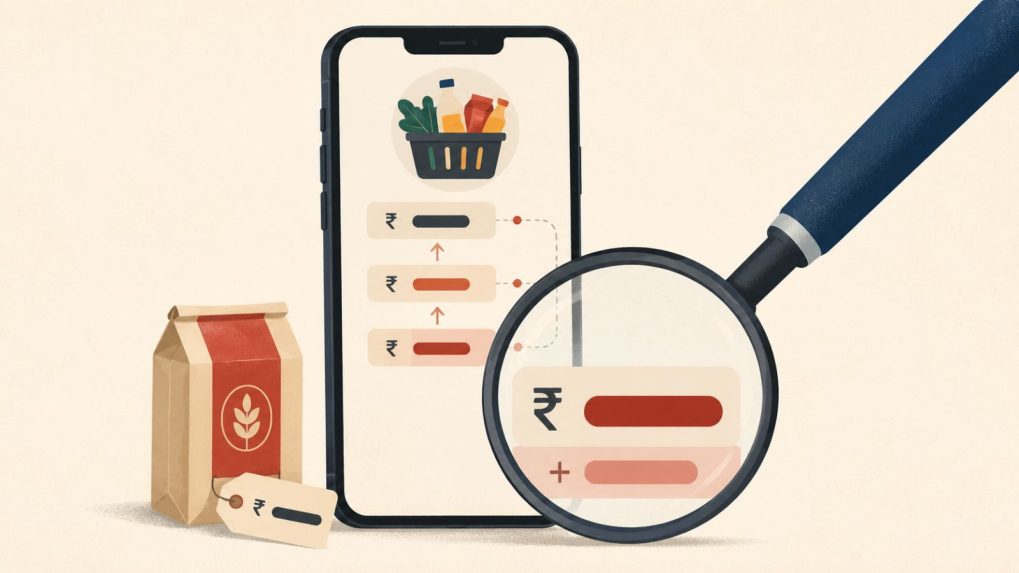
The arithmetic has collided with a sharper reality on quick commerce, where a keyword that cost a brand Rs 60 per click just months ago is now commanding as much as Rs 240, a fourfold jump that is quietly rewriting the economics of festive advertising.
Every festive season begins with the same quiet arithmetic. Brands know that roughly 50 to 60 percent of their annual advertising budget will be spent inside a two-to-three-month window, betting that consumers, buoyed by bonuses, discounts and a mood built for spending, will convert faster than at any other point in the year. This year, that arithmetic has collided with a sharper reality on quick commerce, where a keyword that cost a brand Rs 60 per click just months ago is now commanding as much as Rs 240, a fourfold jump that is quietly rewriting the economics of festive advertising.
The surge is not confined to one platform or one category. Cost per thousand impressions, the currency by which digital visibility is priced, is rising by an average of 20 to 40 percent across channels this festive season, according to industry estimates. Television, OTT, connected TV and retail media are all seeing similar upward pressure, but it is on quick commerce, where discovery and purchase happen almost in the same breath, that the bidding war is most visible and most consequential for marketers watching their spends closely.
That has turned the festive quarter into a test of a much bigger question facing Indian marketing today. As quick commerce becomes the shortest distance between an ad impression and a sale, is the rising cost of visibility a fair price for genuine demand, or a symptom of platforms auctioning off scarce attention to the highest bidder, leaving brands to work out profitability later.
A real time marketplace, not a free for all
Abhishek Shetty, marketing head at Swiggy Instamart, sees the same pressure from the platform side, but frames it as a shift in what quick commerce has become. “Festive periods don’t just increase demand, they increase the value of consumer intent,” he said. “On quick commerce, discovery and transaction sit incredibly close together, so when more brands compete for the same high intent consumer, premium placements and keywords naturally become more valuable.” In his view, quick commerce is increasingly behaving like a real time marketplace for intent, with rates moving almost algorithmically as demand for the same digital shelf space rises. But he is careful to add a caveat that many marketers would do well to remember, simply bidding higher is not a strategy on its own, since the keyword bidding system is entirely automated and brands still need to win through the right assortment, availability, pricing and relevance.
That tension between paying more and earning proportionally more is exactly what worries Chirag Jagwani, chief marketing officer at Fixderma. Customer acquisition cost rises sharply because bids on keywords climb, he explained, citing the now familiar example of a cost per click that moved from Rs 60 to Rs 240, even as the delta in sales does not rise at the same rate. The pattern, he noted, is not restricted to beauty and personal care, categories such as electronics and clothing go through an identical cycle across e-commerce and quick commerce platforms during the festive window. Jagwani frames the scramble as having two possible readings, one purely from a profit and loss lens where spends and sales fail to move in tandem, and another where brands are essentially paying for visibility and choosing to compete for the highest bid regardless of immediate return. Either way, he argued, it is the platforms hosting the auction that stand to benefit most consistently.
Not everyone reads the equation as unfavourable, however. An industry expert in the FMCG sector told storyboard on the condition of anonymity that the festive period brings a genuine spike in purchase intent and impressions across digital channels, which naturally creates a supply crunch and pushes costs up. The volume churn during this window, they said, is often enough to compensate for the high bid environment, with consumption typically rising 3-4 times, which makes the higher spends justifiable by the time the season ends.
The same eyeballs, more bidders
Dhiraj Gupta, CTO and co-founder of mFilterIt, frames the problem in fairly plain terms. “Almost every advertiser ends up spending 50 to 60 percent of its annual budget within a two-to-three-month window, which means demand for advertising spikes sharply,” he said. “Consumer attention, however, does not necessarily rise at the same pace.” Festivals bring more family time and religious engagements, he pointed out, so the hours consumers actually spend on digital platforms can stay flat or even dip even as marketing budgets flood in. That mismatch, more money chasing roughly the same pool of attention, is what Gupta believes pushes CPMs higher each year, and he is clear that no channel is fully insulated from the effect, whether it is television, OTT or retail media.
Building the infrastructure behind the bidding war
Part of the reason bidding has intensified so quickly is structural rather than purely seasonal. According to Menon, brands are shifting 15 to 20 percent more of their digital spends toward quick commerce this festive season depending on the category, with FMCG companies increasingly redirecting budgets that would earlier have gone to Meta, Google and other retail media channels.
That demand shift is being matched by an aggressive build out on the supply side. A UBS report indicates that Blinkit and Swiggy Instamart have raised their capital expenditure guidance per dark store to around Rs 2.5 crore, up from about Rs 1 crore estimated nearly two years ago, as store sizes rise by 60 to 100 percent and facilities move from the earlier 2,000 to 3,000 square feet range to more than 5,000 square feet. The report attributes this less to delivery speed and more to widening assortment, as platforms add electronics, beauty, fashion and medicines to what were once grocery focused stores.
The scale up is visible across the sector. Flipkart Minutes already runs more than 1,000 dark stores across 120 to 130 cities and could add another 1,000 by mid 2027, per UBS estimates, while Amazon Now has scaled to 500 to 600 dark stores processing four to five lakh orders a day and Zepto has earmarked Rs 1,629 crore from its IPO proceeds toward 1,904 dark stores by FY30. Swiggy has said Instamart’s existing network can support more than twice its current gross order value. Every one of these numbers of points to the same underlying story, quick commerce is no longer treating the festive rush as a seasonal spike to be managed, it is building permanent capacity for it.
For brands, the scramble on quick commerce is unlikely to ease soon, if anything, the infrastructure being built today suggests it will only grow more contested each year. The marketers who come out ahead, industry voices suggest, will not be the ones who simply outbid rivals on a keyword, but those who treat quick commerce as what it has genuinely become, a live, fast moving marketplace where assortment, pricing and relevance matter just as much as the size of the bid.
Follow Storyboard18 on Google for the latest and breaking how it works news and industry updates, along with in-depth coverage of digital media and media & entertainment news. Stay informed with the latest perspectives only on Storyboard18.
Tags
First Published onSeptember 15, 2026, 08:45:25 IST
SPOTLIGHT

Special CoverageStoryboard18 crosses 1 million monthly active users, marking a new milestone in its growth journeyRead More
SEE ALL
SAC 2026: Swiggy, Nestlé, HDFC, Flipkart, Puma, Lahori Zeera shine | Why Piyush Pandey remains India’s creative North Star
Storyboard18 brings you top five news updates from the world of advertising, marketing, and business of brands.
