

In 2021, Pear Therapeutics was worth $1.6B. It sold prescription digital therapeutics with FDA clearance. Two years later, it filed for bankruptcy, and the assets went at auction for $6M. The regulator had let the product through. Then no health plan agreed to pay for it.
I spent a long time fighting anxiety and depression. Working with specialists is what moved things. The biggest step came from cognitive behavioral therapy. CBT runs on a thought record. The record only works if you fill it in while the thing is happening. I kept mine in a notebook, then in a spreadsheet. In practice, I filled it in two hours before the session, reconstructing the week from memory. I never found a tool that fit, so I started building one.
Mentalium is a voice CBT diary. You rate your anxiety on a 1–10 scale, answer five CBT questions out loud, then rate it again. The model runs on the phone itself. It sorts the transcript into the fields of the diary, and the audio never leaves the device. A report exports to Excel for the therapist. The app is a self-help tool between sessions. It is not therapy and not a treatment.
The methodology belongs to my co-founder Alexander Erichev, MD, PhD. He is a psychiatrist and psychotherapist, professor at the Department of Psychotherapy, Medical Psychology and Sexology, North-Western State Medical University named after I. I. Mechnikov. He picks the CBT techniques for the app and the wording of the questions.
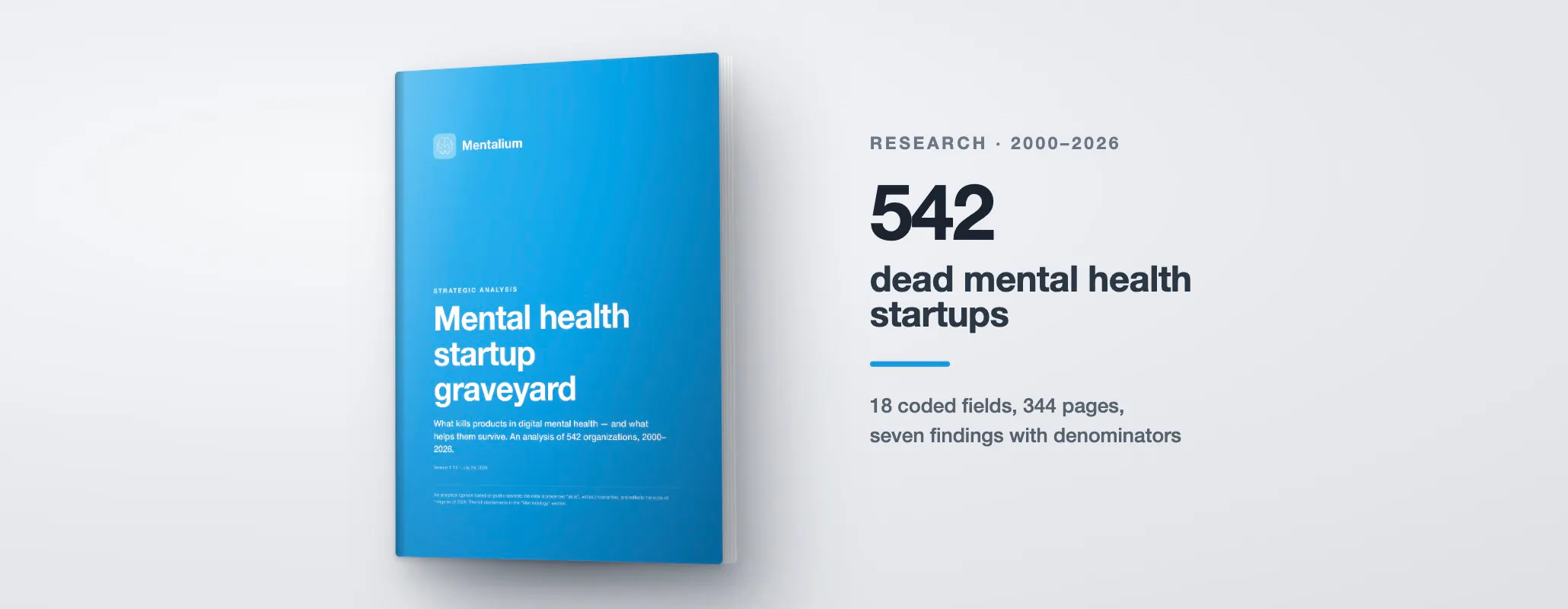
Before putting years into a product here, I wanted to know one thing. Why does this niche have so many corpses in it? One story like Pear reads as bad luck. Post-mortems of digital health failures usually cover thirty or so companies. The large deadpool databases take every industry at once. I found nothing of comparable depth on this niche alone, so we built it. That is 542 organizations, 2000–2026, up to 18 coded fields each. The full version sits on the research page with all 542 companies.
How we counted, and what these numbers do not show.
The subject is digital mental health organizations with a recorded outcome. That means a shutdown, a bankruptcy, an acquisition, a pivot, or a consolidation. After merging duplicates, the graveyard came to 754. Out of those, we pulled 130 brick-and-mortar providers and 81 companies outside mental health, which left the core sample of 542.
Each organization was coded on up to 18 fields. Among them are the business model, who pays, how much was raised, and the reason for leaving the market. We also coded clinical evidence, a medical co-founder, the revenue model, exit size, country, and years of operation. Sources were Crunchbase, CB Insights, Tracxn, public deadpool databases, app store removals, Ahrefs domain data, and trade press. Every company was confirmed against at least two independent sources. A script builds the report from the dataset, so no number was typed in by hand.
Now, the limits, without which this reads as a sales deck.
- Funding is disclosed for 322 of 542 companies (59%), and money cuts are computed on those only.
- An acquisition is not a success. Some deals are fire sales out of bankruptcy, and nowhere do I count an exit as a win.
- Closure dates for products that died quietly are approximate, set by the last recorded activity.
- About 67% of the projects are from the US and the UK, the US alone at 58%, so the findings describe the English-speaking market best.
- The sample is a graveyard, drawn only from companies that have already left the market. Shares compare groups against each other and do not give a probability of failure.
- Groups under 25 observations show a direction only, without a precise value.
- These are descriptive shares, not a statistical model. As a rough guide on this sample, a gap of about 10 percentage points between groups of this size sits outside sampling noise, while a gap of 5–6 points does not. That is why some findings below are stated as results and others as an absence of effect.
External benchmarks line up. Rock Health has mental health as the best-funded clinical category in digital health for years. CB Insights puts about two-thirds of global digital health funding in the US, close to our sample.
The baseline for the whole sample is 242 acquisitions (45%) and 201 deaths (37%). Another 99 records (18%) sit in the gray zone of pivots and consolidation. Mortality above 37% means a group did worse than the graveyard average. In the tables below, acquired and died do not add up to 100%, and the remainder is that gray zone.
Here is how it ended. Acquired 242 (45%), ran out of money 93 (17%), no product-market fit 79 (15%), squeezed out by consolidation 58 (11%). Below that come pivoted 41 (8%), regulator 14 (3%), outcompeted 9 (2%), and lawsuits 6 (1%). More than half of all departures fall between 2021 and 2025, peaking in 2022. That is when the post-COVID telehealth boom collapsed, and cheap money ran out.
How 542 projects ended
Departures from the market by year, peaking in 2022
One of the seven findings below lands on my own team. I left it in.
The Short Version: Seven Numbers
- <strong>53% against 21% mortality: consumer payer against institutional payer.
- 2.2×: how much more often B2C dies than B2B (53% against 24%).
- 85% dead among apps sold as a one-time purchase (22 of 26).
- 25% dead among companies that raised $100M+; 42% reached an exit.
- 34% against 44% mortality: with published clinical data and without it.
- 47% against 47% acquisitions: with a medical co-founder and without one.
- 53% against 27% mortality: replacing the therapist against a human clinician in the loop.
Finding 1. The outcome is decided by who pays: 53% deaths against 21%
The payer is the strongest signal in the dataset. With a paying consumer, more than half the group is dead. With an institution paying, it is one in five.
The fractions are 137/258 against 53/254. The usual objection is that there were simply fewer institutional projects, and it does not hold. Shares are computed inside each group, and the size sits in the denominator. The groups are nearly equal. Pear from the opening belongs here. FDA clearance never turned into insurance coverage, and the company was left with nobody to bill.
Mortality of digital mental health companies by type of payer
Finding 2. B2C dies twice as often as B2B: 53% against 24%
That is 112/210 against 52/214, a ratio of about 2.2×. B2B2C looks best at 9% mortality. With 57 observations and 23% in the gray zone, I read it as a direction. The two models also face different competition. A subscription app in the store stands next to free content, and it depends on a user whose motivation fades in two weeks. An employer or a health plan pays predictably every month. There, the decision belongs to a budget holder.
Finding 3. One-time purchase and freemium are close to a death sentence: 85% dead
A single payment does not fund development. One purchase covers the install. Then a new OS release breaks the app, and there is no money left to fix it. One-time purchase has 26 observations, so the direction is solid and the value I treat with caution. Freemium is only marginally better at 33 of 53. For PEPM, the low mortality partly converts into a gray zone of 33%, because institutional products dissolve into consolidation more often than they die outright.
Mortality of digital mental health tools by revenue model
Finding 4. A large round does not save you: 25% of the $100M+ cohort is dead
Money protects up to the middle of the scale. Under $1M, mortality is 69%, and the curve then falls. At $100M+, it turns back up, with 10 of 40 dead and 17 of 40 at an exit. The best outcomes sit in the middle, where $1–10M produced 70% exits. The denominator is the 322 companies with a disclosed round. The $50–100M group (n=11) is too small to read.
Finding 5. Clinical evidence lowers mortality by 10 points
That is 43/128 against 134/306, a gap of 10 percentage points. Records where evidence status could not be established (n=108) are held outside the comparison.
Published data also keeps working after the company dies. SilverCloud Health, the Dublin iCBT platform selling to the NHS and insurers, raised $30M. Amwell bought it in 2021 largely for its clinical credibility. MindBeacon in Canada raised $103M and was paid through insurers. It went the same way in 2022.
Finding 6. A clinician on the founding team does not move the outcome: 47% against 47%
That is 73/156 against 120/254, a difference inside the noise. On mortality, the group with a physician is even slightly worse, 38% against 32%.
This is the most counterintuitive result in the report. It lands on my own team, where the co-founder is a psychiatrist with a doctorate. The temptation was obvious. Caveat the number, add a line about how a strong clinician changes everything, move on. There is nothing to caveat here; the number is flat.
My reading is that clinical expertise on its own is not a business model. The companies that survive attach clinical work to an institutional payer and to published data. A physician outside that combination affects product quality without affecting whether the company lives. So, Alexander’s involvement has to be converted into methodology, validation, and a payment channel.
Finding 7. Replacing the therapist is deadlier than working through one: 53% against 27%
We coded the product of each company into one of five roles. Clinical replacement treats a disorder without a human in the loop, whether as an autonomous bot, prescription software, or passive monitoring framed as treatment. Wellness self-help is meditation, trackers, and coaching with a low clinical claim.
Care delivery is teletherapy and telepsychiatry, where a human clinician treats through the product. Augmentation strengthens existing therapy through a diary for the therapist and between-session work. Mentalium sits in that role. Infrastructure covers billing, EHR, and drug development.
Raw shares mean little until the payer confound is removed. Replacement is sold to consumers more often than the other roles. So, we compared archetypes inside one payer type.
Replacement dies most in both columns. The mortality belongs to the archetype, and the payer does not explain it away. The harshest contrast comes on institutional money, at 50% for replacement against 9% for care delivery. Same payer, more than five times the mortality. Replacement on institutional money is 11 of 22 records, below the threshold I set above, so read that pair as a direction. Now, watch what happens when the payer changes. Replacement barely moves, from 56% to 50%, while care delivery falls from 43% to 9%. The strongest lever in the report does almost nothing for this archetype.
The causes differ too. Of the 59 replacement companies, 13 (22%) died on no PMF and 5 (8%) on the regulator. The archetype either fails to prove it works or gets prohibited. For care delivery and augmentation, the dominant outcome is acquisition, at 54% and 52%. The market buys them instead of rejecting them.
Replacement exits are small as well. There are 39% acquisitions, but 83% of them come with an undisclosed amount. The disclosed ones are tiny, like Akili at $34M after a SPAC valuing it near $1B, or myStrength at $30M. The generative AI wave changed nothing here. The cohort of autonomous bots is collapsing in the most recent years.
Woebot shut down in 2025 with $124M raised. No regulatory path appeared for therapy by a large language model, and free models started doing much the same thing.
Boundaries, stated plainly. The living leaders (Calm, Headspace, BetterHelp) are not in the sample. Wellness self-help as a business scales past our graveyard, and this finding covers replacement of the therapist only. The seam between care delivery and augmentation is the blurriest part of the coding.
Replacing the therapist against care delivery with a human clinician
Four cases up close.
Cerebral: $4.8B and a regulatory loophole. Online prescribing of stimulants for ADHD without an in-person exam, sold by subscription. The valuation went as high as $4.8B. When the rules on prescribing controlled substances tightened, the model fell apart. An investigation by the Department of Justice followed, then a settlement, then collapse. A business built on a loophole closes together with the loophole.
Akili Interactive: clearance without revenue. The first FDA-cleared prescription video game for ADHD in children aged 8–12, with $230M raised and a SPAC listing at around $1B. The bet was that clearance would push insurers to pay. They declined, and revenue came to $114K against $15M of quarterly expenses. In 2024, the company was bought for $34M, down 97% from the peak.
Mindstrong: $174M and a marquee name. Passive monitoring of mental state through digital traces on the phone. A former director of the National Institute of Mental Health was on the team. Clinical benefit was never shown, and the path to being paid stayed unclear. It shut down in 2023.
Therachat: 7,500 therapists who do not pay. A therapist-facing tool with homework and mood tracking between sessions, which is exactly our lane. It grew past 7,500 therapists and raised under $1M. The problem was that therapists rarely pay for software. Sold in 2020.
I keep that last one in front of me. Augmentation looks decent in the numbers, at 36% mortality against 53% for replacement. Therachat shows where the category breaks and where our own risk sits.
What this means if you are building a mental health startup
Pick the payer before you pick the interface. The 53% against 21% gap is the largest in the report, and it is visible before the first line of code. If you go B2C, subscription is the model that survives. One-time purchase (85% dead) and freemium (62%) leave almost no room.
Plan clinical evidence as a separate asset with its own budget. It is worth 10 points of survival. In the bad scenario it is the thing a buyer will want.
The claim “we will replace the therapist” stays the most expensive one here. The archetype dies at 53%, and institutional money does not pull it out. That is the only place where the payer lever fails. A product that strengthens the work of a human clinician survives more often. It has a ceiling of its own, because that clinician rarely pays.
And the part I still find uncomfortable to write down. A physician on the team does not move the outcome, 47% against 47%. The expertise only counts once it converts into published data and a payer who signs.
A question for people who have been through this
The hole Therachat points at is the one I cannot get past. The patient cannot pay much; the therapist does not pay for software. The institutional buyer moves slowly. Where does durable economics for an augmentation product come from?
Tell me what you have seen. We found seven patterns in why mental health startups fail, and in practice there are more. I am most interested in the failures you watched from close range. Whose product stalled, and what did it stall on?
