

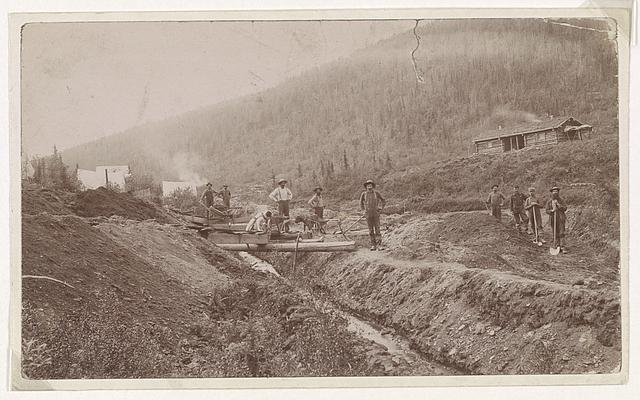
The gold rushes that drew hundreds of thousands of people to the American West may have left behind more than abandoned mines. In a new study, a team of researchers co-led by The University of Texas at Austin found that communities shaped by gold rushes developed an entrepreneurial legacy that remains visible today.
“The gold rush was not only a scramble for gold; it was a massive migration that disproportionately attracted people from places and occupations with strong entrepreneurial ties,” said Samuel Gosling, professor of psychology at The University of Texas at Austin and co-author of the study. “Those newcomers may have helped create local networks, norms and institutions that supported further entrepreneurship. Our findings suggest that the imprint of that migration is still visible today.”
When gold was discovered in present-day California in 1848, hundreds of thousands of fortune-seekers poured into the area and, later, Nevada, Colorado and beyond. By 1850, gold discoveries had transformed California, with nearly three-quarters of the state’s population living in gold rush counties.
Most gold rush migrants failed to strike it rich. But according to researchers, that may have been part of what set these regions apart. The uncertainty of the gold rush may have attracted people with high risk tolerance and resilience, traits often associated with entrepreneurship.
Some of the biggest opportunities also came from outside the mines. Companies such as Wells Fargo, Levi Strauss and Ghirardelli Chocolate Company all emerged from the gold rush economy.

Using U.S. census records dating back to 1850, the researchers tracked who moved to gold rush communities over time. They found that before 1900, people from more entrepreneurial areas were 55% more likely to move to gold rush counties than people from less entrepreneurial areas. Similar migration patterns continued after the height of the gold rush and were also common among people in occupations with high rates of self-employment.
The study also found that people who were not business owners before moving to gold rush countries between 1910 and 1950 were more likely to become self-employed than similar migrants who moved to non-gold rush areas. This trend suggests the entrepreneurial culture of these communities extended beyond the people who were initially drawn there.
“Policymakers often try to create entrepreneurial hot spots from scratch, but our findings suggest that these ecosystems are shaped in part by history,” said Michael Stuetzer, an economist at Baden-Württemberg Cooperative State University in Germany and the study’s lead author. “The people who move to a region, the opportunities they encounter, and the norms and institutions they help create can reinforce one another over very long periods. Understanding those historical roots may be essential for designing more realistic entrepreneurship policy.”
The researchers also analyzed more than 9,000 pairs of neighboring counties, including gold rush counties and non-gold rush counties. Even among counties that shared similar geography and history, those with a gold rush past had higher rates of self-employment, more startup activity, and populations with stronger entrepreneurial personality traits.
“What is striking is the persistence of these patterns,” said Peter J. Rentfrow, a psychologist at the University of Cambridge and co-author of the paper. “The gold itself may have been temporary, but the entrepreneurial imprint of the gold rush appears to have lasted for generations.”
