

Law
Supreme Court strikes down limits on political party spending
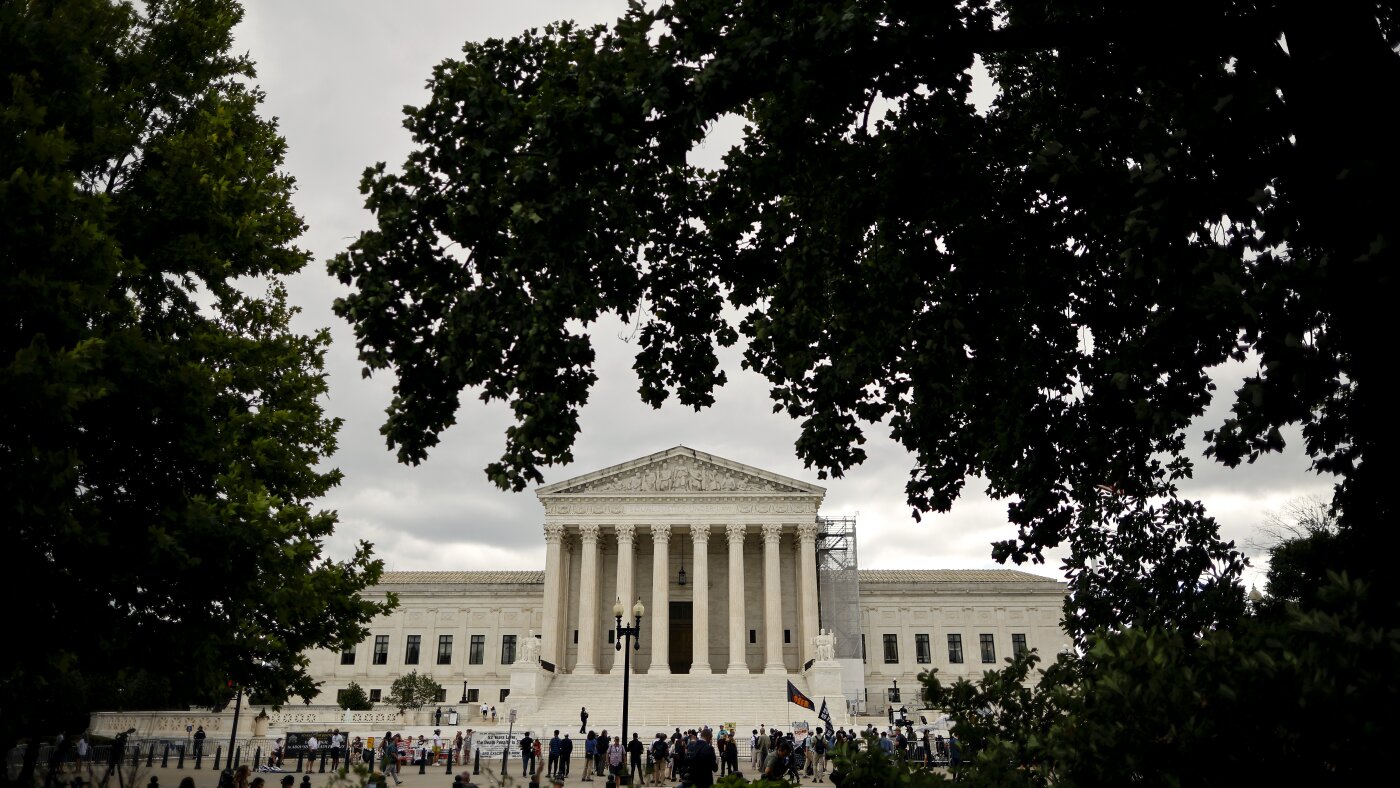
The U.S. Supreme Court
Chip Somodevilla/Getty Images
toggle caption
Chip Somodevilla/Getty Images
The Supreme Court yet again loosened campaign finance restrictions on Tuesday by striking down limits on how much political parties may spend on candidates.
By a 6-to-3 vote along ideological lines, the court ruled the law, which had been enacted in 1974, violates political parties’ First Amendment rights. Justice Brett Kavanaugh wrote the majority opinion.
“Whether the Democratic Party, the Republican Party or other parties, all political parties and candidates going forward can compete equally under the same rules regarding coordinated expenditures and can structure their fund-raising, spending and political speech on a level playing field as they see fit within the law,” he wrote.
At issue in the case was a post-Watergate law that Congress passed to limit the amount of money individuals can give to political parties. The law, the Federal Election Campaign Act, also limited how much money political parties can spend on their candidates. Other types of organizations, like political action committees and Super PACs, have no limits on the amount of money they can raise and spend on elections. But unlike parties, they cannot coordinate with candidates.
Republicans, including Vice President Vance and the National Republican Senatorial Committee, challenged the law as an unconstitutional violation of political parties’ First Amendment right to raise and spend money on their candidates.
Backed by the Trump Justice Department, they contended that the only justification for imposing a fundraising limit on parties is to prevent corruption, but they maintained that there is no evidence that the law has prevented corruption.
This decision, which overturnsa 2001 Supreme Court case, is the latest in a series of rulings since then that have unraveled campaign finance regulations.
The saga began in 2010, when the court ruled inCitizens United that corporations have a First Amendment right to unlimited spending on elections. The following year, the court dismantledArizona’s public election financing scheme, which gave money to less-funded candidates in order to equalize spending between politicians. And in 2014, the court struck down limits on how much money an individual can donate in national elections. All of these decisions were ideologically split votes, just like Tuesday’s ruling, and in each case, the court overturned the regulations for burdening the First Amendment right to spend on elections.
In her dissent, Justice Elena Kagan wrote: “With no limits on coordinated expenditures, the party can serve as the candidate’s checking account.” She said the decision would allow “a legal regime increasingly unable to stop political corruption, and thus to preserve our institutions’ democratic legitimacy.”
The practical implications of Tuesday’s ruling are unclear. Lawyers for the Democratic Party, who intervened in the case in support of the campaign finance restrictions, argued that they are necessary to prevent quid pro quo corruption. Authorizing unlimited coordinated expenditures would “fundamentally reshape the campaign finance regime,” they wrote. “The potential for actual or apparent corruption is obvious.”
Further, in previous decisions, the high court cited these anti-corruption protections as reasons why other campaign finance regulations could be rolled back without worry.
But the Republicans who brought the case argued that the risks of corruption are low. “It doesn’t make any sense to think of a party as ‘corrupting’ its candidates,” lawyers for the Republicans argued in a brief submitted to the court, “because the very aim of a political party is to influence its candidate’s stance.”
CorrectionJune 30, 2026
A previous version of this story incorrectly said the Supreme Court’s ruling on campaign finance limits covered both fundraising and expenditures. In fact, the decision is focused on expenditures only.
- Supreme Court
- campaign spending
