

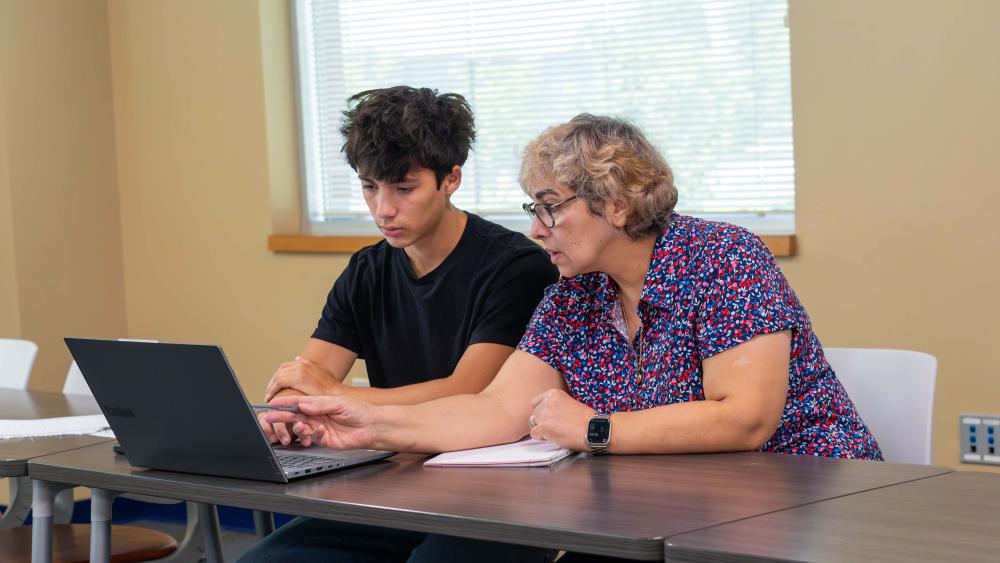
Pa. — For students preparing to begin college, the transition to higher education can bring both excitement and uncertainty. Two summer programs at Penn State Lehigh Valley are helping students approach that transition with greater confidence while building skills they can carry into the classroom
The Summer Math Academy Readiness Training (SMART) program and BRIDGE AI program provide students with opportunities to prepare for college-level learning before the academic year begins. While one focuses on strengthening mathematics readiness and the other introduces students to artificial intelligence, both are designed around a similar goal: giving students an early foundation for success at Penn State.
For Maryam Kiani, associate teaching professor of mathematics at Penn State Lehigh Valley, SMART is as much about changing how students view themselves as it is about improving their mathematics skills.
“Every summer, I meet students who are excited to begin their college journey but are also worried about mathematics,” Kiani said. “Many arrive believing they are simply not ‘math people’ or that one placement test defines what they are capable of doing. SMART gives them an opportunity to challenge those assumptions and build confidence before they ever walk into their first college math class.”
Building mathematics skills and confidence
SMART provides incoming students with focused mathematics preparation and an opportunity to improve their placement through ALEKS, Penn State’s mathematics assessment and learning system.
Students can make significant academic progress during the program with some advancing two or even three mathematics placement levels. But she said placement scores tell only part of the story
Throughout the program, students develop study habits and learning strategies while working alongside other incoming students. They are encouraged to ask questions, learn from mistakes and recognize that persistence and consistent effort are important components of college success.
The experience also gives students an opportunity to begin developing a sense of community at Penn State Lehigh Valley before the semester begins.
Some former SMART participants have later returned to the program as peer mentors or become involved in undergraduate research, helping other students navigate the same transition they experienced.
“The greatest measure of success is not just seeing a placement score improve,” Kiani said. “It is seeing students leave SMART with stronger skills, greater confidence and the belief that they belong at Penn State and are capable of succeeding here. When students come back later as mentors or researchers and want to help the next group of students, you can see the lasting impact that experience had on them.”
Preparing students for an AI-shaped world
As SMART helps students strengthen a foundational academic skill, BRIDGE AI introduces them to a technology increasingly influencing how people learn, work and solve problems.
Led by Rifat Sabbir Mansur, assistant teaching professor of information sciences and technology at Penn State Lehigh Valley, BRIDGE AI gives students an accessible introduction to artificial intelligence without requiring programming experience.
The no-code course explores the history and development of AI, the concepts behind machine learning and contemporary AI systems, and the strengths and limitations of emerging tools. Students also consider ethical issues, including bias, responsible use and the role of human judgment when working with artificial intelligence.
Students have opportunities to explore current AI tools, compare their capabilities and limitations, and discuss how rapidly evolving technologies could affect their education and future careers.
The course is offered at no cost, and students who choose to complete the final assessment have a pathway to earn three Penn State credits.
“AI literacy is becoming an essential skill, but understanding AI also makes critical thinking more important, not less important,” Rifat Sabbir Mansur said. “We want students to understand what these systems can do, where they can fall short and why human judgment still matters. The goal is for students to leave the course prepared to ask better questions, use these tools responsibly and continue adapting as the technology changes.”
Connecting to Penn State’s student success and AI strategy
BRIDGE AI reflects a broader University-wide effort to prepare students for a future in which artificial intelligence will increasingly influence education, careers and society. Penn State’s AI Transformation initiative calls for students across disciplines to develop foundational AI literacy, including an understanding of how AI works, how to use it responsibly and how to think critically about its impact in the classroom, workplace and community.
That emphasis also connects with Penn State’s strategic goal of enhancing student success by preparing students for their academic and professional futures and helping graduates develop the skills needed for in-demand careers. Programs such as SMART and BRIDGE AI bring those priorities together at Penn State Lehigh Valley by giving students opportunities to strengthen foundational academic skills, explore emerging technologies and begin developing confidence before their first semester.
Creating a stronger start at Penn State
Together, SMART and BRIDGE AI illustrate how summer readiness programs can address different aspects of the transition to a four-year degree.
For some students, preparation may mean strengthening mathematics skills before entering a STEM course sequence. For others, it can mean developing the technological literacy needed to navigate classrooms and workplaces increasingly influenced by artificial intelligence.
Both programs also give students something less easily measured: an opportunity to experience college-level learning, interact with Penn State faculty and begin building confidence before the semester starts.
That early connection can be particularly important for students who may be uncertain about their academic preparation or what will be expected of them in college.
For Kiani, that preparation ultimately comes back to helping students recognize their own potential.
“Students learn that mistakes are part of learning, asking questions is a strength and persistence often matters more than where you started,” Kiani said. “If students begin their first semester understanding that, they are not only better prepared for mathematics. They are better prepared to be successful college students.”
Contact
-
- rqa5374@psu.edu
- Cell Phone: 610-285-5000
- https://lehighvalley.psu.edu/person/ryan-abramson
