

A student starting university in 2027 will graduate into a labour market nobody can describe with much confidence yet. AI is already changing what businesses ask executives to do, the skills employers look for, and, in some cases, the jobs themselves. Four years from now, some of today’s newest tools may even feel obsolete.
That makes choosing a business degree a forward-looking decision. For an international family, there are other questions wrapped inside it, too – one of the biggest ones being: after four years of tuition and travelling thousands of kilometres from home, what evidence will there be that the investment paid off?
Stevens Institute of Technology ensures the answer to that is clear from the start.
“The timing is what makes this especially powerful,” says Lindsay Hartelius, Associate Director of Undergraduate Outreach, Reputation, and Alumni Affairs at the School of Business.
“A Stevens first-year student can walk into an interview and talk about Bloomberg as a tool they have actually used — not simply something they hope to learn once they are hired. They can discuss how they used real market data in class, demonstrate familiarity with the platform, and begin taking on more sophisticated financial analysis earlier in their undergraduate career.”
This first year is the evidence that the investment is already paying off.
“What will my child actually learn?”
Stevens’s answer begins with a unique premise for a business school: technology should follow the student into whichever part of business they choose.
Hartelius says the curriculum is informed by conversations with current students, alumni, and the employers and industries graduates eventually enter. The aim is to understand which technology and AI skills are becoming useful in professional practice, then bring that intelligence back into conversations about the curriculum.
“The goal is to ensure students learn how technology and AI are actually being used within business disciplines such as finance, accounting, marketing, management, and analytics,” she says.
Every first-year Stevens business student takes the Business Career Seminar before pursuing internships and other professional opportunities
All eight current undergraduate business degrees – Accounting & Analytics, Business & Technology, Economics, Finance, Information Systems, Management, Marketing Innovation & Analytics, and Quantitative Finance – have STEM designation.
Michelle Crilly, Assistant Dean for Student Success, says designation is significant precisely because traditional programmes such as general management or marketing typically don’t meet the bar. Only specialised, highly quantitative programmes like financial engineering or business analytics usually do.
“Having all eight undergraduate majors qualify means Stevens built enough technical and quantitative rigour into the entire business curriculum — not just one or two speciality tracks — for each programme to meet that classification,” she says.
The key word here is “entire.”
Accounting and Analytics students work with generative AI applications and financial databases. Every Stevens undergraduate also completes three one-credit AI and Emerging Technology Lab courses, with topics that may include machine learning, data science and analytics, biotechnology, sustainability, and quantum computing.
Students entering in autumn 2027 will have another option. The new Business and Artificial Intelligence degree combines business foundations with AI, machine learning, data analytics, and programming, then asks students to apply those tools to finance, marketing, operations, and decision-making. Responsible and ethical AI use is part of the curriculum, too.
“It’s ideal for a student who is interested in AI and technology but sees themselves applying those skills in a business career — whether as an AI product manager, business or data analyst, consultant, entrepreneur, or someone helping an organisation develop and implement its AI strategy,” explains Hartelius.
“What if my child doesn’t know what they want to specialise in?”
Few 18-year-olds arrive with a four-year career plan that pans out 100%, so Stevens leaves room for that.
Business students spend their first four semesters taking courses across different areas of the field, with Quantitative Finance as the exception. Students can move between business majors through the end of their second year.
“This gives them a chance to explore which areas genuinely interest them,” says Crilly. “For example, a student who initially chose Economics would have no trouble switching to Finance or another business major during those first four semesters.”
That appetite for breadth is already visible among international students. Business & Technology is the most popular major among this year’s incoming international cohort.
“They’re completing both a business concentration — such as finance, marketing, management, accounting, economics or quantitative finance — and a technology concentration, with options including computer science, data analytics, information systems, biotechnology, and green technology,” explains Hartelius. “For international students in particular, that combination provides a broad, adaptable education.”
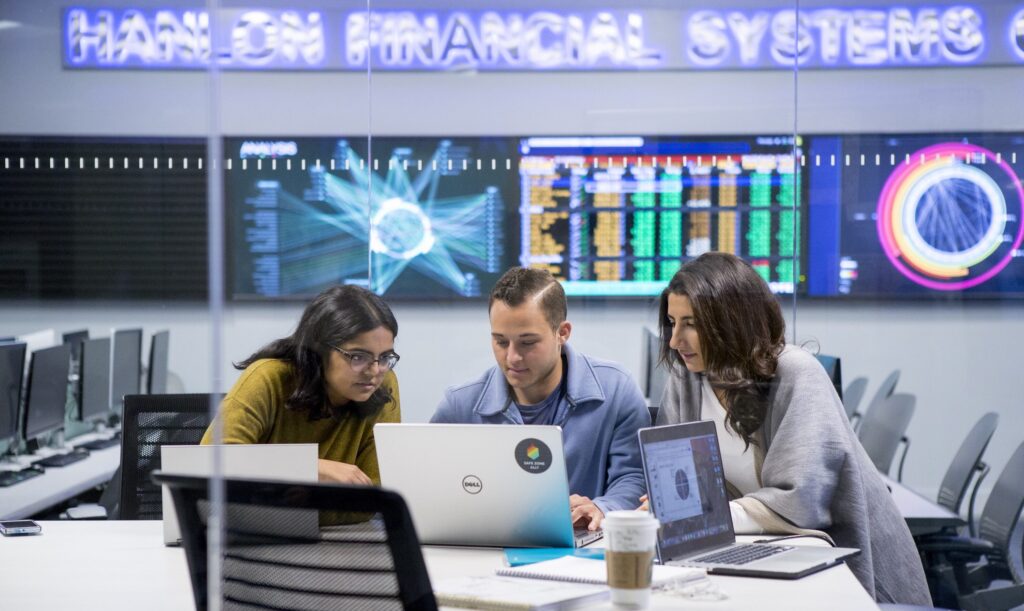
Inside the Hanlon Financial Systems Center, students work with Bloomberg Terminals, real-time market data and cutting-edge tools
“How soon can my child apply their new skills?”
Almost immediately. The Hanlon Financial Systems Centre looks less like a conventional classroom than the sort of place a finance graduate might encounter after university. Bloomberg Terminals sit beside multiple monitors and a live stock ticker, with real-time market data moving across the screens.
Students analyse equities, currencies, fixed income, and derivatives. They build and evaluate portfolios and use Python and R for quantitative modelling. Some progress to faculty research, algorithmic trading competitions, or managing real investments through the Stevens Student Managed Investment Fund. In 2025, two Financial Engineering teams finished in the top 10% of the Bloomberg Global Trading Competition.
Professional preparation develops alongside the technical work. Every first-year business student takes the Business Career Seminar, building a résumé and LinkedIn profile, practising interviews, networking, exploring careers, and meeting employers and alumni. COPA, the School of Business’s dedicated career team, adds one-to-one advising, internship leads, career fairs, and employer connections.
“By their second year, students have stronger interviewing skills, employer connections, and technical skills from their coursework,” says Hartelius. “The goal is to help students to begin building meaningful professional experience well before graduation.”
Then, geography starts earning its place on the prospectus. Stevens’s 55-acre campus is located in Hoboken, New Jersey — less than two kilometres across the Hudson River from Manhattan. The Career Centre works with more than 600 employers a year, and New York is close enough to remind students that the world is at their fingertips.
Think network development, cutting-edge curricula, and cultural wonders, including Broadway, world-class museums, concerts, fashion, restaurants, and so much more. This proximity to Manhattan colours the entire student experience here.
“What happens if my child struggles so far from home?”
Someone usually notices before you have to ask. Crilly’s team uses surveys, grade checks, and mid-semester faculty check-ins to identify students struggling academically or disengaging. A high-risk flag can bring in Crilly, the dean, programme directors, peer mentors, or alumni, depending on what the student needs. The team separately tracks progress towards the four-year graduation target so intervention can happen before a delay becomes difficult to undo.
“We meet with every incoming first-year undergraduate and every new graduate student individually to make sure they understand campus resources and have a clear sense of what a successful path looks like,” Crilly says.
“Before they even arrive, we run a pre-entry survey to catch potential risk factors early, and we’ve built a Summer Connection Series for incoming first-year students to start building community before they set foot on campus. From there, it’s a steady cadence of support: registration workshops, study plan collection and follow-up, minor advising events, an Undergraduate Business Fair connecting students to advisors and clubs, and the Business Buddy Programme, which pairs first-year students with upperclassmen mentors.”

Stevens’ campus sits directly across the Hudson River from Manhattan, connecting university life with opportunities across New York City
“What will my child have to show for four years?”
First, there’s the six-month answer:
Among Stevens School of Business graduates, 95% have a career outcome within six months: 65% are employed and another 30% are continuing their education. For those entering the workforce, the average starting salary is US$87,800. Finance graduates average US$91,700; Quantitative Finance graduates average US$89,800.
Graduates have landed roles at Bank of America, BNY, JPMorgan Chase, Morgan Stanley, PwC, EY, KPMG, and Prudential Financial, with finance, manufacturing, and technology and telecommunications among the top industries that recruit Stevens business graduates.
There’s also the four-year answer:
Federal earnings data places Stevens 32nd among nearly 5,000 US institutions for median graduate earnings — that is, in the top 1% of institutions on that measure. Four years after graduation, graduates record median earnings of US$111,977.
TIME offers another measure: Stevens ranks 30th among 500 institutions in its inaugural America’s Best Colleges 2026–2027 list. Student outcomes account for 75% of the ranking methodology, which also considers the value of an education relative to its cost.
“The throughline across all of this is that we’re not a service students visit once — we’re a consistent presence across their entire time here. Our team is directly involved in the final send-off. That consistency is what shows up downstream in retention, on-time graduation rates, and ultimately in the outcomes data that the university points to as proof of a Stevens degree’s value,” says Crilly.
“Strong outcomes don’t happen at graduation; they’re built through hundreds of smaller interventions along the way, and that’s the work this team owns.”
Then, there’s the longer view. US News & World Report ranks Stevens ninth nationally for 40-year return on investment, based on Georgetown University research, with an estimated ROI of US$3.603 million. For families making a four-year bet on an uncertain future, that’s evidence with a considerably longer shelf life.
FollowStevens Institute of Technology onFacebook,LinkedIn,Instagram,X, andYouTube
