

Shanghai’s Nuclear Fusion Firms Have Raised USD2.7 Billion
Jin Yezi
DATE: 2 hours ago
/SOURCE: Yicai
audio is not supported!
Shanghai’s Nuclear Fusion Firms Have Raised USD2.7 Billion
(Yicai) Sept. 1 — NovaFusion Energy Technology has completed a pre-A round of financing, bringing the total amount raised by Shanghai-based nuclear fusion companies close to CNY18 billion (USD2.7 billion), as the city is opening up a full-chain layout for <a href="https://bitcomme.com/industrial-investment-growth-stands-out-in-cre-recovery/” title=”Industrial Investment Growth Stands Out in CRE Recovery”>industrial capital.
NovaFusionX has secured CNY1.2 billion (USD178.6 million) from existing investors Meituan Dragonball and Hillhouse Capital and new strategic investors, such as Lenovo Capital Incubator Group and Guozhong Venture Capital Management, at a valuation of over CNY10 billion, the company announced yesterday.
In recent years, Shanghai has leveraged its advantages in nuclear energy, artificial intelligence, and high-temperature superconducting, deepened ties with Shanghai State-owned Capital Investment to seize social capital, focused on the HTS tokamak route, promoted the full-chain layout of materials, components, and devices, and attracted innovative teams working along the nuclear fusion industry chain, Zhai Jinguo, deputy director of Shanghai’s science and technology commission said at the Nuclear Fusion Energy Conference on Aug. 25.
Shanghai will continue to rely on China’s fusion technology to build a controllable nuclear fusion innovation consortium, promote key technology research and strategic product development, and advance the coordinated development of the upstream and downstream reaches of the industrial chain, Zhai noted.
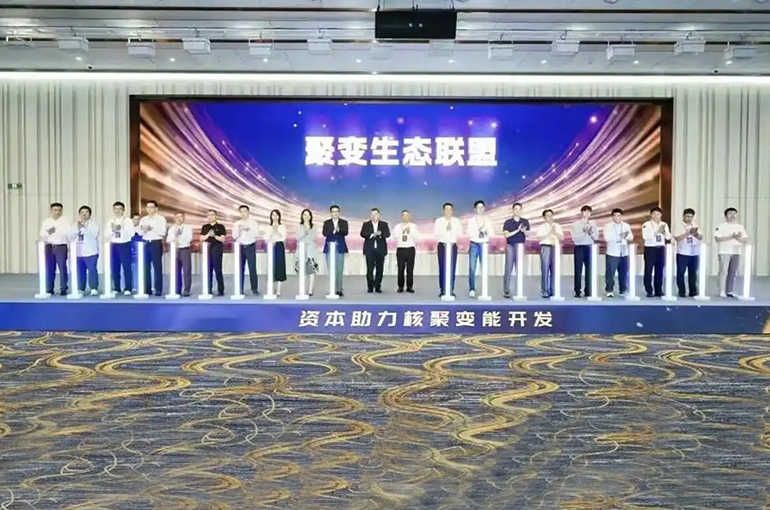
At the conference, Shanghai State-owned Capital Investment established the Fusion Ecological Alliance, with China Fusion Energy as the leader, in collaboration with nearly 20 industry chain enterprises, colleges and universities, research institutes, and investment institutions to connect the entire chain, from basic research and technology development to pilot-scale transformation and industrial implementation.
“Over the past year, we have invested in multiple companies, such as Startorus Fusion and Dongsheng Fusion, focused on key links of the HTS tape and HTS magnet industry chain, supported core enterprises, including Shanghai Superconductor and Shanghai Yixi Technology, and promoted the implementation of leading nuclear fusion projects and verification devices,” said Dai Minmin, president of Shanghai State-owned Capital Investment.
The company has invested more than CNY1 billion and leveraged tens of billions of yuan in social capital to invest in the field of nuclear fusion, Dai noted.
With the development of key technologies for HTS magnets, opportunities for nuclear fusion startups are increasing, the trend of technological development is becoming clear, and the continuous inflow of capital and talent is changing the industry’s judgment about the probability of success, said Mi Lei, founding partner of Chinese tech-focused venture capital firm CAS Star.
Due to the numerous parameters involved in nuclear fusion, each step has the potential to touch the boundaries of human technological capabilities. Materials, devices, and other engineering capabilities may all become bottlenecks, so in the view of business professionals, fusion technology has not yet converged. The diversified technology pattern not only disperses the investment risks, but also opens up the space for industrial capital to invest in the entire chain.
The price of HTS tapes in Shanghai has dropped to around CNY40 (USD6) per meter from CNY400 to CNY500 (USD59 to USD74), and the development of the local superconducting industry ecology has provided confidence for the strong magnetic field route, said Xu Min, professor at the Institute of Modern Physics at Fudan University.
The capital market’s investment in nuclear fusion is far from overheated, Xu believes. The core value of commercial startups is to be an “important supplement and a plan B” to the national mainstream route, he noted, adding that even though the fusion device route is different, upstream key technologies and industrial capabilities may converge.
Follow Yicai Global on
Keywords: Nuclear Fusion,Shanghai,Investment
Report
