

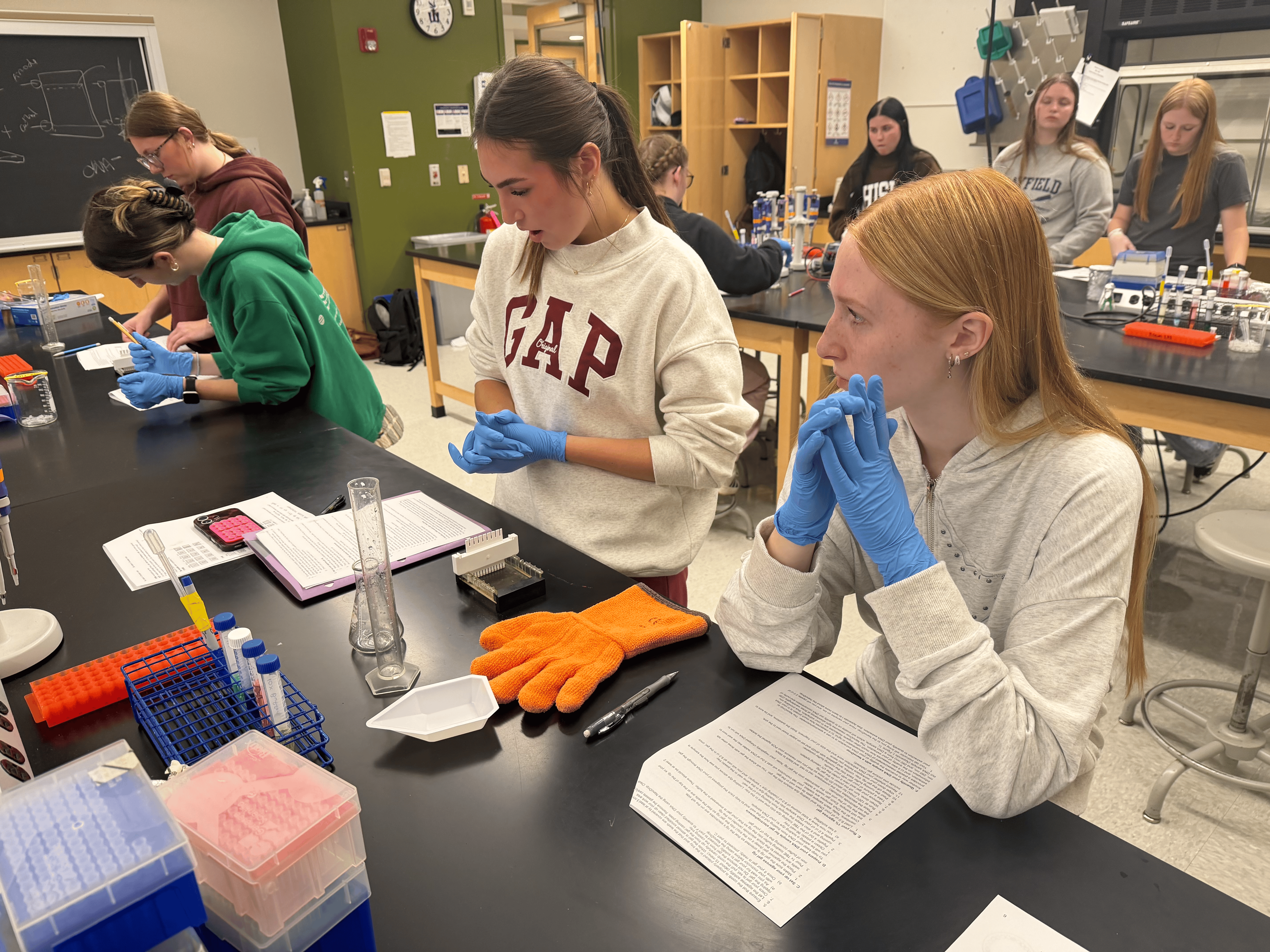
In a Winona State University biology lab, freshman Chayse Pulvermacher was isolating the DNA of an apple and then pipetting it into a special gel to see if she could identify it. The process is full of skills she hopes will help her land a job after college.
“I would love to work in a hospital, but bedside is my worst nightmare,” she said. “[I’d] much rather work in a lab setting, testing things — basically like this,” she said gesturing to the lab equipment around her.
Pulvermacher may have great luck finding a job in nearby Rochester in a few years, where a slew of new bioscience companies are cropping up around Mayo Clinic.
Nurturing and growing these startups is a big goal of Destination Medical Center, Rochester’s 20-year, $5.6 billion endeavor to remake the city and diversify the employer base beyond Mayo Clinic.
MPR News helps you turn down the noise and build shared understanding. Turn up your support for this public resource and keep trusted journalism accessible to all.

But some of those bio-science startups are struggling to find the right employees with the right skills.
In recent years, the Minnesota Department of Employment and Economic Development convened a working group of the region’s public and private sector institutions to come up with solutions.
Starting early
Employers in the DEED working group often say they are looking for people with specific lab skills, said Becky Zoubek, who leads the working group for DEED.
“Cell culture, [laboratory] quality control and regulatory expertise are pretty high on that list,” she said.
Schools like Winona State University have adjusted their curriculum in recent years to meet employer demand.
“[Students] are learning techniques that are being used diagnostically, research-wise,” said WSU Biology Department Chair Amy Runck. “And then all those other skills along the way too, whether it’s pipetting, centrifuges, running gels, quantifying DNA and RNA, all those supportive techniques they’re learning that make them well qualified to work in a lab.”
The working group is also exploring short-term courses that could be taught locally and quickly to expose new hires to a specific skill.
Meanwhile, Destination Medical Center officials are working to rebrand the city as one that’s not only home to Mayo Clinic, but one where innovation can thrive. They tout a soon-to-open shared lab space downtown called One Discovery Square as a big step forward: Once open, it will allow startups born inside Mayo to grow locally without having to build huge, expensive laboratories.
Gov. Tim Walz joined local government, business and health care industry leaders at an event at One Discovery Square Wednesday to praise the DMC’s progress in becoming what Mayo Clinic President and CEO Dr. Gianrico Farrugia called “a world class health care innovation hub and a nexus for economic development in the state and the country.”
Because of the “robust biomedical innovation ecosystem” that has been developed, “world class companies and organizations are now constantly looking to Rochester as the place to come pursue these innovation ideas,” Farrugia said.
It’s an advantage the region is trying to capitalize on.
“Rochester really has a combination of assets that’s really difficult to replicate, especially with the Mayo Clinic, and that’s obviously an extraordinary anchor,” DEED’s Zoubek told MPR News. “Companies can be located in close proximity to the Mayo researchers and clinicians and other life science companies and a growing innovation infrastructure.”
But these biomedical and med-tech startups are not just having difficulty finding people with bioscience degrees and experience working in laboratories; that’s just one piece of Rochester’s employment puzzle. Employers also need workers with business, legal, technology and bookkeeping skills and experience, too.
Niche skills
Cytotheryx is a Mayo Clinic spin-off that focuses on growing human liver cells called hepatocytes in pigs, so they can be used in research and in liver disease treatment.
Finding workers with animal husbandry experience has been essential to the company’s success so far, said Anna Argo, who is the company’s interim CEO. It’s a niche expertise, but one easier to come by in the rolling farmland of the Upper Midwest compared to the east and west coasts, where most biotech science and commercialization is happening.
“It’s the workforce that we have here — the ability to draw from people who have lived and grown up around animals, and who studied animal science,” she said.
But Argo said filling other jobs is more difficult. For example, she said it took a year to fill a finance and operations job. Argo said it can be difficult to draw certain types of candidates to Rochester because of Mayo’s dominance.
“When you recruit people, especially from out of state, if they were to want to take a career step someplace else, there’s Mayo, of course. There are smatterings of biotech companies here, but not a lot,” she said. “And so, you’re asking them to relocate for potentially a very small pool of next opportunities.”
Another Mayo spin-off is Vyriad, which is developing new cancer therapies. After developing the concept within Mayo’s walls, Vyriad was created in 2015 — and staying in the community was an obvious choice, said Vyriad president Luke Russell.
Vyriad has drawn on expertise within Mayo Clinic and recruited employees from the hospital, too. It grew quickly into unused office space once home to IBM.
But Russell said it’s hard to find executives with drug development experience in Rochester, partly because the city doesn’t have a major academic anchor.
“In large cities like in Boston or in San Francisco where the ecosystem for biotech exists in just a much stronger way, it’s also much easier to find the biotech executives that you need to run these types of companies.”
Russell said diversifying Rochester’s workforce will take time, because the city’s reputation needs to change, too. In the meantime, the company is developing talent from within, giving younger hires opportunities to grow professionally, with the hope that they’ll put down roots and stay for the long haul.
“It’s a huge branding operation. Just getting the name out there, talking about what we’re doing, and talking more about the number of opportunities that exist here,” Russell said. “I think it’s really helpful in making people aware that this really is an opportunity, and it’s worth moving for.”
