

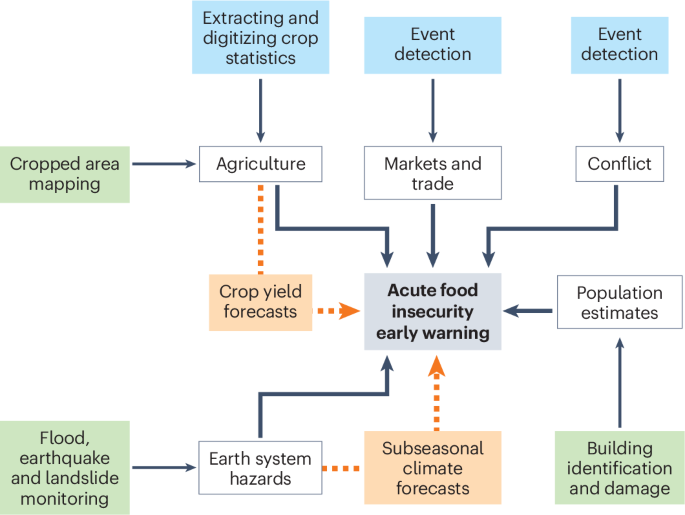
Artificial intelligence and machine learning are already enhancing food security early warning systems by improving data collection, event monitoring and forecasting. However, to avoid costly errors, artificial intelligence and machine learning should be applied selectively alongside expert oversight, robust governance and transparent practices to maintain accountable and effective humanitarian decision-making.
This is a preview of subscription content, access
Access options
- Purchase on SpringerLink
- Instant access to the full article PDF.
Prices may be subject to local taxes which are calculated during checkout
References
-
Martini, G. et al. Nat. Food3, 716–728 (2022).
-
Balashankar, A., Subramanian, L. & Fraiberger, S. P. Sci. Adv.9, eabm3449 (2023).
-
Herteux, J. et al. Commun. Earth Environ.5, 611 (2024).
-
Lentz, E. C., Michelson, H., Baylis, K. & Zhou, Y. World Dev.122, 399–409 (2019).
-
Machefer, M. et al. Glob. Food Secur.45, 100859 (2025).
-
Busker, T. et al. Earth’s Future12, e2023EF004211 (2024).
-
Backer, D. & Billing, T. Glob. Food Secur.29, 100510 (2021).
-
Zhou, Y., Lentz, E., Michelson, H., Kim, C. & Baylis, K. Appl. Econ. Perspect. Policy44, 893–910 (2022).
-
Miller, E., Kishi, R., Raleigh, C. & Dowd, C. Sci. Data9, 593 (2022).
-
Maxwell, D. et al. J. Humanit. Affairs6, 40–53 (2025).
-
Davis, K. F. et al. Environ. Res. Lett.20, 052001 (2025).
-
Tiggeloven, T. et al. iScience28, 113689 (2025).
-
Wardrop, N. A. et al. Proc. Natl Acad. Sci. USA115, 3529–3537 (2018).
-
Vesco, P. et al. Int. Interact.48, 860–896 (2022).
-
Carneiro, B. et al. Sci. Rep.15, 36709 (2025).
Acknowledgements
The scientific results and conclusions, as well as any views or opinions expressed herein, are those of the author(s) and do not necessarily reflect those of NOAA or the Department of Commerce. Part of this research is being implemented by CGIAR researchers from the Alliance of Biodiversity International and CIAT.
Funding
B.C. received funding from the CGIAR Science Program on Food Frontiers and Security. Y.L. and R.V. received funding from the Google.org Foundation and the CGIAR Accelerator on Digital Transformation. P.V. acknowledges funding by the ANTICIPATE project from the European Research Council Advanced Grant (grant agreement no. 101055176). A.J.T. was supported by the Patrick J. McGovern Foundation (grant no. 1556), the Wellcome Trust (grant no. 308679/Z/23/Z) and the Gates Foundation (grant no. INV-088965). Y.L. and R.V. thank all funders who supported this research through their contributions to the CGIAR Trust Fund: https://www.cgiar.org/funders/. W.A. was supported by NASA Harvest grant 80NSSC23K042.
Authors and Affiliations
Ethics declarations
Competing interests
The authors declare no competing interests.
Peer review
Peer review information
Nature Food thanks Markus Reichstein and the other, anonymous, reviewer(s) for their contribution to the peer review of this work.
Rights and permissions
About this article
Cite this article
Anderson, W., Becker-Reshef, I., Bodanac, N. et al. Responsible use of artificial intelligence and machine learning for food security early warning systems.
Nat Food (2026). https://doi.org/10.1038/s43016-026-01400-6
-
Version of record:06 August 2026
-
DOI
:https://doi.org/10.1038/s43016-026-01400-6
