

Abstract
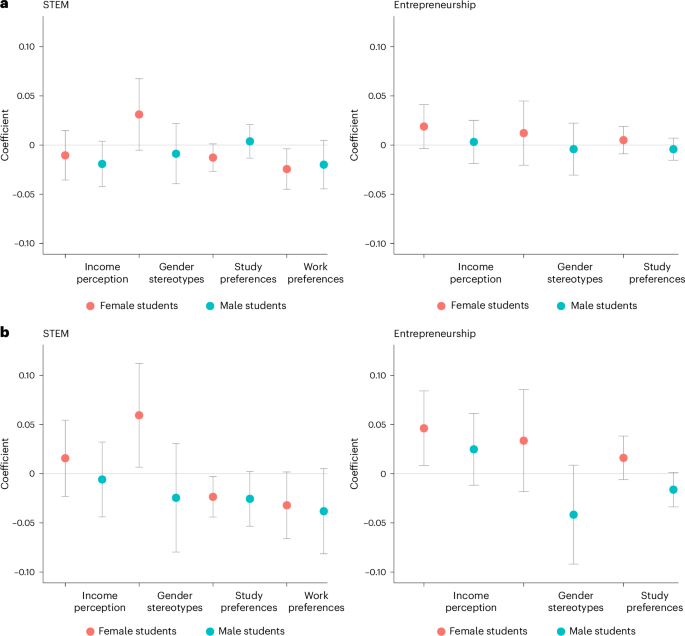
Youth often decide what to study with limited exposure to many high-paying careers. In-person visits from role models can change behaviour but are difficult to scale and typically expose youth to only one person in one career. We test the impact of exposing youth to multiple role models, in both science, technology, engineering and mathematics (STEM) and entrepreneurship careers, using online video interviews to intervene at large scale in a randomized trial with 29,243 students in 813 Ecuadorian high schools. Girls treated with multiple role models reduce their likelihood of choosing a STEM major, increasing enrolment in business majors instead. Boys also shift their major choice away from STEM and move towards other majors such as agriculture. The contrast between fields appears to shift youth away from what they see as the more challenging career and reinforces girls’ stereotypical college major choice.
This is a preview of subscription content, access
Access options
- Purchase on SpringerLink
- Instant access to the full article PDF.
Prices may be subject to local taxes which are calculated during checkout
Subjects
- Economics
- Science, technology and society
Data availability
Code availability
The replication package (code and data) is available
References
-
Wilson, W. J. The Truly Disadvantaged (Univ. Chicago Press, 1987).
-
Jensen, R. The (perceived) returns to education and the demand for schooling. Q. J. Econ.125, 515–548 (2010).
-
Serra, D. Handbook of Experimental Development Economics (Edward Elgar, 2022).
-
Morgenroth, T., Ryan, M. & Peters, K. The motivational theory of role modeling: how role models influence role aspirants’ goals. Rev. Gen. Psychol.19, 465–483 (2015).
-
Kipchumba, E., Porter, C., Serra, D. & Sulaiman, M. Influencing Youths’ Aspirations and Gender Attitudes through Role Models: Evidence from Somali Schools, Working Papers 20210224-002 (Texas A&M Univ., 2021).
-
Breda, T., Grenet, J., Monnet, M. & Van Effenterre, C. How effective are female role models in steering girls towards STEM? Evidence from French high schools. Econ. J.133, 1773–1809 (2023).
-
Agurto, M., Bazan, M., Hari, S. & Sarangi, S. Women in Engineering: the Role of Role Models (Blacksburg, 2021).
-
Gladstone, J. & Cimpian, A. Which role models are effective for which students? A systematic review and four recommendations for maximizing the effectiveness of role models in STEM. Int. J. STEM Educ.8, 59 (2021).
-
Lafortune, J., Riutort, J. & Tessada, J. Role models or individual consulting: the impact of personalizing micro-entrepreneurship training. Am. Econ. J. Appl. Econ.10, 222–245 (2018).
-
Porter, C. & Serra, D. Gender differences in the choice of major: the importance of female role models. Am. Econ. J. Appl. Econ.12, 226–254 (2020).
-
Ferrara, E., Chong, A. & Duryea, S. Soap operas and fertility: evidence from Brazil. Am. Econ. J. Appl. Econ.4, 1–31 (2012).
-
Banerjee, A., La Ferrara, E. & Orozco, V. The Entertaining Way to Behavioral Change: Fighting HIV with MTV (NBER Working Paper no. 26096, 2019).
-
Bjorvatn, K., Cappelen, A., Sekei, L. H., Sørensen, E. & Tungodden, B. Teaching through television: experimental evidence on entrepreneurship education in Tanzania. Manage. Sci.66, 2291–2799 (2020).
-
Riley, E. Role models in movies: the impact of Queen of Katwe on students’ educational attainment. Rev. Econ. Stat.106, 334–351 (2024).
-
Bhan, P. Do Role Models Increase Student Hope and Effort? Evidence from India (Univ. Glasgow, 2020)
-
Ahmed, H., Mahmud, M., Said, F. & Tirmazee, Z. Encouraging female graduates to enter the labor force: evidence from a role model intervention in Pakistan. Econ. Devel. Cult. Change72, 919–957 (2024).
-
Estrategia Nacional para el Cambio de la Matriz Productiva (Vicepresidencia de la República del Ecuador, 2015); https://www.vicepresidencia.gob.ec/wp-content/uploads/2013/10/ENCMPweb.pdf
-
Hastings, J., Neilson, C., Ramirez, A. & Zimmerman, S. (Un)informed college and major choice: evidence from linked survey and administrative data. Econ. Educ. Rev.51, 136–151 (2016).
-
Chetty, R. et al. The association between income and life expectancy in the United States, 2001–2014: association between income and life expectancy in the United States. JAMA315, 1750 (2016).
-
List, J. The Voltage Effect: How to Make Good Ideas Great and Great Ideas Scale (Crown Currency, 2022).
-
Asanov, I. et al. System-, teacher-, and student-level interventions for improving participation in online learning at scale in high schools. Proc. Natl Acad. Sci. USA120, e2216686120 (2023).
-
Asanov, I., Flores, F. P., McKenzie, T. D., Mensmann, M. & Schulte, M. Remote-learning, time-use, and mental health of Ecuadorian high-school students during the COVID-19 quarantine. World Dev.138, 105225 (2021).
-
Chernozhukov, V., Demirer, M., Duflo, E. & Fernández-Val, I. Generic machine learning inference on heterogenous treatment effects in randomized experiments, with an application to immunization in India. Econometrica3, 1121–1164 (2025).
-
Angrist, N., Bergman, P. & Matsheng, M. Experimental evidence on learning using low-tech when school is out. Nat. Hum. Behav.6, 941–950 (2022).
-
Lichand, G., Doria, C. A., Leal-Neto, O. & Fernandes, J. P. C. The impacts of remote learning in secondary education during the pandemic in Brazil. Nat. Hum. Behav.6, 1079–1086 (2022).
-
Bastian, B., Bach-Mortensen, A. & Engzell, P. A systematic review and meta-analysis of the evidence on learning during the COVID-19 pandemic. Nat. Hum. Behav.7, 375–385 (2023).
-
DesJardins, S. L. & Toutkoushian, R. K. in Higher Education: Handbook of Theory and Research (ed. Smart, J. C.) 191–240 (Springer, 2005).
-
Harrison, N. in Access to Higher Education: Theoretical Perspectives and Contemporary Challenges (eds Mountford-Zimdars, A. & Harrison, N. E.) 85–100 (Routledge, 2017).
-
Seron, C., Silbey, S. S., Cech, E. & Rubineau, B. Persistence is cultural: professional socialization and the reproduction of sex segregation. Work Occup.43, 178–214 (2015).
-
Fouad, N. A., Chang, W. H., Wan, M. & Singh, R. Women’s reasons for leaving the engineering field. Front. Psychol.8, 875 (2017).
-
Bertrand, M. & Duflo, E. in Handbook of Economic Field Experiments (eds Duflo, E. & Banerjee, A.) 309–393 (North-Holland, 2017).
-
Belloni, A., Chernozhukov, V. & Hansen, C. Inference on treatment effects after selection among high-dimensional controls. Rev. Econ. Stud.81, 608–650 (2014).
-
Anderson, M. Multiple inference and gender differences in the effects of early intervention: a reevaluation of the Abecedarian, Perry Preschool, and Early Training Projects. J. Am. Stat. Assoc.103, 1481–1495 (2008).
Acknowledgements
We thank the technical teams of the Ministry of Education of Ecuador and the National Direction of Bachillerato for their collaboration, and the Ministry of Higher Education of Ecuador (SENESCYT) for providing us with administrative data on college majors. We gratefully acknowledge funding from the World Bank’s Strategic Impact Evaluation Fund funding Nimble Evaluations—received by I.A., T.A., G.B., B.C., D.M. and M.M.; the funding call COVID-19 Emergency Window received by I.A., B.C., D.M., M.M., and M.S.; the Innovations for Poverty Action ‘Path-to-Scale’ award (TEM0280-X1)—recevied by I.A., T.Å., G.B., B.C., F.P.F.T., D.M., M.M., and M.S.; the Laboratory of Excellence in Economics and Decision Sciences, Ecole Nationale de la Statistique (Labex ECODEC–ENSAE) Paris, the HEC Foundation—recevied by T.Å. and B.C.; the International Center for Higher Education Research (Kassel) Innovation Fund-2018—received by I.A., G.B. and F.P.F.T.; and the Innovation Growth Lab—received by I.A., T.Å., G.B., F.P.F.T., D.M. and M.S. M.M.’s work was funded by the Deutsche Forschungsgemeinschaft (German Research Foundation) under Germany’s Excellence Strategy—EXC 2126/1–390838866. A.-M. Noha provided excellent research assistance. The funders had no role in study design, data collection and analysis, decision to publish or preparation of the manuscript.
Authors and Affiliations
Contributions
I.A., T.Å., G.B., B.C., F.P.F.T., D.M., M.M. and M.S. designed the research. I.A. and F.P.F.T. performed the research. F.P.F.T. analysed the data. T.Å., B.C., F.P.F.T. and D.M. wrote the paper. I.A., F.P.F.T. and D.M. revised the paper.
Ethics declarations
Competing interests
D.M. is employed by the World Bank, which works with country governments to improve development policies. The intervention evaluated here was not the result of a World Bank country engagement, and the World Bank only had a role as a funder of this work. The authors declare no other competing interests.
Peer review
Peer review information
Nature Human Behaviour thanks Noam Angrist, Fabricio Guevara-Viejó, Marion Monnet and the other, anonymous, reviewer(s) for their contribution to the peer review of this work. Peer reviewer reports are available.
Additional information
Publisher’s note Springer Nature remains neutral with regard to jurisdictional claims in published maps and institutional affiliations.
Supplementary information
Supplementary Figs. 1–3, Supplementary Discussion and Supplementary Tables 1–26.
Rights and permissions
Springer Nature or its licensor (e.g. a society or other partner) holds exclusive rights to this article under a publishing agreement with the author(s) or other rightsholder(s); author self-archiving of the accepted manuscript version of this article is solely governed by the terms of such publishing agreement and applicable law.
About this article
Cite this article
Asanov, I., Åstebro, T., Buenstorf, G. et al. Remote delivery of STEM and entrepreneurship role models at scale changes college major choice in Ecuador.
Nat Hum Behav10, 1223–1233 (2026). https://doi.org/10.1038/s41562-026-02421-8
-
DOI
:https://doi.org/10.1038/s41562-026-02421-8
