

Acronis Cyber Protect Cloud
for Service Providers
Try Now
Ransomware protection is a coordinated set of controls that reduces the likelihood of compromise, detects and contains malicious activity, protects recovery infrastructure and restores operations when an attack succeeds. It spans identity security, vulnerability and patch management, endpoint protection, EDR or XDR, incident response, targeted rollback, immutable backup and disaster recovery. No single control covers the complete ransomware lifecycle. An integrated platform can combine multiple controls, but no individual anti-ransomware engine or backup feature is sufficient by itself.
The 2026 Verizon Data Breach Investigations Report found that vulnerability exploitation became the leading initial-access vector, accounting for 31% of breaches, and that ransomware appeared in 48% of breaches, up from 44% the year before. Third-party involvement reached 48% of breaches. There is one encouraging data point: 69% of ransomware victims in the current dataset did not pay. At small and medium businesses specifically, the 2025 Verizon DBIR found ransomware present in 88% of breaches — a 2025, SMB-specific finding, not a current overall figure. IBM reported that ransomware or extortion incidents disclosed by an attacker averaged $5.08 million in breach costs, and among breached organizations that reported recovery timelines, most required more than 100 days to recover.
What ransomware protection means in 2026
Ransomware protection means having controls in place before, during and after an attack: reducing exposure so attackers find fewer entry points, detecting and containing malicious activity before it spreads, reversing or recovering from what gets through, and closing the gap that allowed the intrusion so it cannot happen again. Ransomware operations today are rarely a single encryption event. They are multi-stage intrusions that combine exploitation, identity abuse, lateral movement and, increasingly, data theft.
Four shifts have changed what ransomware protection requires.
Vulnerability exploitation is now the leading way in. Attackers increasingly exploit exposed and unpatched software before defenders can remediate it. The 2026 Verizon DBIR found that vulnerability exploitation became the leading initial-access vector, accounting for 31% of breaches, up from 20% the year before. Valid credentials, phishing and third-party compromise remain important entry paths, so ransomware protection must address both software exposure and identity risk, not just the payload that eventually runs.
Identity compromise still opens doors signature-based tools cannot see. Stolen credentials and infostealer activity remain a major precursor to ransomware: recent DBIR analysis links a majority of ransomware victims to a prior infostealer infection or credential leak. A threat actor who logs in with a real password looks nothing like malware to an antivirus engine scanning for known binaries, which is why identity hardening and behavioral detection both matter.
Extortion no longer depends on encryption alone. Ransomware operations increasingly combine encryption and data theft, while some campaigns rely on data-theft extortion with little or no meaningful encryption. Verizon classifies ransomware cases with or without encryption, and its analysis covers exfiltration-only extortion alongside cases where encryption failed or had limited impact. A successful restore from backup addresses availability, but it does not reverse a confidentiality loss, regulatory exposure or reputational damage caused by exfiltration — those require separate detection, response and disclosure processes.
Attackers target the recovery chain, not just backup files. Ransomware operators increasingly attack the infrastructure organizations depend on to recover, which can include security and backup agents, local rollback caches, shadow copies and snapshots, backup-management credentials, backup repositories, hypervisors, recovery points and replication or disaster-recovery infrastructure. CISA recommends maintaining offline, encrypted backups and regularly testing their availability and integrity, because many ransomware variants attempt to find and delete or encrypt accessible backups.
The ransomware resilience lifecycle
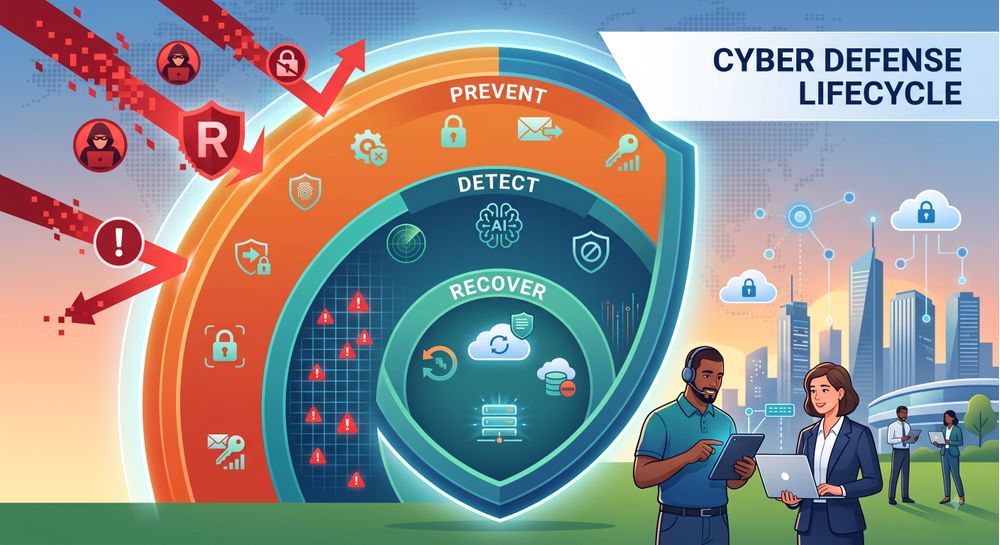
Effective ransomware protection is not a strict sequence — it is a set of interconnected capabilities that map closely to NIST Cybersecurity Framework 2.0’s Govern, Identify, Protect, Detect, Respond and Recover functions, and to NIST’s ransomware risk-management profile. This guide frames the lifecycle in five stages: govern and prepare, prevent and harden, detect and contain, roll back and recover, and patch and improve. Removing any one of them leaves a gap that attackers reliably exploit.
Govern and prepare
- Define ownership and response authority for a ransomware incident.
- Establish recovery time objectives (RTOs) and recovery point objectives (RPOs).
- Maintain and rehearse incident-response and recovery plans.
- Define backup-retention and immutability policies.
- Establish escalation and communication procedures, including regulatory notification.
- Test recovery before it is needed, not during an incident.
Prevent and harden
- Maintain asset and vulnerability visibility, with risk-based patch prioritization.
- Enforce MFA and privileged-access controls.
- Apply least-privilege access across identities and service accounts.
- Filter malicious email and web traffic before it reaches users.
- Deploy endpoint prevention that blocks known and previously unseen malware.
- Segment networks to limit lateral movement.
- Reinforce security-awareness training for high-risk behaviors.
Detect and contain
Detection must identify malicious activity in real time, before a recovery point is corrupted, and it needs to cover more than encryption. Behavioral detection watches for suspicious encryption, tampering with security tools, credential dumping, suspicious remote administration, lateral movement, shadow-copy deletion, backup-service manipulation, exfiltration indicators and exploit activity. Detection effectiveness depends on telemetry, policy, evasion techniques and the speed of the attack; behavioral analysis can catch previously unseen ransomware, but it is not a guarantee.
For MSPs managing multiple clients, containment must be centrally governed and rapidly executable. High-confidence ransomware detections may trigger automated process termination, quarantine or endpoint isolation according to policy, while analysts investigate whether the attacker reached additional endpoints, identities or shared resources. Automation should scale with detection confidence, asset criticality, customer authorization, policy and potential operational impact, not apply uniformly to every alert.
Roll back and recover
Rollback, backup recovery and disaster recovery are related but distinct response paths, and treating them as interchangeable understates what each one requires.
Attack rollback reverses specific malicious changes, typically using a protected local cache or attack telemetry, and applies when the malicious changes are known and a suitable protected copy exists.
Backup recovery restores files, images or workloads from a recovery point, and applies when broader restoration is needed.
Disaster recovery restores service availability through workload failover or infrastructure recovery, and applies when business services must come back quickly or primary infrastructure is unavailable.
Recovery workflows should validate that the selected recovery point is suitable for restoration before reconnecting it to the network. Depending on risk and platform capabilities, that validation may include malware scanning, integrity checks, isolated recovery testing, forensic review and confirming the exploited vulnerability is closed. It should also include identity reset, credential rotation, persistence removal and post-recovery monitoring — restoring the data is only part of the job if the door the attacker used is still open.
Patch and improve
- Close the exploited vulnerability.
- Reset compromised identities and rotate affected credentials.
- Remove any persistence mechanisms the attacker established.
- Update detection rules and response policies based on what was learned.
- Document lessons learned and update the incident-response plan.
How Acronis Active Protection detects, stops and automatically rolls back ransomware changes
Acronis Active Protection is the behavioral ransomware detection engine built into Acronis Cyber Protect Cloud and Acronis Cyber Protect. It continuously monitors process and file activity for behaviors associated with ransomware and other destructive attacks: rapid file renaming, mass modification, code injection into a clean process, and attempts to modify the master boot record. Behavioral heuristics identify suspicious patterns, while machine-learning-assisted process-stack analysis adds confidence in cases involving unusual or injected activity in otherwise legitimate processes, helping reduce false positives without weakening coverage of ransomware families that have not appeared in any signature database.
When Active Protection identifies malicious activity, it stops the process and can automatically revert affected file changes using its own protected service cache, a mechanism distinct from Windows Volume Shadow Copies, which ransomware commonly attempts to delete. This cache-based rollback is a different response path from backup-based recovery: Acronis backup still uses VSS for application-consistent snapshots on relevant Windows workloads, so the two mechanisms coexist rather than replace one another.
Active Protection also protects its own agent processes, registry records and configuration, along with backup archives stored in local folders and the master boot record. That self-protection covers the agent and local backup files specifically; it is separate from the protected rollback cache and from immutable cloud or repository-level backup storage, which is enforced independently at the storage layer.
Active Protection is included with Acronis Cyber Protect Cloud and runs in the same management console as Acronis EDR and anti-malware, so the detection event and the containment action are handled by the same platform.
Rollback versus backup recovery versus disaster recovery
These three response paths are often used interchangeably, but they solve different problems and depend on different infrastructure.
Attack rollback. Reverses specific malicious changes using a protected local cache or attack-specific telemetry. Fast, and useful when the affected files and the malicious changes are both known, but it only covers what the rollback mechanism tracked.
Backup recovery. Restores files, images or workloads from a protected recovery point. Broader than rollback, and the right path when more of the environment needs to come back, or when rollback data is unavailable.
Disaster recovery. Restores service availability through workload failover or infrastructure recovery. The right path when primary infrastructure is unavailable or business services need to come back on a defined RTO, not just the data.
Immutable backups as the recovery layer of last resort
Immutable backup storage prevents protected recovery points from being modified or deleted before their configured retention period expires, subject to the selected storage architecture and immutability mode. Object-lock and write-once-read-many (WORM) storage enforce immutability at the storage layer, which generally offers stronger separation from the backup application’s administrative plane than an application-level protection flag, though durability still depends on correct retention configuration, account security, provider architecture and the specific governance or compliance mode in use.
For an immutable backup to function as a genuine recovery layer, three conditions must be met.
- Immutability should be enforced at the storage layer, not just at the application layer. An application-level “protected” flag can be reversed by an attacker who has compromised the application account. Storage-enforced object lock or WORM generally offers stronger separation from the backup application’s administrative plane, though no implementation should be treated as impossible to alter under every administrative or provider scenario.
- The backup must be tested. A backup that has never been tested for restoration is not a recovery asset. CISA explicitly recommends regularly testing backup availability and integrity.
- The recovery point must be validated before restoration. Restoring from a backup that was already compromised at the time it was taken can re-infect the environment. Depending on risk and platform capabilities, validation may include malware scanning, integrity checks, isolated recovery testing and forensic review before the restored system is reconnected.
Acronis Cyber Protect Cloud supports immutable storage in the Acronis Cloud with tenant-level retention window configuration. In Acronis H2 2025 telemetry, enabling immutability was not associated with a meaningful difference in backup success rate, job duration or retry behavior. Storage consumption, retention planning and cost should still be evaluated separately.
For a detailed implementation walkthrough, see Acronis’ complete guide to immutable backup.
How Acronis protects across the ransomware lifecycle
Acronis helps MSPs address ransomware across the full resilience lifecycle. Acronis Cyber Protect Cloud combines behavioral anti-ransomware protection, endpoint prevention, EDR or XDR, vulnerability and patch management, protected backup and disaster recovery through one multitenant platform. When an attack occurs, MSPs can contain malicious activity, reverse targeted changes through attack rollback, restore files or workloads from protected recovery points and patch the vulnerability that enabled the intrusion. Acronis MDR adds 24/7 expert monitoring and response for partners that do not operate their own SOC.
- Real-time behavioral anti-ransomware protection.
- Automated process termination.
- Cache-based automatic rollback where configured and supported.
- Agent and local backup self-protection.
- Investigation and attack-chain context.
- Endpoint isolation.
- Process termination and quarantine.
- Attack-specific remediation and rollback.
- Forensic investigation.
- Integrated file-, image- and workload-level recovery.
- Vulnerability closure and patching after containment.
- Extends detection and response beyond endpoints to supported email, identity, Microsoft 365 collaboration and network telemetry.
- Better aligned with multi-stage ransomware and data-theft scenarios that do not show up in endpoint telemetry alone.
- 24/7/365 SOC monitoring and investigation.
- Containment and response.
- Advanced remediation, recovery and patching depending on service tier and authorization.
- Purpose-built for MSP delivery to SMB clients.
Acronis Backup and Disaster Recovery
- Immutable recovery points.
- File- and system-level recovery.
- Workload recovery and disaster-recovery options.
- MSP-managed recovery operations.
- Vulnerability assessment.
- Patching and closing security gaps that enabled the intrusion.
How to evaluate ransomware protection software: an MSP and IT buyer checklist
Evaluate whether the proposed architecture closes material gaps across governance, prevention, detection, response and recovery, and whether the MSP can operate those controls consistently across client environments. Integration is an important total-cost-of-ownership and response benefit, but it should not be the only evaluation criterion; independent efficacy, interoperability, recovery testing and operational maturity still matter.
- Defined incident ownership, response authority and escalation procedures.
- Documented RTOs, RPOs and backup-retention policies.
- Regularly tested incident-response and recovery plans.
- Vulnerability assessment and risk-based prioritization.
- Automated or managed patching.
- MFA and privileged-access controls.
- Application and script controls.
- Email and URL protection.
- Endpoint anti-malware.
- Agent-uninstallation and tampering protection.
- Segmentation and restricted administrative access.
- Uses behavioral detection, not only signatures, to identify novel ransomware families and RaaS payloads.
- Monitors the process stack and file-access patterns in real time, with detection extending beyond encryption to tampering, credential dumping, lateral movement and exfiltration indicators.
- Includes machine learning to reduce false positives on legitimate processes.
- Can terminate a confirmed malicious process according to policy and detection confidence.
- Can quarantine detected files and isolate affected endpoints.
- Protects its own agent, registry records and backup archive from tampering.
- Reverts targeted malicious changes using a protected cache or verified attack-specific recovery mechanism.
- Documents which operating systems and workloads support rollback.
- Defines what happens when rollback data is unavailable.
Backup, recovery and disaster recovery
- Supports immutable storage with tenant-configurable retention windows.
- Validates recovery points before restoration.
- Delivers granular recovery options: individual files, full images and virtual machine or workload instantiation.
- Supports disaster recovery and failover where required.
- Maps each capability to each workload individually — behavioral anti-ransomware coverage, EDR telemetry, supported response actions, backup coverage, immutable recovery points and restore granularity can all vary across Windows, Linux, macOS, virtual machines, Microsoft 365 and Google Workspace, so confirm each rather than assuming parity.
- Multitenancy and tenant isolation.
- Role-based access control, with per-client policies and exceptions.
- Audit logging and response authorization.
- Data residency.
- Incident escalation and PSA/RMM/SIEM integration.
- Usage and service reporting, with SLA management.
- Offboarding and data-retention handling.
- MDR escalation available for 24/7 coverage.
Evidence and independent validation
- Publishes results from independent tests against current ransomware families.
- Provides clear documentation of how behavioral detection works and what it covers.
Enterprise ransomware protection programs and MSP stacks should both pass this checklist before a vendor is selected. A product that scores well on detection but provides no immutable recovery layer, or that covers governance and prevention but cannot demonstrate rollback and recovery for the workloads that matter, leaves clients exposed to exactly the gap attackers exploit.
Frequently asked questions
What is ransomware protection? Ransomware protection is a multilayer strategy covering governance, vulnerability and identity hardening, endpoint prevention, behavioral detection, investigation, containment, rollback and clean recovery. Endpoint prevention can block known and previously unseen threats, while EDR, XDR and MDR provide deeper detection and response. Protected backups and disaster recovery preserve the ability to restore operations when preventive controls are bypassed.
What is the best ransomware protection for a business? The best ransomware protection for a business closes material gaps across governance, prevention, detection, response and recovery, rather than relying on a single layer. Key requirements are behavioral detection that covers novel variants, defined containment and rollback paths, immutable cloud backup with storage-enforced retention, and validated recovery before reconnection. For most businesses receiving IT services from an MSP, this protection is delivered through a multitenant platform such as Acronis Cyber Protect Cloud.
How does ransomware protection software detect an attack? Modern ransomware protection software uses behavioral detection: it monitors the process stack and file-access patterns and compares each process’s chain of actions against known malicious behavior patterns, often with machine-learning assistance. Detection covers more than encryption; it can include security-tool tampering, credential dumping, suspicious remote administration, lateral movement, shadow-copy deletion, backup-service manipulation and exfiltration indicators. This approach can catch novel ransomware families that have never appeared in a signature database, though effectiveness still depends on telemetry, policy and the speed of the attack.
Does cloud backup protect against ransomware? Cloud backup can support ransomware recovery, but resilience depends on how the backup is isolated and protected. Strong implementations use separate administrative controls, MFA, encryption, deletion protection, immutable retention where appropriate and regular restore testing. Cloud file synchronization is not equivalent to backup, because malicious or encrypted changes can synchronize across copies. CISA recommends offline, encrypted and regularly tested backups because accessible backups may be deleted or encrypted by ransomware.
What is enterprise ransomware protection? The core principles of ransomware protection are consistent across SMB and enterprise environments, but the architecture, regulatory obligations, operational complexity and recovery objectives vary with scale. Enterprises may additionally face hybrid and multicloud environments, complex identity estates, OT or industrial systems, data-sovereignty constraints, multiple business units, third-party dependencies, formal RTO/RPO commitments and global response and communications requirements. Many mid-market enterprises receive enterprise-grade ransomware protection through an MSP using a multitenant platform.
Choosing ransomware protection for your business or MSP
Ransomware in 2026 is a multi-stage intrusion and extortion operation, not just a file-encryption event. Protection that only detects encryption and restores from backup leaves the exploitation, identity abuse and data-theft stages uncovered. Reduce exposure. Detect and contain the attack. Reverse what can be rolled back. Recover what must be restored. Patch the entry point. Keep the client operating.
Acronis Cyber Protect Cloud combines behavioral anti-ransomware protection, endpoint prevention, EDR or XDR, vulnerability and patch management, and immutable backup and disaster recovery in one multitenant platform, built for MSPs and the businesses they protect. Acronis MDR adds 24/7 expert monitoring and response for partners that do not operate their own SOC. Start a free trial or talk to a ransomware protection specialist to walk through a deployment for your environment.
A Swiss company founded in Singapore in 2003, Acronis has 15 offices worldwide and employees in 60+ countries. Acronis Cyber Platform is available in 26 languages in 150 countries and is used by over 21,000 service providers to protect over 750,000 businesses.
Ransomware protectionCyber protectionMalware protectionMSP cybersecurityCorporate cybersecurityCyber protection for businessesSecurity software for businessCloud cyber protection
