

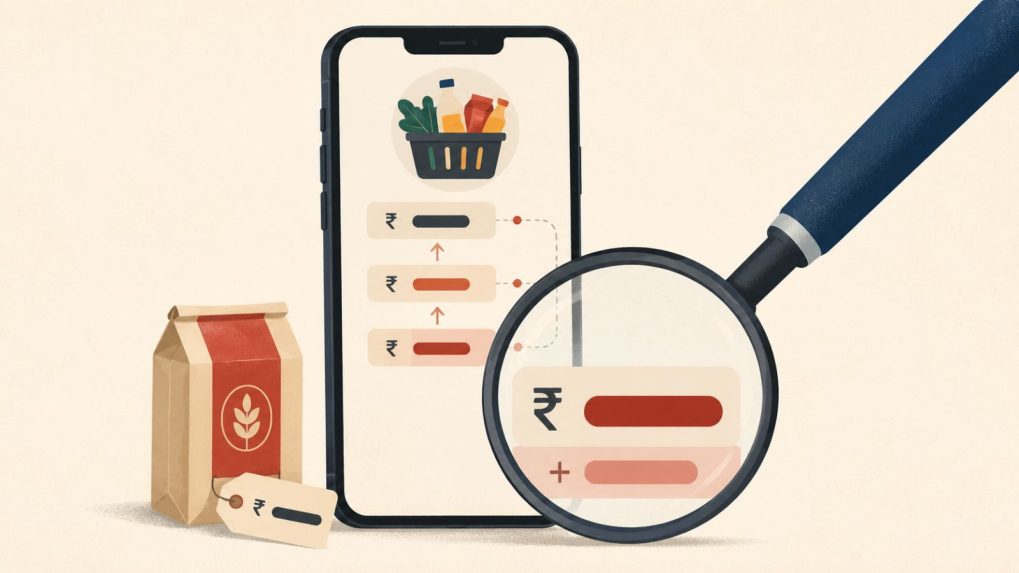
The playbook says 10-to-20-minute delivery is compressing the cycle between product discovery, trial and learning, particularly for products suited to impulse-led purchases. Quick commerce accounted for 16-17% of India’s e-commerce GMV in 2025, according to the report.
The agency has launched a new commerce-first product launch playbook, highlighting the growing role of e-commerce, quick commerce, retail media and creator-led discovery in helping brands identify demand, validate products and scale beyond metros.
Titled ‘From Concept to Scale: The Commerce-First Launch Playbook for India’, the framework argues that product launches are moving beyond campaign-led models, with commerce platforms evolving from points of transaction into environments for demand discovery, proposition testing and agile scaling.
The playbook combines inputs from leading platforms, real-world brand case studies and industry specialists to examine how brands can use commerce environments to generate behavioural proof before committing to larger-scale launches.
According to the playbook, observing what consumers discover, click, consider, abandon, trial, review and repeat on live or simulated product listings can provide sharper feedback than traditional market research alone. This allows brands to test propositions in real shopping environments and use actual shopper behaviour to inform decisions on product-market fit and distribution.
Trending Topics
Uday ShankarTata TrustRed Bull FSSAIMyntra CMO ResignsTukaram Mundhe
Tier 2+ cities emerge as a key testing ground for product launches
The shift is particularly relevant outside India’s metros. With Tier 2+ cities accounting for around 65% of new e-retail shoppers acquired in 2024-25, the playbook argues that brands can use digital commerce to identify high-potential consumer cohorts and pin codes before committing to broader distribution.
Quick commerce is another structural shift identified by the report. The playbook says 10-to-20-minute delivery is compressing the cycle between product discovery, trial and learning, particularly for products suited to impulse-led purchases. Quick commerce accounted for 16-17% of India’s e-commerce GMV in 2025, according to the report.
Citing Bain & Company and Flipkart, the playbook estimates that quick commerce could contribute 45-50% of incremental e-retail GMV through 2030.
D2C brands race into quick delivery as festive shopping moves to 60-minute commerce
From digital demand validation to omnichannel scale
The report also makes a case for digital demand validation before offline expansion. Around 90% of India’s retail remains offline, according to the playbook, making omnichannel expansion a critical part of the route from digital proof to scale. It argues that brands should use digital channels to establish demand before expanding into general trade, modern trade and specialised retail.
Rather than treating every channel as interchangeable, the framework assigns different roles across the launch journey. D2C, marketplaces, quick commerce, retail media and creators can contribute differently to discovery, intent, purchase and fulfilment, requiring brands to build a deliberate launch architecture around each channel.
To help brands operationalise this approach, WPP Media India has introduced a 90-day gated launch operating system, commercial health guardrails, a quick commerce entry framework and seven core questions for commerce leaders. The tools are designed to help brands move from concept validation to repeatable omnichannel scale.
Ashwin Padmanabhan, COO, WPP Media South Asia, said the launch landscape in India is undergoing a transformation, with the opportunity extending beyond launching products faster to learning earlier and scaling based on shopper evidence.
“We spearhead the transformation of commerce, unlocking new opportunities for brands to grow,” Padmanabhan said. “The opportunity is not simply to launch faster, but to learn earlier, activate smarter, and scale with greater precision based on real shopper evidence.”
Sairam Ranganathan, Head of Ecommerce, WPP Media India, said commerce platforms are evolving beyond transaction points into environments for discovery, trial, conversion and learning.
“The future of product launches in India is decisively commerce-first,” Ranganathan said. “The launch landscape is becoming increasingly dynamic, with commerce platforms evolving beyond points of transaction into powerful environments for discovery, trial, conversion, and learning.”
According to Ranganathan, the playbook is intended to help brands test, learn, optimise and scale with greater confidence.
WPP Media India positions commerce-first launch planning as a broader operating system rather than a standalone tactic. The framework calls for brands to build launch systems that continuously learn, protect commercial health from Day 1 and scale only where repeatable demand has been demonstrated.
A 22-second checkout and a 16% quick commerce share. India’s festive shopper has stopped comparing
Follow Storyboard18 on Google for the latest and breaking advertising news and industry updates, along with in-depth coverage of digital media and agency news. Stay informed with the latest perspectives only on Storyboard18.
Tags
First Published on September 30, 2026, 13:00:02 IST
