

Principle wants companies to stop predicting the future — and start simulating it
Principle uses AI-powered strategic simulations to test hundreds of possible outcomes, from competitor moves to geopolitical shocks.
Cate Lawrence8 hours ago
What if, instead of trying to predict the future, companies could simulate hundreds of versions of it — and work out what they would do in each one?
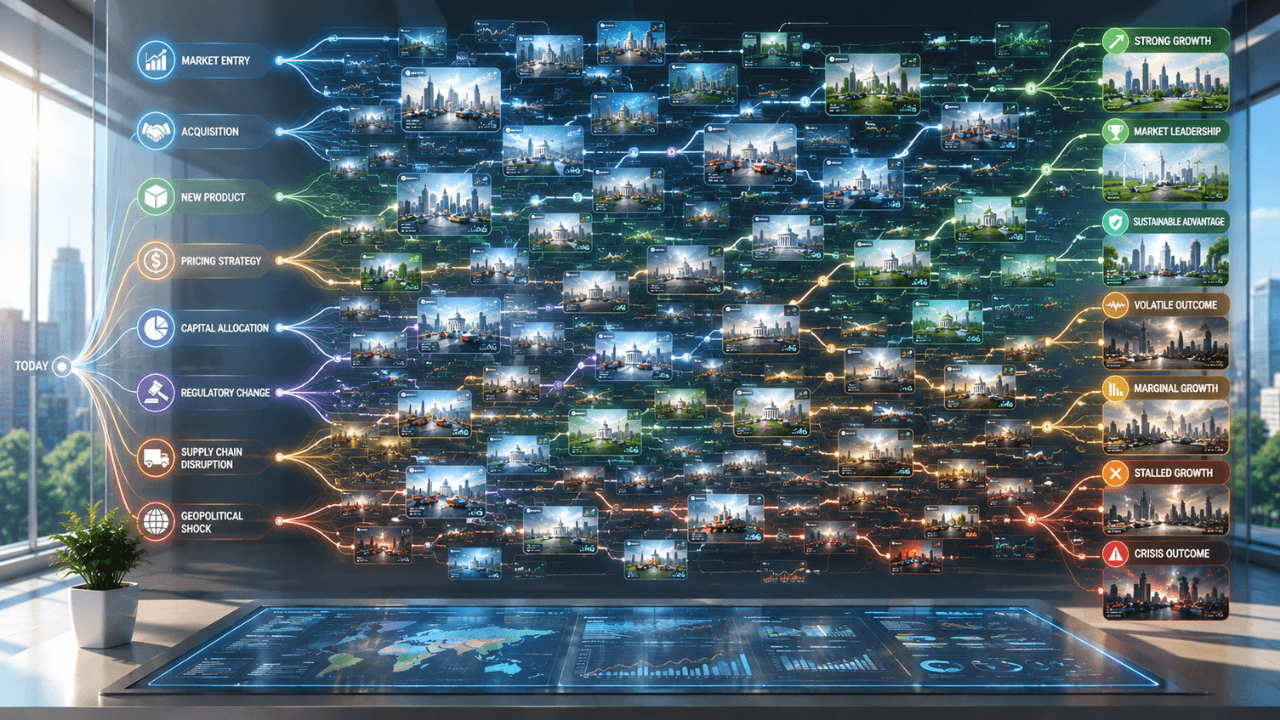
That’s the premise behindPrinciple, an AI-powered strategic simulation platform that builds digital models of organisations, competitors, regulators, and other market forces, then plays out hundreds of plausible futures to stress-test strategic decisions.
Its founder, entrepreneur Artur Kiulian, is adamant that Principle isn’t trying to build a crystal ball.
“We’re not really building a prediction machine. We’re building an action machine.”
It’s a distinction shaped by Kiulian’s own experience of events few organisations were adequately prepared for — from COVID-19 to Russia’s full-scale invasion of Ukraine — and by his subsequent work using AI for crisis response and government decision-making.
Now Principle is applying that thinking to corporate strategy, helping companies model everything from competitor moves and market expansion to geopolitical shocks — and explore what they could do before those futures arrive.
Methodologically, Principle uses an LLM as a compressed world model, grounded in real-world market conditions. The system maps the state of the market, asks each digital twin what it would do next under those conditions, and then advances the simulation step by step as each actor responds to others’ moves.
A company can use the platform to stress-test decisions such as entering a new market, making an acquisition, responding to a competitor, allocating capital, or preparing for regulatory or geopolitical change. Principle shows how those decisions might play out under different conditions, what could break, and which strategies appear more resilient.
Kiulian is originally from Vinnytsia, Ukraine. He asserts he got into startups at probably the worst time possible, during Russia’s first invasion of Ukraine in 2014.
“It made me realise that capital was fleeing the country and there was no way for me actually to get funding, so I followed the capital to the US. There, I met two American partners who convinced me to start a venture studio.
The concept was essentially to build a conveyor belt for startups — to be more involved than a startup incubator and actually build things.”
Kiulian has built 65+ startups through his venture studio work.
From crisis response to strategic simulation
During lockdown, he saw a call to action to use AI to help navigate the uncertainty of the COVID pandemic, both in policy and medical research.
Kiulian admits, “The request was quite vague, with all respect, and I thought nobody was going to do anything about it. I have this superpower of crafting structure out of uncertainty, so I did a little bit of that, and it took off virally.”
The team had 1,500 data scientists join within two weeks, was featured in The Wall Street Journal, and I started doing TV interviews.
“What a perfect excuse to become delusional that social impact is easy,” he jokes.
He left venture capital and created a nonprofit focused on building AI infrastructure that could respond very quickly to any future crisis, whether that was another pandemic or something else.
“We were essentially preparing for all the shitty futures we could imagine might arrive. And then one of them did — the shittiest one of all for us.”
When the full-scale invasion of Ukraine began, Principle rolled out its AI infrastructure within the first hours.
“We started with evacuations because that was the most pressing need, then moved very quickly to housing support and humanitarian aid,” he shared. It went viral because people were sharing thank-yous on social media.
“Very quickly, we were receiving tens of thousands of requests that no human could manage. So we started using AI to triage them and create decision-support systems. Eventually, it expanded to working with governments and to me convincing NVIDIA to donate supercomputers to support that work.”
Simultaneously, public support for Ukraine in the US began to decline as the AI market took off.
“Those were two inflexion points happening at once, and suddenly there were no resources for us to continue the work.”
When Kiulian asked the NVIDIA executive who had helped secure the supercomputers for more support, he was told the AI boom meant GPUs were already sold two years in advance.
“He said, ‘Do what you’ve done best before. Start a startup.’ He wrote the first angel investment cheque, and that’s how this company started.”
From governments to corporate strategy

Kiulian was still trying to work with government through 2025. He spent most of that year working both in Ukraine, which he describes as “a social-impact market where there’s really no money,” and the Middle East, where there is a lot of money
. He helped with national strategies and models in Qatar and Saudi Arabia. Then, by the end of 2025, the Dubai Future Foundation invited the team to deploy AI policy decision-making simulations for their government.
According to Kiulian, “There’s almost nowhere else on Earth where a bunch of delusional people can fly in and start working with the government on day one. It was an opportunity for us to see how the impossible could become possible again.”
However, government work proved difficult to turn into a sustainable business. Attending the Dubai Future Forum, they met people who kept saying, “Wow, this is what Shell has been doing for decades.”
He realised they’d built a precursor to scenario planning, a business practice that, historically, only very large organisations could afford to employ. He showed the tech to Shell, who told him about 100 people were doing the same work but manually.
“By the end of the meeting, they basically said, ‘We should work together,” with one caveat: “Don’t sell this to BP.”
However, Kiulian’s team realised that even though their goal was social impact, civic service, and benefit, “there was no way we could get enough resources from that market.”
“Meanwhile, there was an entire world of business and corporate strategy that urgently needed this because the world is becoming increasingly unstable.”
Principle was launched in January. This year, the company raised $2.5 million in pre-seed funding.
Why traditional scenario planning is struggling
Some larger organisations already use dashboards, analysts, and scenario planning — approaches dating back to the Cold War. But those frameworks struggle in a world where humans can no longer absorb the volume of information and mentally simulate every “what if?” scenario
“There are thousands of signals flying around every single day. The density of AI disruption, geopolitical risks, conflicts, and wars — all together — makes it almost impossible for human strategists to operate without AI augmentation.”
Scaling the number of people involved has limitations as well. Traditional consultants also have a problem because by the time they deliver a report or a quarterly or annual plan, it’s already outdated.
So there are two issues: speed and the sheer amount of information flowing through the market. Not a prediction machine, but an action machine, Kiulian is fast to stress that Principle is not selling prediction of the future:
“We’re selling the capability to model all of those potential worlds — imagined worlds — and then reverse-engineer how not to end up in a shitty future and how to end up in a good future where you achieve the outcome you desire.”
He contends that both the full-scale invasion of Ukraine and COVID-19 were highly improbable events.
“Nobody was ready. If you had already gamed out a strategy for how to respond the moment something like that arrived, then you could act.”
That said, Kiulian is critical of competitors who assert they can sell predictions of the future. “Some go on Bloomberg and literally say they can predict every human behaviour.
“I call bullshit on it. It’s impossible. But VCs and companies keep buying it. As humans, we crave it. Instead of telling you what happens, why don’t we give you tools that help you understand where you’re going and where you want to be? That’s much more powerful.”
Turning simulations into decisions
That said, there’s still a very strong human element to this. A company needs the mindset and skills actually to respond, pivot, and adapt. I wanted to understand how Principle ensured that the simulations translate into behavioural or structural change rather than just becoming interesting information.
Kiulian explains that Principle is built around the idea of a discovery engine: users can ask questions and explore an “action space” of potential ways forward.
He gave the example of a conversation with a Japanese VC during which Principle mapped potential outcomes in real time.
“For me, it wasn’t about Principle telling me what to do. It was about seeing all the potentialities: this person could potentially be an investor and also our first Japanese client.
The system showed me possible moves. That doesn’t mean I unthinkingly follow them, but it shows me the limitations. For example, they can’t lead the round. They rarely lead, and they had already told us they wouldn’t.”
In practice, Principle is designed to place individual interactions like this within a company’s broader strategy, showing how decisions and external signals intersect as they unfold.
Client MacPaw was assessing how to sequence growth across five product lines over the next 24 months. Over five weeks, Principle mapped more than 500 strategic directions, ran 480 scenarios and modelled 90 market actors. Three finalist strategies were stress-tested against different competitive responses and market developments. The simulations found that strategies which appeared similar initially could produce materially different long-term outcomes depending on the order in which moves were made.
Notably, the option that maximised short-term revenue did not produce the strongest long-term valuation.
Principle also identified potential strategic counterparts through its market modelling, including several organisations that had already independently approached MacPaw, despite the simulation having no access to CRM or relationship data.
The engagement subsequently evolved beyond a one-off strategy project.
MacPaw integrated Principle into its decision-making processes, with around 50 competitive topics tracked continuously, monthly re-simulations using updated data, and executives able to submit strategic questions for simulation-backed analysis.
“For MacPaw, adapting to an Apple event took a couple of days,” explained Kiulian.
Previously, it might have taken them a month to align internally.
From annual strategy to continuous decision-making
One thing Principle has seen from its customers is a shift away from annual or quarterly planning.
“Internally, companies are adjusting strategy monthly. They’re continually building insights and collecting signals. They have their own indicators for determining how they should change strategy next month. So even though it isn’t necessarily formalised, people are already doing it monthly internally.” The platform has also decentralised decision-making for its users.
Originally, the team thought the Chief Strategy Officer would craft the strategy, and everybody else would follow. Still, for their own internal use, they realised that everybody in the company makes decisions every single day, and all those decisions can be saved in these loops. All of a sudden, it becomes almost a democratisation of strategy and authority inside the company.
Modelling bias rather than pretending it doesn’t exist
Kiulian takes an unusual approach to bias: rather than attempting to eliminate it, he argues that simulations should incorporate diverse biases. When Principle simulates something, it seeds the simulation with hundreds of factors representing different biases, and those biases are maximised. If you’re modelling China or modelling Iran, you have to have their biases represented.
“The only way to model reality is to maximise those biases and make the simulation representative of how biased the world actually is — and how biased we as humans actually are.”
He claims there will be a new job title: “future designer.” He describes the role as that of someone who helps organisations navigate possible futures.
“Hopefully, it’ll become one of the most desired job titles two or three years from now. We’re going to drive that.”
Kiulian also wants to make Principle affordable for startups, which he believes are particularly well suited to this kind of continuous strategy.
“Startups are the fastest organisations to adapt. They have the most urgent need, but they also have the capacity for much faster change.
Often, they don’t really know where they’re going, which can sometimes be helpful because they aren’t locked into a particular outcome. They can adjust in real time. They’re much more nimble.”
Simulating the next two years of AI
Principle ran Cirque de Simulé, a live simulation of the AI market, at New York Tech Week this year. For the event, the company simulated the next two years of the enterprise AI market through mid-2028. The model spanned 123 plausible timelines, 74 digital twins, and 19 market forces.
Each actor was tracked across three core vitals: market power, technical edge, and momentum, with a financial layer modelling revenue and capital position. The simulation also accounted for the real-world biases of the actors it represented, including how specific regulators, countries, companies, and other market participants tend to behave, rather than assuming a neutral or optimistic default.
One pattern recurred across most of the futures: power, not models, becomes the main constraint on growth. In 110 of 123 timelines, the question was no longer who had the strongest model or the most chips, but who could actually secure enough electricity, permits, and grid connections to bring new AI infrastructure online.
Around 110 gigawatts of AI power capacity has been announced globally, yet only about 5 GW is online today. Across the simulation, that gap repeatedly emerged as the real bottleneck. In other words, the market’s next limiting factor may not be model quality, but access to the infrastructure needed to run AI at scale.
The simulation also surfaced several black swan events that the current market narrative tends to overlook. One was an agentic cascade: a scenario in which AI agents are given control over money and software systems, and a single failure spreads automatically from one system to the next, faster than people can intervene.
Another was an AI-driven market crash, in which automated trading systems turn a sharp sell-off into a much larger one.
Ultimately, Principle’s simulations are less about getting the future right than being better prepared when it inevitably turns out differently than expected. Principle has already moved from crisis response and government experiments to enterprise customers using its simulations continuously.
How far this model can scale — and can strategic simulation become as commonplace for startups and smaller companies as Kiulian believes it should be? Principle is planning for all possibilities.
Would you like to write the first comment?
